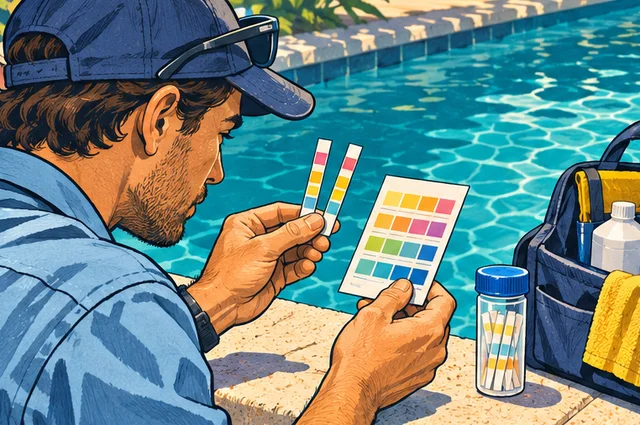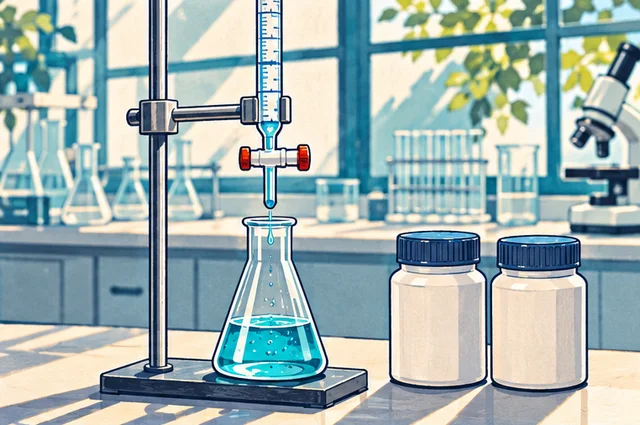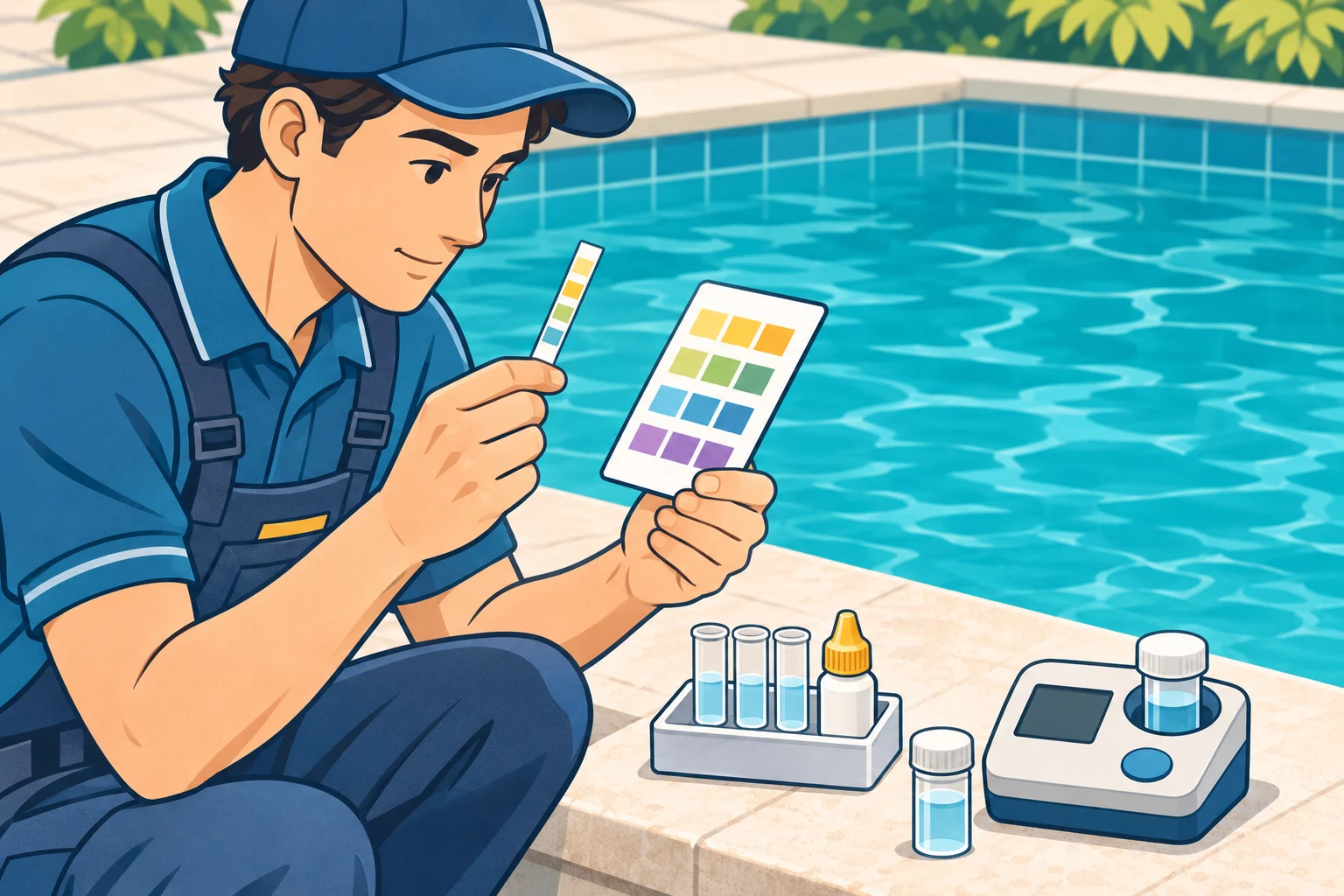
Pair two testing tiers instead of relying on one tool. Use a drop-count FAS-DPD kit or an NSF/ANSI 50 photometer for chemical dosing, commercial logs, and troubleshooting, and pair 7-way test strips for 15-second screening and retail shelves.1 Visual DPD comparators top out at 5 ppm before bleaching, while digital pocket pens should be reserved for pH and temperature checks.
PoolTradeDesk (operated by our company, Kingnod) compiled this guide from manufacturer specs, CDC MAHC guidance, NSF/ANSI 50 listings, and US retail prices checked 2026-11-25 to 2026-11-26. Match your primary method to dosing precision, counter speed, or local code rules first, then add a fast or high-range backup.
- Test strips (AquaChek Silver 551236): 15-second read across seven factors; $23.99 per 100-strip bottle (~$0.24/strip, checked 2026-11-25).
- FAS-DPD titration (Taylor K-2006): 0.2 ppm or 0.5 ppm per drop without color matching; from $149.49 direct ($99.33 distributor) and $14.50 for ~140 routine chlorine tests (~$0.10/test, checked 2026-11-25).
- Handheld photometers (ColorQ 2x vs. HI97711): LaMotte Model 2087 all-tablet TesTabs PRO 7 kit lists at $263.37 sale ($396.00 regular, 2026-11-25), while the liquid-plus-tablet R-2086 refill pack lists at $109.00 sale ($155.00 regular, 2026-11-26); chlorine-only Hanna HI97711 lists at $379.99-$599.99 with ~$0.13/test free-chlorine reagents.
- Spin-disk photometer (LaMotte Spin Touch): 60-second automated panel from under 3 mL; Model 3582 Mobile Commercial kit $1,295.00 sale ($1,956.00 regular) plus $189.74 sale ($285.00 regular) per 50-pack ($3.79/disk, checked 2026-11-25).
- Pocket digital pen (Hanna HI98127 pHep 4): $139.99 upfront (2026-11-25) for ±0.1 pH and temperature only, plus $84.99 HI73127 spare electrodes and pH 7.01 buffers from $18.99 (2026-11-26)—no free chlorine measurement.
Pool Test Strips vs. Liquid/Tablet Kits vs. Digital Testers: Side-by-Side Specs and Cost
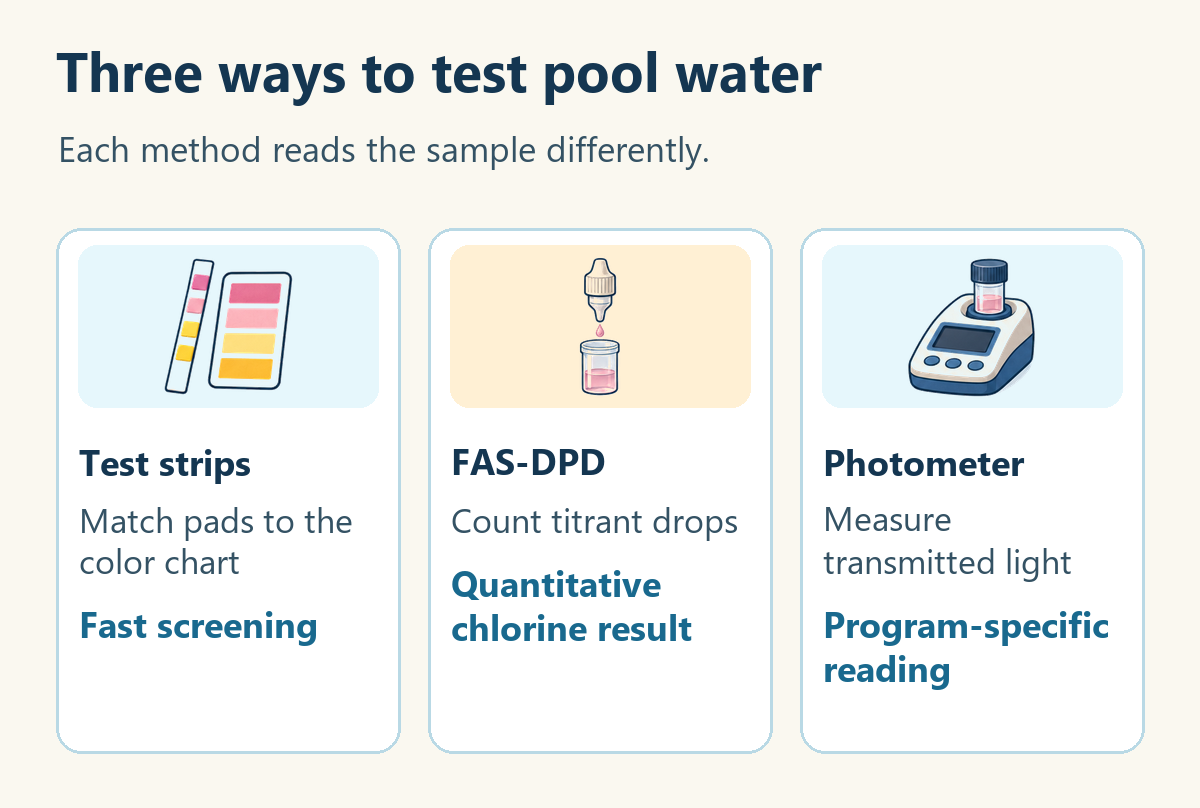
Choosing between pool test strips, liquid or tablet kits, and digital meters comes down to three practical trade-offs: measurement resolution, test speed, and recurring cost per test. CDC guidance states that a DPD colorimetric test (a dye reaction that turns pink in proportion to chlorine) gives more accurate chlorine and pH readings than test strips.1
Three method terms shape every equipment decision below. FAS-DPD titration counts liquid drops until a pink water sample turns clear, eliminating eye-based color matching. A digital photometer shines light through a reacted sample to read color digitally. A spin-disk photometer automates that optical step using a prefilled spinning disk, while a digital pocket pen dips an electronic probe into water and reads only pH and temperature.
Accuracy, Speed, and Cost Matrix Across Seven Pool Testing Tiers (Data as of 2026-11)
The table below compares all seven pool testing tiers on test scope, workflow speed, accuracy or NSF/ANSI 50 status, and dated US direct or retail prices checked 2026-11-25 to 2026-11-26.
| Testing Tier | Scope & Workflow Speed | Accuracy / NSF 50 Status | Upfront Price (2026-11) | Refill / Ongoing Cost (2026-11) | Best-Fit Role |
|---|---|---|---|---|---|
| Test Strips (AquaChek 7-in-1) | 7 factors (FC 0-20 ppm); 15-sec visual read | Semi-quantitative visual blocks | $23.99 (100-strip bottle) | ~$0.24/strip retail | Fast screening and retail shelves |
| Visual DPD Kit (Taylor K-2005) | FC/CC up to 5 ppm; manual color match | More accurate than strips (CDC)1 | From $119.91 direct | No reliable public data | Routine DPD at moderate chlorine |
| FAS-DPD Kit (Taylor K-2006) | Full panel; manual drop titration | NSF 50 certified; 0.2 or 0.5 ppm/drop | From $149.49 direct / $99.33 dist. | ~$0.10/test R-0871 ($14.50/140) | Route dosing and high-chlorine checks |
| Multi-Factor Photometer (LaMotte ColorQ 2x) | 7 factors (FC 0-8 ppm NSF); manual reagent + digital read | NSF 50 L1-L3 (Model 2086) | $263.37 sale / $396.00 reg. (Model 2087) | $109.00 sale / $155.00 reg. (R-2086) | Commercial logs and mid-volume counters |
| Chlorine-Only Photometer (Hanna HI97711) | FC & TC only (0.00-5.00 mg/L); manual cuvette + digital read | ±0.03 mg/L ±3% at 25 °C (0.01 res.; EPA 330.5) | $379.99-$599.99 direct | ~$0.13/test FC ($39.99); ~$0.20/test TC ($58.99) | Dedicated chlorine compliance verification |
| Spin-Disk Photometer (LaMotte Spin Touch) | Full series from <3 mL; 60-sec automated | 6-wavelength ±0.01 AU (check NSF 50 by model) | $1,295.00 sale / $1,956.00 reg. (Model 3582) | $3.79/disk sale ($189.74/50) / $285.00 reg. | High-traffic retail testing bars |
| Digital Pocket Pen (Hanna HI98127) | pH & temp only (no chlorine); instant probe read | ±0.1 pH (0.1 res.); not for Cl compliance | $139.99 direct | $84.99 HI73127 probe; buffers $18.99+ ($77.99 bundle) | Dedicated pH spot checks only |
Five specification details change how you interpret those numbers:
- Test strips stay semi-quantitative despite broad printed ranges. AquaChek Silver 7-in-1 (551236) covers Free Chlorine 0-20 ppm, Total Chlorine 0-10 ppm, Total Bromine 0-20 ppm, pH 6.2-8.4, Total Alkalinity 0-240 ppm, Total Hardness 0-1,000 ppm, and cyanuric acid (CYA, chlorine stabilizer) 0-300 ppm after a 15-second wait. Palintest notes that free chlorine strips rely on TMB or syringaldazine (FACTS) indicators read against color blocks, keeping readings semi-quantitative and sensitive to lighting and color vision. Taylor direct also lists S-1403 7-Way strips at $18.25 and S-1452 PRO 7 strips at $31.15 on 2026-11-25.
- Visual DPD comparator kits sit below FAS-DPD on range. Visual DPD liquid or tablet kits separate free chlorine from combined chlorine, yet AyerGuides notes they top out at 5 ppm before bleaching and still depend on pink shade matching. For visual DPD kits like the Taylor K-2005 and foil-blister tablets, there is No reliable public data for a single standardized per-test refill cost because liquid bottle sizes and blister tablet box counts vary across distributors.
- NSF/ANSI 50 accuracy levels depend on method and reagent format. Taylor K-2006 carries NSF/ANSI 50 certification and six pH standards (7.0 to 8.0), while Taylor's K-1515-A/C combined chlorine listing shows how titration technique shifts tiers: L2 with the 0.2 ppm method, L3 with 0.5 ppm, and L1 with the syringe method.15 On LaMotte ColorQ 2x PRO 7 (Model 2086, liquid plus tablet kit covering 144 tests per liquid factor and 100 tablets per tablet factor), Free Chlorine 0-8 ppm rates L1 for pools (L2 for spas) with tablets and L2 with liquid, while pH rates L3 with tablets (6.5-7.9) and L2 with liquid (6.5-8.2).
- Model numbers and refill formats matter on digital photometer quotes. The $263.37 sale price ($396.00 regular, checked 2026-11-25) covers LaMotte Model 2087 (all-tablet TesTabs PRO 7), while PoolSupply4Less lists the Model 2086 liquid-plus-tablet refill pack (R-2086) at $109.00 sale ($155.00 regular, checked 2026-11-26). Likewise, the $1,295.00 sale price ($1,956.00 regular, checked 2026-11-25) covers Spin Touch Model 3582 (Mobile Commercial kit with carry case), distinct from Model 3580 (Store Version), which runs a 60-second cycle from under 3 mL of water.
- Chlorine-only photometers price free and total chlorine reagents separately. Hanna HI97711 adapts EPA DPD method 330.5 from 0.00 to 5.00 mg/L at 0.01 mg/L resolution (±0.03 mg/L ±3% of reading at 25 °C) and lists at $379.99-$599.99 (2026-11-25). Free Chlorine liquid reagents (300 tests, HI93701-F) cost $39.99 (~$0.13/test), Total Chlorine reagents (HI93701-T) cost $58.99 (~$0.20/test), and CAL Check standards (HI97701-11) cost $219.99.
Method & Reagent Tier Note: Buying an NSF/ANSI 50 brand name does not guarantee the highest L1 tier across every test. Both Taylor K-1515-A/C titration steps and LaMotte ColorQ 2x tablet versus liquid formats hold distinct L1, L2, or L3 ratings by parameter and pool-versus-spa use.15
Hardware vs. Per-Test Consumable Math—and the Pocket Digital Pen Trap
Upfront hardware price hides the real seasonal operating bill. On 2026-11-25, Taylor direct listed K-2006 from $149.49 while commercial distributor RecSupply listed it at $99.33. Once a truck has the box, a 2 oz bottle of R-0871 titrating reagent costs $14.50 for ~140 routine chlorine tests (~$0.10/test), and a full annual K-2006 refill set costs $52.00—though shock recovery uses extra drops.
Compare that running cost to a spin-disk photometer. At the 2026-11-25 PoolSupply4Less sale price of $189.74 per 50-pack ($285.00 regular), each LaMotte 4328-H SpinDisk costs $3.79 before regular-list replenishment. Burning single-use disks on low-margin route stops drains profit fast, while a busy retail counter selling chemical baskets can absorb that disk cost for 60-second staff consistency. Wholesale volume discounts vary by distributor contract, so price full-season refills before equipping a fleet.
The Pocket Digital Pen Trap: Buyers searching for a digital pool tester sometimes buy a waterproof pocket pen expecting a full-panel meter. Hanna HI98127 pHep 4 ($139.99 direct, checked 2026-11-25; -2.0 to 16.0 pH, ±0.1 pH) reads only pH and temperature—no free chlorine, alkalinity, or CYA. Ongoing upkeep adds HI73127 replacement pH electrodes ($84.99 direct, checked 2026-11-26) plus calibration buffers—either individual pH 7.01 bottles and sachets from $18.99 to $124.99 or 2-buffer bottle bundles (HI547-11PB pH 4 & 7 or HI5710-11PB pH 7 & 10) at $77.99 each.
For related testing guides, start at our Testing hub. When comparing specific products inside a tier, see Best Pool Test Kits Compared and Pool Test Strip Brands.
Once accuracy, speed, and per-test cost sit on one sheet, commercial operators still face a stricter filter: what CDC MAHC guidance and NSF/ANSI 50 certification allow during a health inspection.
Commercial Pool Compliance: What CDC MAHC and NSF/ANSI 50 Actually Require
Commercial pool inspections aligned with CDC MAHC guidance and many state or county health codes require an approved NSF/ANSI 50 DPD test kit with paired reagents rather than test strips for disinfectant compliance, even though NSF/ANSI 50 Section 19 also includes a test-strip evaluation protocol. The 2024 CDC MAHC (the Centers for Disease Control and Prevention's Model Aquatic Health Code) sets a voluntary benchmark for public pools. Under Section 5.7.3.6, facilities must keep onsite testing devices for disinfectant residual, pH, alkalinity, CYA if used, and temperature, and staff must check reagent expiration dates at every use.2
CDC's 2024 Aquatic Facility Inspection Form Cross-Reference Guide (CS356382-C) reinforces that rule in Item #19. It checks for an approved NSF/ANSI 50 (the US commercial aquatic testing standard) DPD test kit. Inspectors review free disinfectant, pH, and combined chlorine (chloramines formed from swimmer waste).3
NSF/ANSI 50 Accuracy Levels (L1-L3), Validation Caps, and Paired Reagents
NSF/ANSI 50 official listings (current as of October 2026) record four specifics for every certified device: parameter, operational range, accuracy level (L1, L2, or L3—where L1 is the strictest accuracy tier and L3 is the widest), and end use (pool or spa/hot tub).10 Two certification boundaries trip up commercial buyers who skim spec sheets.
First, certification applies only when reagents are used with their listed, paired instrument.10 Putting third-party drops or off-brand tablets into an NSF-listed meter or comparator voids the listed certification even when chemical names match.
Second, NSF/ANSI/CAN 50 caps validation testing at 0-10 ppm for free chlorine and 0-2.5 ppm for combined chlorine.11 A photometer or strip bottle may print a wider scale, yet accuracy above 10 ppm is outside NSF/ANSI 50 validation.
Commercial Pump-Room Check: Keep your official NSF listing printout and current reagent lot dates in the pump-room binder. Verify that your exact model, accuracy tier, end use (pool vs. spa), and paired reagent part numbers match local code before opening day.1011
Voluntary MAHC Guidance vs. Enforceable State and County Bans on Strips and OTO
The CDC MAHC is guidance, not federal law. It becomes enforceable only when adopted in whole or in part by a state, local, territorial, or tribal health authority.5 Commercial operators therefore must confirm the exact aquatic code enforced by their county or state inspector.
Local codes frequently enforce stricter equipment bans than retail advice suggests. For example, Lake County, Illinois (under 77 Ill. Adm. Code 820) mandates a DPD-type colorimeter test kit for disinfectant residual and prohibits substituting orthotolidine (OTO, a yellow total-chlorine indicator) drops or test strips for a DPD kit.8
For state-by-state logbook schedules and daily test intervals, check our guide to Commercial Pool Testing Frequency.
Passing an inspection means carrying certified gear, yet even an NSF/ANSI 50 DPD kit or photometer can output a wrong reading when high chlorine, non-chlorine shock, or dirty optics interfere.
Where Each Testing Method Fails: Bleaching, Interferences, and Handling Errors
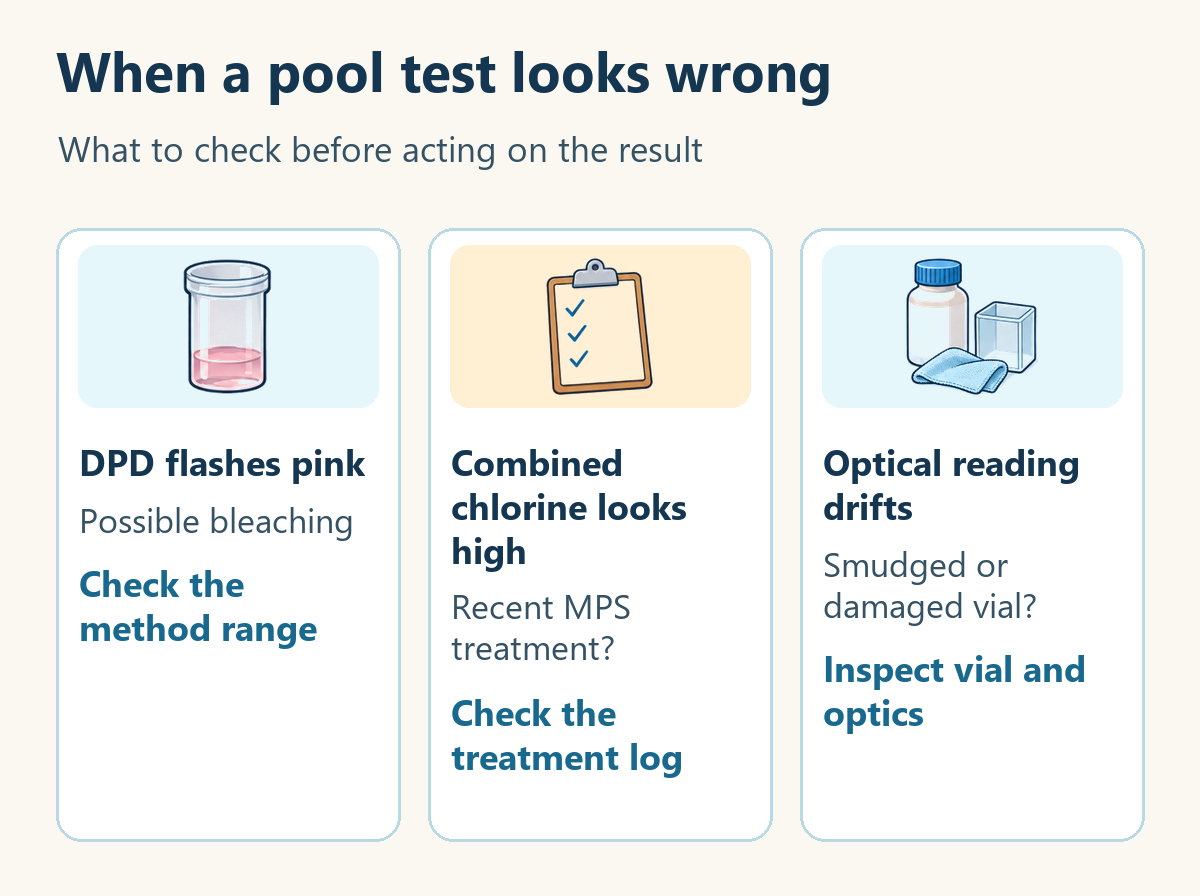
Every pool testing category produces predictable false readings once chemical thresholds or handling limits are crossed. Knowing those exact failure signatures stops technicians from double-dosing an over-chlorinated pool or chasing phantom combined chlorine after non-chlorine shock.
| Failure Symptom | Likely Cause | Failure Trigger / Limit | Immediate Field Fix |
|---|---|---|---|
| DPD reads 0 ppm or low | DPD bleaching from high chlorine1 | >5 ppm visual DPD; ≥6 mg/L Cl disc; >10 ppm (CDC)61 | Watch pink flash; dilute with Cl-free water & retest13 |
| False-high combined chlorine | MPS non-chlorine shock9 | Any MPS present (>25 ppm also skews FC)9 | Check shock log before superchlorinating9 |
| Slow or muted DPD color | Cold water or poor reagent buffer97 | Water <60 °F (16 °C) or outside pH 6.2-6.5 buffer97 | Warm sample to ≥60 °F; use buffered DPD reagents97 |
| Erratic strip CYA reading | Timing error or unbalanced water | Read off 15-sec mark, pH outside 7.0-8.4, or TA >240 ppm | Rebalance water or verify with CYA turbidity drop test |
| Drifting photometer or pen | Optical scatter or fouled probe | Smudged/scratched glass vial or clogged junction | Wipe vial & CAL Check; renew junction & buffer cal |
High-Chlorine DPD Bleaching, MPS Shock Interference, and Cold-Water Bias
DPD bleaching (high sanitizer destroying the pink indicator dye so the sample turns pale or clear) is the riskiest false reading in pool care. Different manuals flag different warning points depending on the comparator scale—from 5 ppm on standard residential visual DPD blocks up to ≥6 mg/L on comparator discs and >10 ppm in CDC guidance—yet all reflect the same dye-bleaching failure. CDC warns that when pool or hot tub chlorine exceeds 10 ppm, DPD results can partially or totally bleach out, showing a false low or 0 ppm chlorine reading.1
On visual DPD comparator discs, UK HPA/HSE guidance (2006-03) warns that color flashing and vanishing, failing to develop, or hitting the disc ceiling (6 mg/L chlorine or 10 mg/L bromine) signals potential bleaching and requires diluting the sample and multiplying the result. High CYA turbidity readings of 80-100 ppm similarly use a 1:1 half-dilution multiplied by 2.6
Zero-Chlorine Sanity Check: Watch the test tube the exact second DPD reagent hits the sample. PWTAG advises looking for an initial flash of pink and retesting after diluting with chlorine-free water before adding more sanitizer.113
Two other chemical factors skew DPD readings without operator error. First, the 2024 MAHC Annex warns that potassium monopersulfate (MPS, a non-chlorine oxidizer shock) creates false-high combined chlorine readings and skews free chlorine above 25 ppm. Second, the MAHC Annex recommends gently warming water below 60 °F (16 °C) to at least 60 °F before testing.9 Behind the scenes, ISO 7393-2:2017 requires ready-for-use field DPD liquids, powders, and tablets for mobile photometers to include an adequate buffer system maintaining pH 6.2-6.5 so pool pH swings do not bias dye color.7
Strip Timing/CYA Limits, Photometer Optics, and Pocket Electrode Drift
Test strips depend heavily on exact timing and sample water balance. AquaChek Silver 7-in-1 instructions specify waiting 15 seconds before reading the bottle chart, and its CYA pad works only when water pH sits between 7.0 and 8.4 and total alkalinity is at or below 240 ppm. Holding strips flat during the wait also prevents indicator dye from bleeding across adjacent pads.
Digital instruments remove eye-based color matching yet introduce optical and sensor upkeep. For portable photometers, Hanna supplies a cuvette-wiping cloth and NIST-traceable CAL Check validation standards (Cuvettes A and B) because smudges, bubbles, cloudy water, or scratched glass vials distort light absorbance. On pocket pH pens, reference junctions foul in chlorinated water and slow response. Hanna HI98127 addresses drift with a replaceable HI73127 electrode featuring an extractable cloth junction plus automatic 1- or 2-point buffer calibration (4.01/7.01/10.01 or 4.01/6.86/9.18) to maintain ±0.1 pH accuracy.
To avoid tablet-formulation mismatches that cloud photometer cuvettes, read Photometer Tablets vs. Rapid Tablets. For deeper meter drift troubleshooting and buffer routines, see Digital Pool Tester Accuracy.
Knowing where each tool breaks down explains why experienced service fleets, retail stores, and commercial venues build two-tier workflows around these exact limits.
How Service Routes, Retail Counters, and Commercial Pools Combine Testing Methods
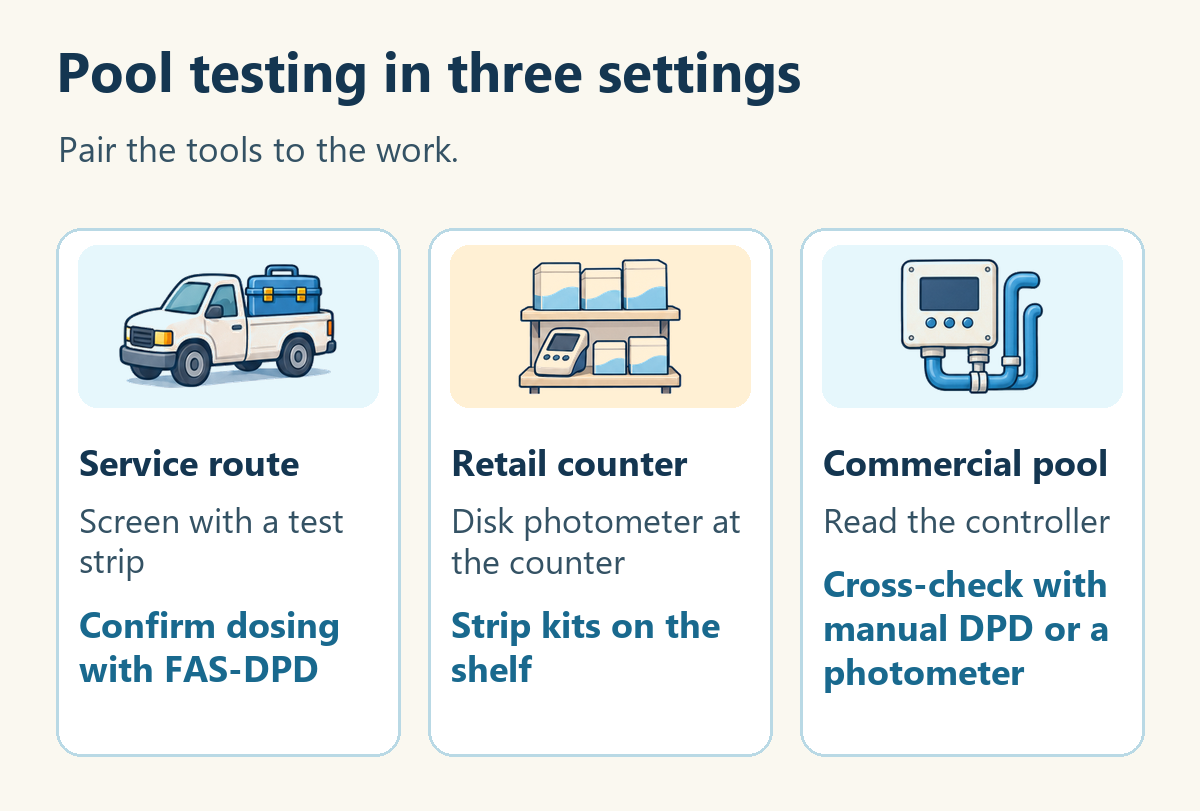
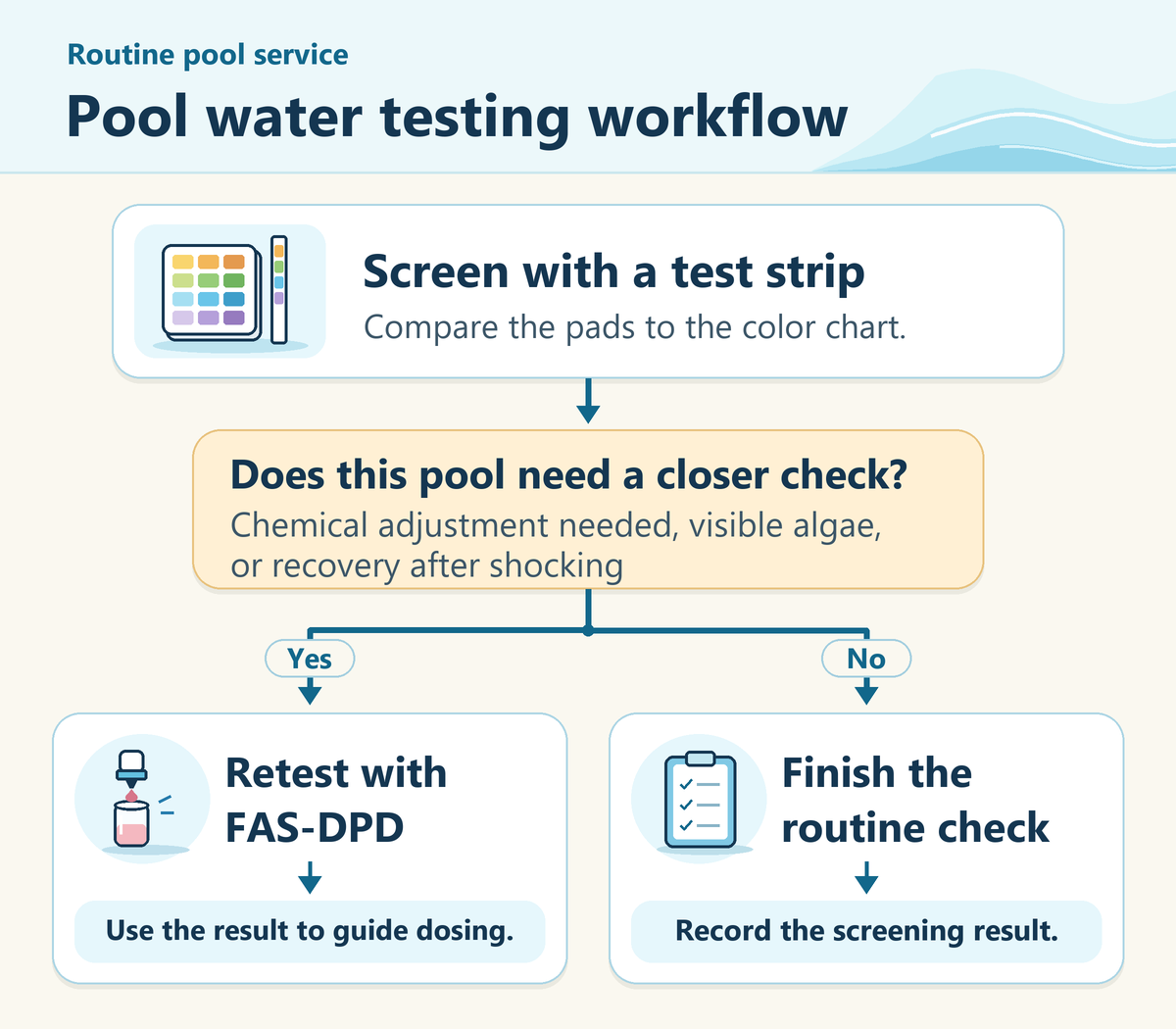
Professional pool teams separate fast routine screening from precision dosing and compliance verification. That two-tier design keeps per-stop labor short while protecting chemical budgets and swimmer safety from semi-quantitative guesswork.
Service Routes: Fast Screening Plus FAS-DPD Dosing Confirmation
Route technicians need speed on balanced weekly pools and exact drop-count precision whenever chemistry shifts. Pool chemistry guides (Oddy) frame test strips as useful fast screening tools when stored and timed properly. However, broad color blocks, humidity, lighting, and color vision make liquid titration or calibrated digital meters necessary for chemical dosing. Hanna Instruments similarly points out that human color perception across wide strip ranges risks under- or over-dosing.
The practical truck standard pairs 7-way strips for quick screening with an FAS-DPD titration kit whenever a pool needs chemical adjustment, shows algae, or sits in shock recovery. AyerGuides summarizes the chlorine reagent ladder cleanly: OTO reads only total chlorine, while visual DPD splits free and combined chlorine up to 5 ppm before bleaching. FAS-DPD titration removes color matching and reads 20+ ppm. That pairing keeps routine per-test reagent spend low while handling high-chlorine calls cleanly.
Good sampling technique protects both tiers equally. Collect water elbow-deep away from return jets and test immediately before sunlight degrades free chlorine.
Retail Counters and Shelves: Balancing 60-Second Throughput Against Per-Disk Cost
Retail pool stores run two distinct testing businesses under one roof: the free customer water-testing bar and the retail testing aisle. At high-traffic counters, staff consistency and short lines drive chemical basket sales. Centrifugal disk photometers like the LaMotte WaterLink Spin Touch process a full multi-parameter test from under 3 mL of water in 60 seconds and store up to 250 results for PC download or Bluetooth transfer.
That 60-second automation carries higher single-use cartridge spend (detailed in the dated cost table above), so store owners should match meter choice to walk-in chemical conversion. Busy seasonal bars recover disk spend through attached balancer and sanitizer sales. Lower-volume stores protect margin with a handheld photometer at the counter while stocking multi-parameter strips and drop kits on the retail shelf.
Commercial Facilities, Escalation Triggers, and Specialist Method Guides
Commercial pools operate on stricter verification rules than residential routes. Lovibond observes that commercial leisure operators test disinfectant and pH multiple times daily with tablet reagent comparators or photometers instead of test strips. Individually foil-sealed reagent test tablets resist moisture degradation from first tablet to last.
Even facilities running continuous automated chemical controllers require manual cross-checks. Under the UK PWTAG Code of Practice (updated July 2025), operators check controller readouts daily against manual sample-cell tests. Staff recalibrate whenever pH differs by more than 0.2 or free chlorine differs by more than 15%.14
Commercial Escalation & Hyperchlorination Trigger: Automated controllers require daily manual DPD or photometer checks (recalibrate above 0.2 pH or 15% free chlorine variance per PWTAG).14 During fecal-incident hyperchlorination at 20-40 ppm, conventional kits hit their ceiling; CDC advises using specialized high-range 20-40 ppm chlorine test strips or diluted DPD testing—never standard residential strips.4
For deeper reagent chemistry, our DPD vs. FAS-DPD vs. OTO guide explains each chlorine test method. Teams choosing kit sizes can compare models in Taylor K-2006 vs. K-2005 and K-2006C.
Even the right two-tier equipment setup loses accuracy quickly if reagents bake in summer truck cabs or go unverified—making storage control, end-to-end verification, and shelf-stocking checks the final piece of the system.
Shelf Life, Truck Storage, Field Verification, and Retail Stocking Checks
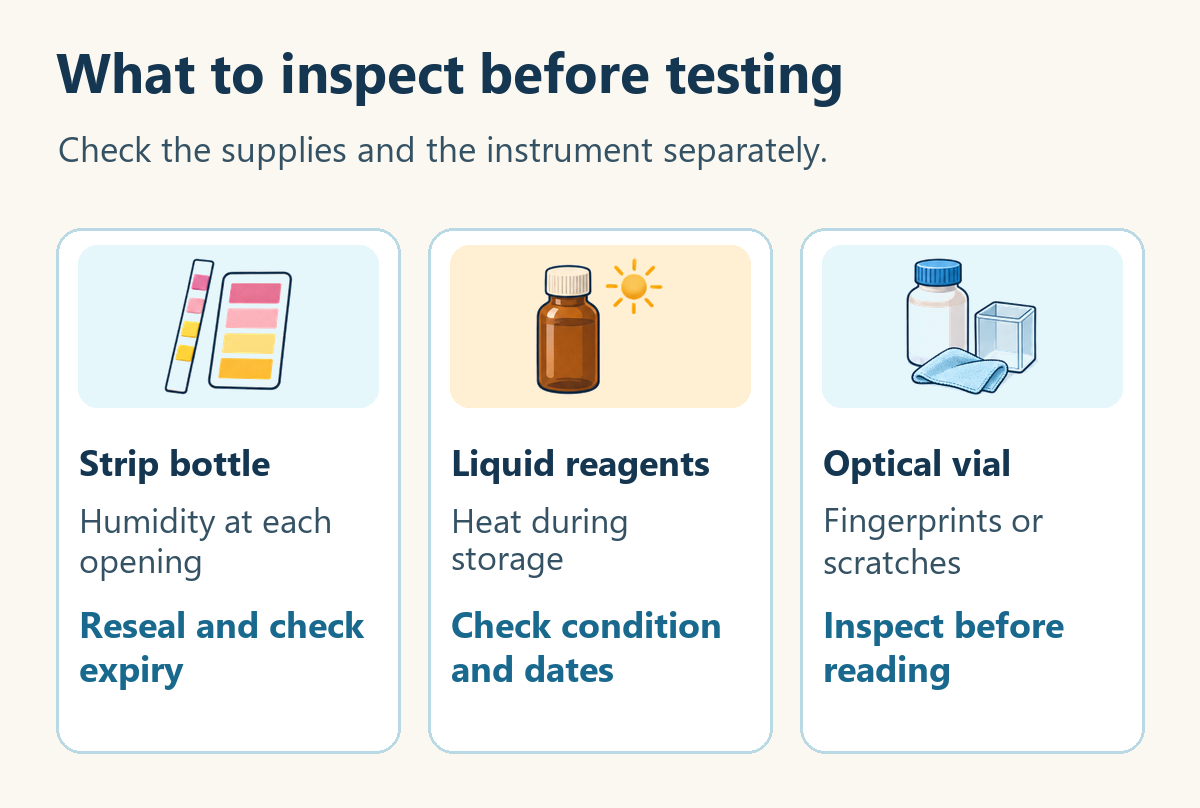
Accurate equipment still fails when reagents degrade in heat and humidity or go unverified across a season. Treat every strip bottle, tablet blister, and liquid reagent as a perishable supply managed on a clear inspection checklist.
Truck Heat Control, Shelf Life, and Optical vs. End-to-End Verification
Follow four field verification checkpoints across service trucks, retail counters, and pump rooms:
- Control storage temperature and light exposure. Taylor Technologies states that all testing reagents—liquids, powders, crystals, tablets, and strip pads—are perishables formulated to stay effective for at least one year when stored consistently around 2-29 °C (36-85 °F) away from light. Keep active route kits inside an insulated cooler bag out of direct sun, and mark the opening date on every cap.
- Keep brand reagents paired without cross-brand mixing. Taylor warns that identically named reagents from different brands carry different concentrations and cannot be interchanged. Mixing reagents across brands risks biased readings and breaks NSF/ANSI 50 device pairing.
- Run optical checks and full-chain reference-water checks. Portable photometers such as Hanna HI97711 offer NIST-traceable CAL Check standards (Cuvettes A and B, $219.99 as of 2026-11-25) to verify meter optics on demand and recalibrate when out of spec. In his 2018 manual, Robert Lowry distinguishes optical instrument checks from reference-water verification that tests the entire chain—operator technique, reagent freshness, and meter reading—together. Passing an optical cuvette check alone will not flag expired drops or heat-cooked strips.
- Verify start- and end-of-shelf-life lot discipline. NSF/ANSI 50 Section 19 includes test strips as water quality testing devices and requires testing units from at least 2 manufacturing batches, each starting with at least 50% remaining shelf life and retested at end of life for accuracy and repeatability.12 Rotating stock by lot code and refreshing liquid reagents annually mirrors that reliability standard in daily operations.
Retail Stocking and Packaging Checks
Retail buyers and distributors stocking test strips or blister tablets for store shelves and private-label programs should inspect moisture barriers, batch-matched color charts, and unopened versus opened dating before placing seasonal orders. Phenol red (the standard indicator dye used to measure pool pH) and DPD reagents degrade quickly once exposed to damp air, making desiccant bottles, foil pouches, and individually sealed foil blisters essential for shelf turnover.
Kingnod (Our Company) Retail Packaging & Shelf-Life Specs:
- Pool & Spa Test Strips: Kingnod (our company) supplies configurable test strips across seven parameters—total hardness, free chlorine, bromine, total chlorine, CYA, total alkalinity, and pH—with an optional custom salinity pad, a 1-second dip and 15-second hold procedure, 3-year unopened and 150-day opened shelf life, batch-matched color charts, and customizable 20, 50, or 100 strips per bottle or foil pouch.
- Foil-Blister Reagent Tablets: Our foil-blister reagent tablets cover DPD1, DPD3, and DPD4 in 6 mm or 6.5 mm diameter, packed 10 tablets per blister strip and 10 or 100 strips per box, with a 2-year unopened shelf life for DPD and phenol red tablets.
Where a commercial facility requires NSF/ANSI 50 compliance, specify an NSF-listed brand-paired system as covered in the compliance section above. When evaluating blister tablets or strips for a specific photometer or private-label program, run live split-sample checks against a reference kit using actual production samples before standardizing. You can contact our team for batch-matched packaging details or production sample options.
With storage rules, reference-water verification, and packaging checks locked in, you can choose and maintain a two-tier testing setup with predictable accuracy and cost.
Bottom Line: Build a Two-Tier Testing Setup Instead of Chasing One Tool
No single pool testing method wins on speed, precision, commercial compliance, and per-test cost at the same time. The reliable trade setup pairs a precision primary method with a fast or high-range backup matched to how your team actually works.
Equip service routes with multi-parameter test strips for quick screening plus an FAS-DPD drop titration kit for dosing and shock recovery. Size retail water-testing counters to walk-in chemical conversion before committing to high per-disk spin cartridges. On commercial pools, run NSF/ANSI 50 DPD or photometer systems with paired reagents, daily manual controller verification, and high-range hyperchlorination backup. Protect every tier with cool dark storage, dilution retests whenever DPD flashes pink and reads zero, and periodic reference-water verification across your staff and reagents.
References
- CDC Healthy Swimming — Home Pool and Hot Tub Water Treatment and Testing — 2025-07-21
- CDC 2024 Model Aquatic Health Code (5th Ed.) Section 5.7.3.6 — Onsite Water Quality Testing Devices & Reagents — 2026-09-18
- CDC 2024 Aquatic Facility Inspection Form Cross-Reference Guide (CS356382-C, Item #19) — 2026-09-18
- CDC Fecal Incident Response Recommendations — High-Range Chlorine Testing During Hyperchlorination — 2026-09-18
- CDC Model Aquatic Health Code — Voluntary Adoption by State and Local Authorities — 2026-09-18
- UK HPA/HSE Management of Spa Pools (Part 2) — DPD Bleaching, Sample Dilution & CYA Turbidity — 2026-09-22
- ISO 7393-2:2017 — Water Quality Determination of Free & Total Chlorine (DPD Field Reagent Buffering) — 2026-10-11
- Lake County Health Department Swimming Facility Manual (77 Ill. Adm. Code 820) — DPD Colorimeter Requirement — 2026-09-19
- CDC 2024 Model Aquatic Health Code Annex (5th Ed.) — MPS Interference & Cold-Water Sample Warming — 2026-09-19
- NSF/ANSI 50 Certified Pool Water Quality Testing Devices — Accuracy Levels (L1-L3) & Paired Reagent Scope — 2026-10-11
- NSF/ANSI 50 Certified Pool Water Quality Testing Devices — Free & Combined Chlorine Validation Range Caps — 2026-09-18
- NSF/ANSI 50 Section 19 — Water Quality Testing Devices (Test Strip Batch, Accuracy & Shelf-Life Testing) — 2026-10-11
- PWTAG — Typical Pool Water Problems & High-Chlorine DPD Pink-Flash Dilution Check — 2026-10-11
- PWTAG Code of Practice (Updated July 2025) — Automated Controller Verification & Recalibration Thresholds — 2026-09-22
- NSF/ANSI 50 Official Listings — Taylor Technologies Test Kits (Method-Dependent Accuracy Levels) — 2026-09-18
How this guide was prepared
Prepared by Martin. Based on 15 cited sources listed in References. Content date: 2026-11-26.