To legally place swimming pool chlorine disinfectants on the European Union market under Regulation (EU) No 528/2012 (EU BPR), every Product-type 2 (PT2) disinfectant must clear two separate, cumulative gates 15. First, either your active-substance supplier or your product supplier must appear on ECHA's Article 95 list for PT2. Second, the finished product must qualify under a destination Member State's national transitional system (registration or notification, depending on the country) or hold a formal EU BPR product authorisation 15. A factory Safety Data Sheet (SDS) or a REACH registration number never substitutes for BPR compliance.
This guide serves experienced B2B pool chemical importers, distributors, and private-label brand owners placing bulk sanitizers on the EU/EEA market, with a separate contrast for Great Britain below. It reflects regulatory data as of 2026-11 and is published by Martin on PoolTradeDesk, a technical trade resource operated by pool chemical manufacturer and exporter Kingnod (our company). It offers practical trade information, not formal legal or regulatory advice, and does not cover United States disinfectant rules or US-market imports.
Start by checking your active substance's live PT2 status on ECHA. Next, verify a closed Article 95 supply chain before paying a deposit. Then match each destination country to its national transitional system or formal BPR authorisation, audit your REACH Annex II SDS, CLP Annex VIII UFI/PCN notification, and BPR labels before shipment, and confirm destination-country rules with the local authority. For broader bulk chemical import workflows outside EU biocides law, see our sourcing and import hub.
How EU BPR Applies to Pool Chlorine Disinfectants (PT2 and the Two-Gate Rule)
Why Swimming Pool Disinfectants Fall Under Product-Type 2 (PT2)
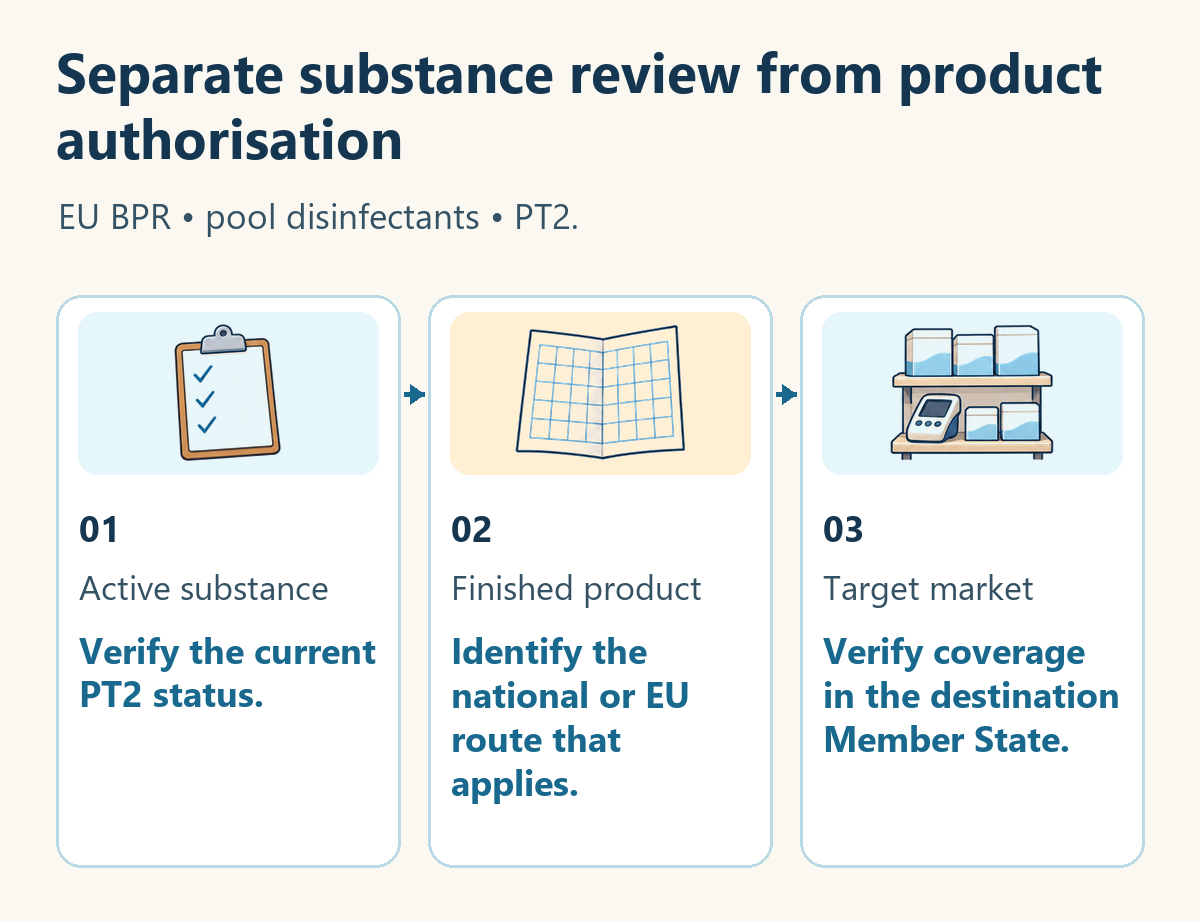
Under EU BPR, the Biocidal Products Regulation (Regulation (EU) No 528/2012) governs chemicals sold to control bacteria, viruses, or algae by chemical or biological (rather than mere physical or mechanical) action in the EU. Annex V divides biocides into 22 product-types. Product-type 2 (PT2) covers disinfectants and algaecides not intended for direct application to humans or animals, and it explicitly includes swimming pools, aquariums, bathing waters, and other waters 15.
Because pool chlorine tablets, granules, liquids, and bromine-chlorine tablets claim antimicrobial or algaecidal action in pool water, EU customs and national inspectors regulate them as PT2 biocides. Selling the same chemical strictly as an industrial raw material without biocidal claims falls outside PT2. Once a pail label or web page markets it for pool sanitation, full EU BPR PT2 obligations apply.
The Two-Step Rule: Why an SDS or REACH Registration Is Not BPR Compliance
EU BPR's statutory two-step framework operates at two levels: first, the active substance must be approved at EU level (or remain under assessment in the EU Review Programme) for PT2; second, Article 17(1) prohibits making any finished biocidal product available on the EU market or using it unless that specific product holds a BPR authorisation or qualifies under Member State transitional rules while its active substance is under review 15. On top of that two-step framework, Article 95 adds the cumulative supplier-source gate tying your active-substance or product supplier to the EU active-substance dossier—which is why importers verify both an Article 95 PT2 supplier listing (Gate 1) and finished-product authorisation or applicable national transitional compliance (Gate 2) before ordering.
To win formal product authorisation, a company must prove to authorities that the product works for its claimed pool use and poses no unacceptable risks to human health, animal health, or the environment 3. That efficacy-and-risk dossier is why generic chemical paperwork fails at EU border or market inspection. REACH registers substances for industrial safety, and an SDS communicates hazards; neither authorizes you to sell a pool disinfectant.
Practical Trade Scope (Data as of 2026-11): The European Commission launched a formal evaluation of Regulation (EU) No 528/2012 in Q4 2025 to review its effectiveness, efficiency, and coherence 3. Always confirm current obligations with your destination Member State Competent Authority (MSCA) or qualified EU regulatory counsel before finalizing compliance spend.
When screening an overseas supplier before requesting samples or a proforma invoice, ask for written confirmation of the official active-substance name, the PT2 scope, and the Article 95 supply-chain link in the first email. Pausing a purchase order up front is straightforward compared with port delays. Landing unmarketable stock at an EU port triggers customs holds, mandatory withdrawals, and national fines.
Quick Route Selector by Importer Situation:
- Importing TCCA (symclosene), SDIC (troclosene sodium), or BCDMH into an EU Member State: Verify an ECHA Article 95 PT2 supplier trail first, then complete each destination country's applicable national transitional system (registration or notification, depending on the Member State) under Article 89 while tracking live Review Programme status on ECHA.
- Importing calcium hypochlorite, sodium hypochlorite, chlorine gas, or electrolysis-generated active chlorine: Confirm Article 95 PT2 traceability and secure, or supply under, a formal EU BPR product authorisation (National Authorisation, Mutual Recognition, or Union Authorisation).
- Distributing across both EU Member States (or Northern Ireland) and Great Britain: Maintain two separate compliance files: EU BPR for the EU and Northern Ireland, and HSE's GB BPR for England, Scotland, and Wales.
Because your finished-product filing route depends directly on whether the active substance is already EU-approved or still under review, your first technical check is locating your pool chlorine chemistry in the 2026-11 status table below.
2026 EU BPR Status by Pool Chlorine Active Substance: Approved vs. Review Programme
As of 2026-11, EU BPR splits swimming pool disinfectants into two distinct legal tracks. Active chlorine released from sodium hypochlorite, calcium hypochlorite, chlorine gas, and salt electrolysis already holds EU PT2 approvals 45611. By contrast, symclosene (TCCA), troclosene sodium (anhydrous and dihydrate SDIC), and BCDMH were listed in the EU Review Programme, whose programme-wide completion target has been extended to 31 December 2030 (individual substance decisions can occur earlier; verify live status on ECHA) 1213.
The EU BPR Review Programme is the European Union's ongoing work programme evaluating existing active substances that were already on the European market before BPR took effect. Treating an EU-approved hypochlorite and a Review Programme chlorinated isocyanurate as legally identical causes importers to file under the wrong regulatory pathway.
EU BPR PT2 Pool Chlorine Active Substance Status Table (Data as of 2026-11)
| Common Trade Name | Official EU BPR Substance Name | Identifiers (EC / CAS) | Primary EUR-Lex Instrument | Key Specification / Scope | PT2 Status (Data as of 2026-11) |
|---|---|---|---|---|---|
| Liquid chlorine / bleach | Active chlorine released from sodium hypochlorite | EC 231-668-3 / CAS 7681-52-9 | Implementing Reg. (EU) 2017/1273 (14 Jul 2017) 4 | Aqueous solution of releaser NaOCl, max. 180 g/kg (<=18% w/w) active chlorine; PT1–5 4 | Approved (1 Jan 2019 – 31 Dec 2028) 4 |
| Cal hypo | Active chlorine released from calcium hypochlorite | EC 231-908-7 / CAS 7778-54-3 | Implementing Reg. (EU) 2017/1274 (14 Jul 2017) 5 | Min. 655 g/kg (>=65.5% w/w) Ca(OCl)2, equiv. 65% w/w active Cl; PT2–5 5 | Approved (1 Jan 2019 – 31 Dec 2028) 5 |
| Chlorine gas | Active chlorine released from chlorine | EC 231-959-5 / CAS 7782-50-5 | Implementing Reg. (EU) 2017/1275 (14 Jul 2017) 6 | Min. 995 g/kg (>=99.5% w/w) chlorine; PT2 & PT5 6 | Approved (1 Jan 2019 – 31 Dec 2028) 6 |
| Saltwater pool chlorination | Active chlorine generated from sodium chloride by electrolysis | In-situ generated active chlorine | Implementing Reg. (EU) 2021/345 (25 Feb 2021) 11 | In-situ generation from NaCl precursor complying with EN 973, EN 14805, EN 16370, EN 16401, or NF Brand; PT2–5 11 | Approved (1 Jul 2022 – 30 Jun 2032) 11 |
| TCCA (tablets/granules) | Symclosene | EC 201-782-8 / CAS 87-90-1 (Entry 85, DE) | Delegated Reg. (EU) 2022/825 & 2024/1398 1213 | Annex II Review Programme; PT2 12 | Review Programme (programme target extended to 31 Dec 2030; verify live ECHA status) 13 |
| SDIC / Dichlor (anhydrous & dihydrate) | Troclosene sodium & sodium dichloroisocyanurate dihydrate | EC 220-767-7 / CAS 2893-78-9 (Entry 345) & CAS 51580-86-0 (Entry 346, DE) | Delegated Reg. (EU) 2022/825 & 2024/1398 1213 | Annex II Review Programme; PT2 12 | Review Programme (programme target extended to 31 Dec 2030; verify live ECHA status) 13 |
| BCDMH (bromine-chlorine tablets) | Bromochloro-5,5-dimethylimidazolidine-2,4-dione | EC 251-171-5 / CAS 32718-18-6 (Entry 588, NL) | Delegated Reg. (EU) 2022/825 & 2024/1398 1213 | Annex II Review Programme; PT2 12 | Review Programme (programme target extended to 31 Dec 2030; verify live ECHA status) 13 |
EU-Approved Active Chlorine Substances (PT2)
Two specification details inside the approved rows regularly trip up buyers. First, for active chlorine released from calcium hypochlorite (solid granular or tablet unstabilized chlorine), Commission Implementing Regulation (EU) 2017/1274 sets a minimum purity of 655 g/kg (65.5% w/w) calcium hypochlorite, equivalent to 65% w/w available active chlorine 5. Do not confuse compound purity with available chlorine when checking a supplier's technical data sheet against the EU approval annex.
Second, active chlorine released from sodium hypochlorite (liquid pool bleach) specifies an aqueous solution of releaser sodium hypochlorite with a maximum concentration of 180 g/kg (18% w/w) active chlorine under Commission Implementing Regulation (EU) 2017/1273 4. Meanwhile, active chlorine released from chlorine (chlorine gas, minimum 995 g/kg or 99.5% w/w) 6 and active chlorine generated from sodium chloride by electrolysis (where precursor sodium chloride must meet EN 973, EN 14805, EN 16370, EN 16401, or NF Brand purity requirements when marketed with biocidal claims) 11 each carry separate approval annexes and expiry windows. Always verify the exact specification line in the implementing regulation so technical equivalence matches your dossier or Letter of Access.
Review Programme Pool Sanitizers (TCCA, SDIC, and BCDMH Through 2030)
In EU BPR terminology, trichloroisocyanuric acid (TCCA) is listed as symclosene (slow-dissolving stabilized tablets and granules). Sodium dichloroisocyanurate (SDIC) is listed as troclosene sodium (fast-dissolving stabilized chlorine in anhydrous or dihydrate form). BCDMH stands for bromochloro-5,5-dimethylimidazolidine-2,4-dione (slow-dissolving bromine-chlorine tablets widely used in spas and indoor pools) 12.
The Review Programme rows in the table draw from Commission Delegated Regulation (EU) 2022/825 (17 March 2022), which updated Annex II to Regulation (EU) No 1062/2014 with Germany evaluating Entries 85, 345, and 346 and the Netherlands evaluating Entry 588 12. Commission Delegated Regulation (EU) 2024/1398 (14 March 2024) amended BPR Article 89(1) to extend the overall Review Programme completion target to 31 December 2030 13. Because any individual substance can still receive an approval or non-approval decision before 2030, check ECHA's live active-substance database before each seasonal booking.
For an EU private-label buyer weighing approved hypochlorites against Review Programme chemistries, each track has clear operational consequences. Approved hypochlorites offer settled EU active-substance status through 2028, but they require a formal BPR product authorisation (or access to an authorised product family). While TCCA, SDIC, and BCDMH remain in the Review Programme (verify live on ECHA), products enter via country-by-country Article 89 national transitional systems while staying exposed to future Review Programme evaluation outcomes.
Why Product-Type Specificity Matters (The PT12 Non-Approval Warning)
Warning on Product-Type Boundaries: Under Commission Implementing Decision (EU) 2020/1036 (15 July 2020), the European Commission decided not to approve symclosene (Entry 85), troclosene sodium (Entry 345), and sodium dichloroisocyanurate dihydrate (Entry 346) for PT12 (slimicides) 8. That decision does not ban them in PT2 swimming pools, which remain in the Review Programme. Equally, PT2 eligibility never permits marketing a pool sanitizer for cooling-tower slimicide (PT12) or drinking-water (PT5) use unless that product-type is separately covered 8.
Once you confirm whether your active substance is EU-approved or still in the Review Programme, the next mandatory gate applies equally to both tracks: proving your supply chain connects to ECHA's Article 95 list.
Verifying the ECHA Article 95 List and Letter of Access Supply Chain
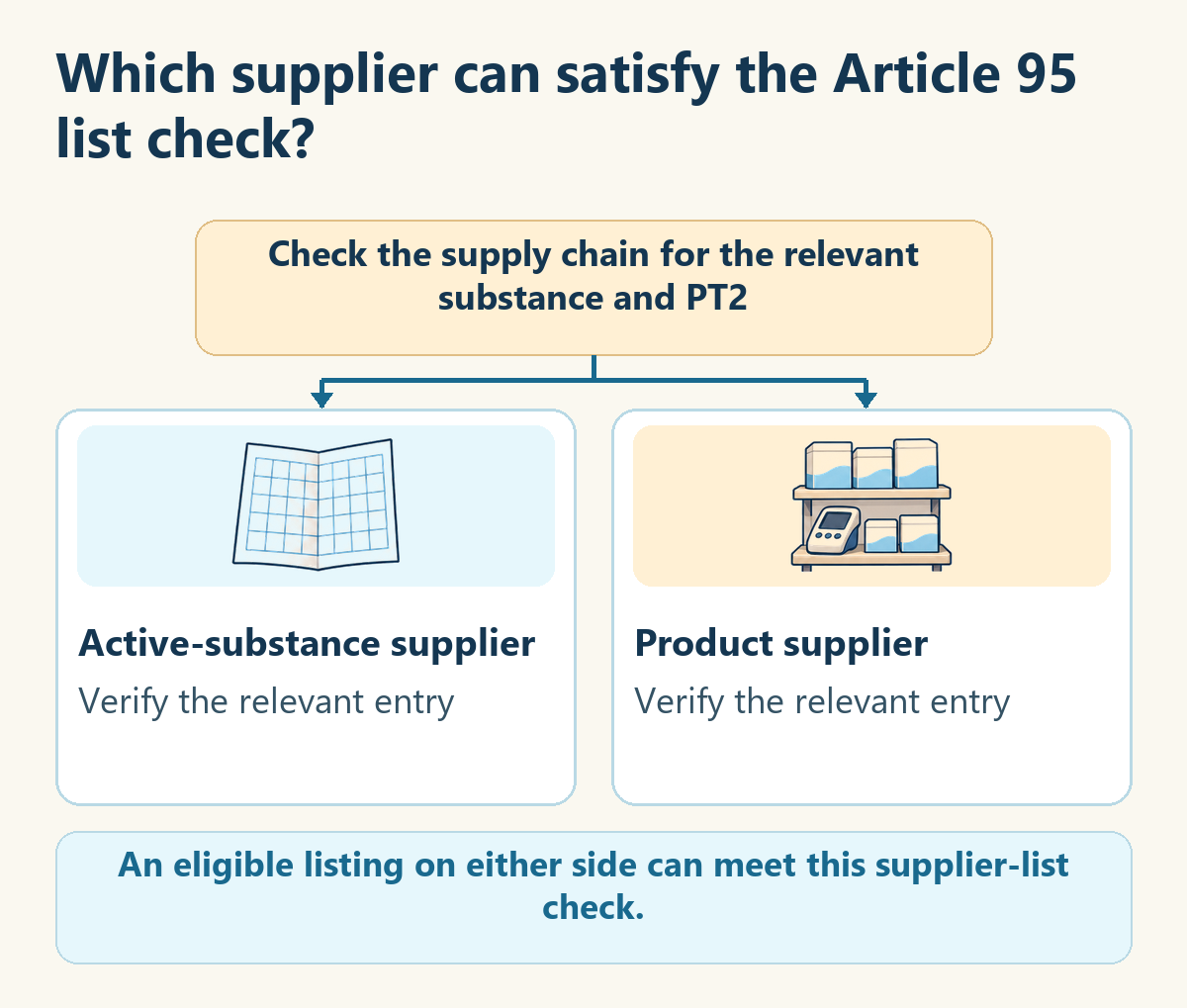
Under BPR Article 95(2), no pool disinfectant may be placed on the EU market unless either the active-substance supplier or the product supplier appears on ECHA's Article 95 list for Product-type 2 15. Pay close attention to the legal logic. Between substance supplier and product supplier, it is an either/or rule, so both do not need to be listed. However, Article 95 supplier compliance is cumulative with product authorisation or transitional compliance and never replaces it 15.
The ECHA Article 95 list is the official European Chemicals Agency register of active-substance and biocidal-product suppliers who have contributed to the cost of EU regulatory data. A Letter of Access (LoA) is formal written permission from a data owner letting another supplier rely on that protected dossier to gain Article 95 listing 14.
How to Search the Live ECHA Article 95 List by Official Substance Name and PT2
Never rely on a static PDF screenshot emailed by a trading company, because ECHA updates the Article 95 list regularly. Run this 4-step verification yourself before wiring any deposit:
- Open ECHA's live Article 95 list (Active Substance Suppliers) on the official ECHA website.
- Search using the official EU BPR substance name, not the trade acronym. Search
symclosenefor TCCA,troclosene sodium(orsodium dichloroisocyanurate dihydrate) for SDIC,active chlorine released from calcium hypochloritefor cal hypo,active chlorine released from sodium hypochloritefor liquid bleach, orbromochloro-5,5-dimethylimidazolidine-2,4-dionefor BCDMH (cross-checking CAS32718-18-6/ EC251-171-5because ECHA's live database can display an updated reaction-mass identity). - Filter strictly for Product-type 2 (
PT2). A supplier listed only for PT4 (food/feed area) or PT11 (cooling systems) cannot legally supply PT2 swimming pool disinfectants. - Match the exact legal entity name and country. Confirm that the listed company name (or its EU Representative for a non-EU manufacturer) matches the qualifying active-substance supplier or product supplier named in your supply-chain Article 95 declaration—your direct trading-company seller does not need to be listed separately if a documented upstream active-substance supplier in the chain appears on the PT2 list. Holding a private Letter of Access PDF alone does not satisfy Article 95(2) until that qualifying supplier's legal entity appears live on ECHA's PT2 register.
Substance Supplier vs. Product Supplier, Letter of Access (LoA), and Trading Chains
Commission Regulation (EU) No 334/2014 amended Article 95 to set out how suppliers qualify. A company joins the list by submitting a complete active-substance dossier, submitting a Letter of Access to a complete dossier, or referencing a dossier whose data-protection period has expired. The same obligation applies to precursors manufactured or imported to generate an active substance in situ 14.
For an EU importer, this opens two practical sourcing routes:
- Sourcing from an already-listed active-substance supplier: If your manufacturer, or an upstream raw-material producer in a documented trading chain, already appears on ECHA's Article 95 list for PT2, your importing company does not need to purchase its own LoA. You simply must document every commercial link from that listed entity to your EU entity 1516.
- Applying as a listed product supplier with your own LoA: If an EU brand owner wants freedom to switch formulators or packagers later, it can buy a Letter of Access and register itself as a PT2 product supplier on Article 95 at higher upfront regulatory cost 14.
When buying from overseas exporters outside the EU, check both their EU BPR supply-chain trail and their underlying corporate credentials. See our guide on how to verify a Chinese chemical supplier's licenses for business-license and hazardous-chemical permit checks.
What Supply-Chain Proof Importers Must Keep on File
EU inspectors audit the paper trail connecting the listed Article 95 entity to the EU importer placing goods on the market. Using the UK Health and Safety Executive's (HSE) published Article 95 enforcement benchmark as a practical audit template (bearing in mind that EU Member State language rules depend on the destination MSCA), keep an unbroken folder covering every intermediary: supplier declarations confirming active-substance origin from the listed PT2 entity, commercial invoices, delivery notes, and bills of lading linking each step 16.
Critical Boundary (Article 95 Is Only Gate 1): Appearing on ECHA's Article 95 list satisfies only the active-substance source rule under Article 95(2). It never serves as a finished biocidal product authorisation under Article 17(1) and does not allow you to sell a pool sanitizer in any EU Member State without the matching product-level filing 15.
With a verified Article 95 supplier trail in hand, your shipment still cannot legally enter EU retail or commercial channels until it clears Gate 2: finished-product registration, notification, or authorisation in each target Member State.
National Transitional Registration vs. Formal EU BPR Product Authorisation
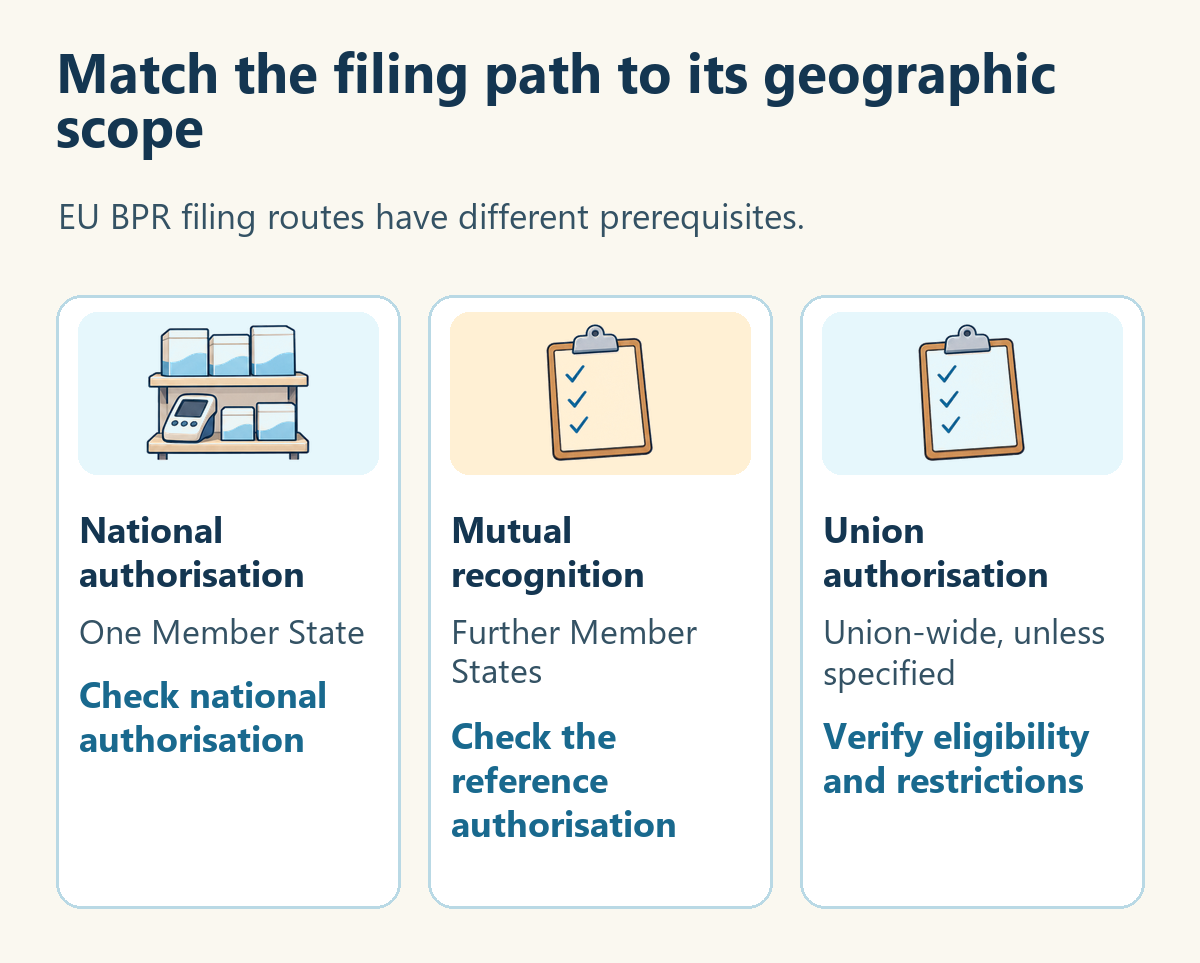
Your finished-product filing path under EU BPR depends directly on your active substance's legal track. Pool disinfectants containing Review Programme actives (TCCA, SDIC, BCDMH) enter individual Member States under Article 89 national transitional rules while those substances remain under review 15. Products containing already-approved actives (calcium hypochlorite, sodium hypochlorite, chlorine gas, and electrolysis active chlorine) require a formal EU BPR product authorisation 2.
Transitional National Rules vs. Formal EU BPR Product Authorisation Routes
| Pathway | Which Pool Chlorine Actives Use It (2026-11) | Geographic Coverage | Primary Legal Basis | Key Operational Feature |
|---|---|---|---|---|
| National Transitional Rules (Art. 89) | Review Programme actives: TCCA (symclosene), SDIC (troclosene sodium), BCDMH | Single Member State per filing | BPR Art. 89(2)–(3) 15 | Jurisdiction-specific national system (registration or notification); up to 3 years post-approval only when a formal authorisation application is filed by the approval date of the last active substance for that product-type 15 |
| National Authorisation | Approved actives: cal hypo, NaOCl, Cl2, electrolysis | Single Member State | BPR Art. 17 / EC guidance 2 | Standard single-country BPR dossier submitted to one MSCA 2 |
| Mutual Recognition (Sequence or Parallel) | Approved actives (cal hypo, NaOCl, Cl2, electrolysis) | Multiple Member States | BPR / EC guidance 2 | Extends one reference Member State's authorisation to others either after approval (sequence) or simultaneously (parallel) 2 |
| Union Authorisation (Arts. 41–42) | Approved actives with similar use conditions across the EU | Entire European Union (unless otherwise specified) | BPR Arts. 41–42 15 | Single authorisation granted by the European Commission valid throughout the EU unless otherwise specified (where conditions of use are similar across the Union) 15 |
Transitional National Rules Under Article 89 (TCCA, SDIC, and BCDMH)
Under Article 89(2)–(3) of Regulation (EU) No 528/2012, while an existing active substance remains in the Review Programme, each Member State may keep applying its own national system or practice for placing biocidal products on its market 15. That transitional window can continue for up to 3 years after the approval date of the last active substance for that product-type, provided the company submits a formal BPR product authorisation application no later than that approval date—it is not an unconditional grace period 15. While the Review Programme's overall completion target runs to 31 December 2030, individual substances can receive an approval or non-approval decision earlier; confirm live on ECHA that TCCA, SDIC, or BCDMH remains under review before relying on national transitional rules.
One rule catches cross-border distributors repeatedly: national transitional filings do not carry over across EU borders. Each Member State runs its own notification portal, fee schedule, and review procedure, and those national fees and timelines change often. Before expanding a Review Programme disinfectant into another EU country, confirm directly with that destination Member State Competent Authority (or a local regulatory consultant) whether a simple notification, full national registration, or national fee applies.
Formal BPR Product Authorisation Routes (National, Mutual Recognition, Union)
Once an active substance holds EU approval and its Article 89(3) post-approval transitional window has closed—which is already the case as of 2026-11 for calcium hypochlorite, sodium hypochlorite, chlorine gas (approved 1 January 2019), and electrolysis-generated active chlorine (approved 1 July 2022)—finished products cannot rely on Article 89 transitional rules. Companies must hold, or supply under, a formal BPR product authorisation through one of three paths: National Authorisation in a single Member State, Mutual Recognition (in parallel across several countries at once, or in sequence after a first national approval), or EU-wide Union Authorisation granted by the European Commission under Articles 41–42 for products with similar conditions of use across the Union (valid throughout the EU unless otherwise specified) 215.
Your geographic footprint and product eligibility determine which formal route fits your rollout. Launching in a single EU country uses National Authorisation, with Mutual Recognition in sequence available later if distribution expands to additional Member States 2. Rolling out across multiple Member States at the same time uses Mutual Recognition in parallel, or Union Authorisation under Articles 41–42 where the product meets eligibility criteria for similar conditions of use across the Union 215.
Non-Approval Phase-Out and Multi-Country Planning Risks
Transition Risk for Review Programme Stocks: According to the European Commission, if an active substance receives a non-approval decision under the Review Programme, biocidal products containing that substance are usually removed from the market within 12 months unless national authorities stipulate otherwise 1. Track ECHA Biocidal Products Committee opinions before committing to multi-year private-label packaging runs for Review Programme chemistries.
Once your Article 95 source and product-level transitional compliance or formal authorisation are aligned, the final operational hurdle before containers clear customs and reach store shelves is EU SDS, poison-centre notification, labeling, and advertising compliance.
CLP Labels, REACH Annex II SDS, UFI/PCN, and BPR Advertising Rules
Before placing pool chlorine disinfectants on the EU market, importers must align four operational compliance pieces. These cover hazard classification and labeling under the Classification, Labelling and Packaging Regulation (EC) No 1272/2008 (CLP), a current REACH Annex II EU Safety Data Sheet in the destination language, a harmonised CLP Annex VIII Poison Centre Notification (PCN) with a Unique Formula Identifier (UFI), and strict BPR Articles 69 and 72 label and advertising wording 151079.
REACH Annex II EU Safety Data Sheets (Regulation (EU) 2020/878) and Cross-Check Traps
- Legacy pre-2020/878 SDS formats are no longer valid: Commission Regulation (EU) 2020/878 amended REACH Annex II to modernize EU Safety Data Sheets with nanoform fields, endocrine-disrupting property entries, and UFI disclosure where applicable, ending the transition for legacy SDS formats on 31 December 2022 10. Where an SDS is required under REACH Article 31 and BPR Article 70—standard for B2B hazardous pool chlorine—every EU supply since 1 January 2023 requires a Regulation (EU) 2020/878-compliant SDS in the official language(s) of the destination Member State 10.
- Check typical TCCA CLP hazard codes: Reviewing a historical legacy-format export TCCA EU SDS reference from Kingnod (our company, v1.3, 2019-03-04) illustrates the typical CLP hazard classifications EU importers verify on stabilized chlorine paperwork:
Ox. Sol. 2 / H272(oxidizing solid),Acute Tox. 4 / H302(harmful if swallowed),Eye Irrit. 2 / H319(serious eye irritation),STOT SE 3 / H335(respiratory irritation),Aquatic Acute 1 / H400, andAquatic Chronic 1 / H410. - Cross-check Section 2 hazards against Section 14 transport: Under REACH Annex II consistency rules 10, compare Section 2 (CLP hazard classification) against Section 14 (UN number and IMDG/ADR transport class) before approving artwork or shipping paperwork. If Section 2 lists oxidizing hazards while Section 14 leaves transport fields incomplete or inconsistent, require a corrected 2020/878-format SDS before booking freight. For auditing chemical specifications and available-chlorine COAs alongside your SDS review, see our pre-order sample available-chlorine testing guide.
CLP Annex VIII Poison Centre Notifications (PCN) and UFI Codes
A Poison Centre Notification (PCN) is a harmonised emergency-health dossier filed with EU poison centres via ECHA's portal, linked to the product by a unique alphanumeric Unique Formula Identifier (UFI) code under CLP Annex VIII Part A Section 5.1—printed on the label for consumer and professional mixtures, or alternatively indicated in the SDS for industrial-use or unpackaged hazardous mixtures under Section 5.3. Three official CLP Annex VIII milestones govern pool chemical mixtures classified for health or physical hazards:
- Consumer-use mixtures (1 January 2021): Commission Delegated Regulation (EU) 2020/11 (adopted 29 October 2019) amended CLP Annex VIII Part A Section 1.1 to defer the first consumer-use compliance date from 1 January 2020 to 1 January 2021 9.
- Professional and industrial mixtures (2021 and 2024): Commission Regulation (EU) 2017/542 Annex VIII Part A Sections 1.2 and 1.3 set harmonised PCN compliance dates at 1 January 2021 for professional-use mixtures and 1 January 2024 for industrial-use mixtures 7.
- All legacy national transitions ended on 1 January 2025: Under Regulation (EU) 2017/542 Annex VIII Part A Section 1.4, all transitional periods allowing importers to rely on older national poison-centre notifications expired on 1 January 2025 7. Every pool disinfectant mixture classified for health or physical hazards placed on the EU market today requires a harmonised PCN submission and a valid UFI (on the label, or in the SDS where permitted for industrial-use or unpackaged mixtures under Annex VIII Part A Section 5.3) under CLP Annex VIII 79.
BPR Article 69 Label Mandates and Article 72 Advertising Red Lines
- Mandatory positive BPR label items (BPR Articles 69(2)–(3)): Under Article 69(2), biocidal product labels must clearly and indelibly show the identity of every active substance and its concentration alongside applicable BPR and CLP product information, while Article 69(3) governs Member State official-language requirements 15.
- Banned misleading wording (BPR Article 69(2) for labels and Article 72(3) for advertisements): Biocidal product labels and advertisements must never mislead buyers about risks to human health, animal health, or the environment. Article 69(2) (and Article 72(3) for advertisements) explicitly bans phrases such as
"low-risk biocidal product","non-toxic","harmless","natural","environmentally friendly","animal friendly", or any similar indication 15. Strip every such misleading claim from pail artwork and online bullet points before printing. - Mandatory advertising sentence (BPR Article 72(1)–(2)): Every advertisement for a pool disinfectant, including distributor catalogs, trade brochures, and online product pages, must display the exact legally required notice in a manner clearly distinguishable and legible in relation to the whole advertisement (Article 72(2) allows advertisers to replace the word
"biocides"with a clear reference to the product-type being advertised) 15:
Mandatory BPR Article 72(1) Advertising Notice: "Use biocides safely. Always read the label and product information before use." 15
Audit Section 2 against Section 14, confirm the Regulation (EU) 2020/878 format and UFI placement, check Article 69(2) active-substance disclosures, and strip every banned phrase before approving private-label pail printing. Fixing a digital artwork file before production is far simpler and less costly than relabeling containers at an EU warehouse.
With EU labeling, SDS, and PCN checks covered, one last jurisdictional boundary catches European distributors off guard before you run your final pre-order check: selling across both the EU and Great Britain.
EU BPR vs. GB BPR and Pre-Order Compliance Verification Checklist
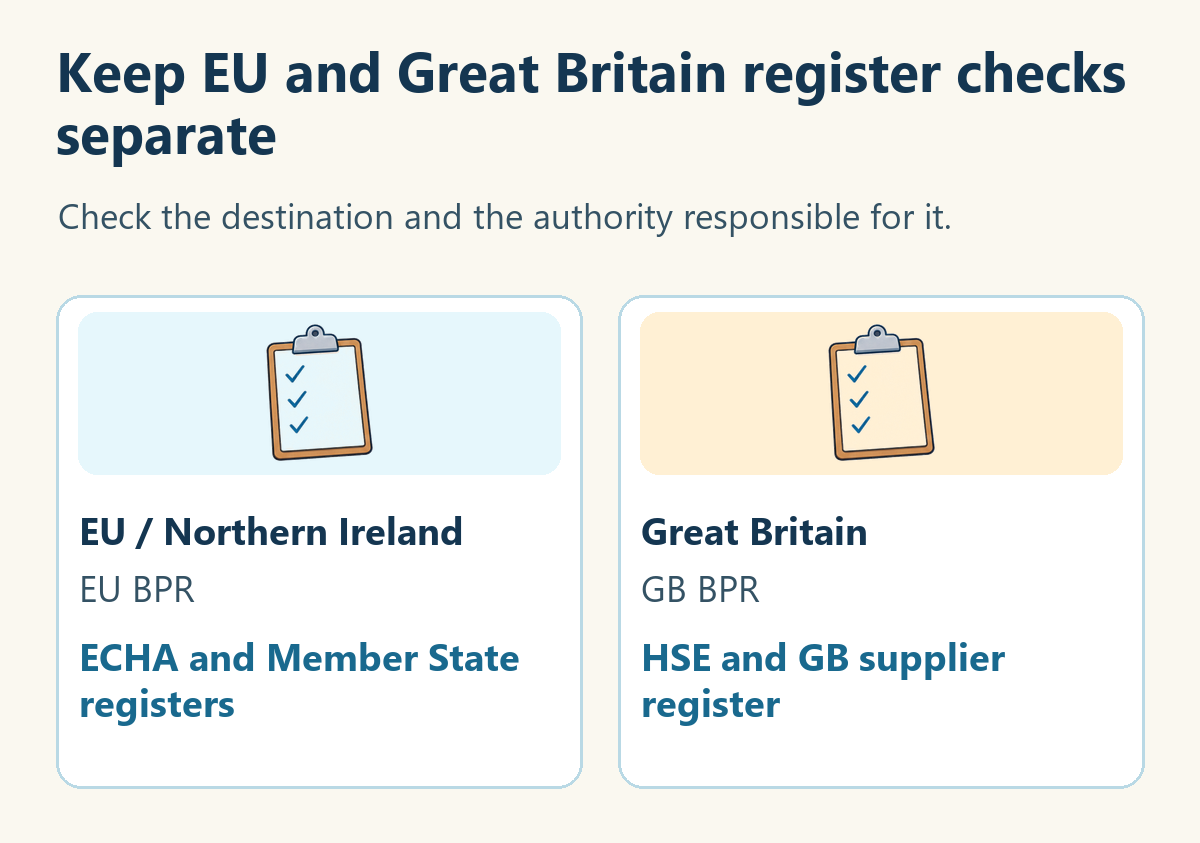
Run a five-step pre-order EU BPR compliance gate before paying any deposit on pool chlorine, and keep Great Britain completely segregated from your EU-27 and Northern Ireland compliance files 171615.
Five-Step Pre-Order EU BPR Verification Checklist (and Common Traps)
Use this EU BPR Pre-Order Importer Compliance Checklist on every new supplier quote and repeat seasonal booking. Have four document sets ready: the supplier quotation and chemical spec sheet, the Article 95 declaration and invoice/LoA trail, the destination registration, notification, or authorisation identifier, and the draft EU SDS, PCN/UFI proof, and label artwork.
- Verify live active-substance status and deadlines for PT2 (Data as of 2026-11): Match the official substance name (
symclosene,troclosene sodium,active chlorine released from calcium hypochlorite, etc.) on ECHA's live database, confirm the annex specification/purity floor for EU-approved actives, and check renewal status ahead of the 31 December 2028 expiry for approved hypochlorites. Trap avoided: Treating Review Programme actives and EU-approved hypochlorites as identical, or missing active-substance approval or non-approval clocks. According to the European Commission, a non-approval decision usually triggers a 12-month removal window unless national authorities specify otherwise, while an approval decision starts the clock for formal BPR product authorisation applications 1. - Audit the ECHA Article 95 PT2 supply-chain trail: Confirm directly on ECHA's live register that either the active-substance supplier or the product supplier is listed for PT2, and collect an unbroken chain of declarations, invoices, and delivery notes linking the listed entity to your importing company 15. Trap avoided: Accepting a trading company's verbal assurance or static PDF screenshot without checking live PT2 coverage.
- Confirm Gate 2 product compliance or authorisation in every destination country: Match Review Programme products (TCCA, SDIC, BCDMH) to each destination Member State's national transitional system (registration or notification, depending on the country), and match approved actives (calcium/sodium hypochlorite, chlorine gas, electrolysis) to a valid National Authorisation, Mutual Recognition, or Union Authorisation 15. Trap avoided: Assuming an Article 95 listing or one country's transitional filing covers the entire EU.
- Audit REACH Annex II SDS, CLP Annex VIII UFI/PCN, and BPR Art. 69/72 labels: Confirm the EU SDS follows Regulation (EU) 2020/878 in the destination language with consistent Section 2 and Section 14 data. Verify harmonised PCN submission and UFI placement (on the label, or in the SDS where permitted for industrial-use or unpackaged mixtures) for mixtures classified for health or physical hazards (all legacy national transitions ended 1 January 2025), confirm active-substance concentration display, remove banned wording such as
"environmentally friendly"or"non-toxic", and add the Article 72(1) notice to every catalog or web listing. Trap avoided: Shipping legacy pre-2020/878 SDS formats, unnotified mixtures, or non-compliant retail artwork that forces costly warehouse relabeling. - Confirm destination-country specifics with the MSCA or regulatory counsel: Because Member State transitional fees, renewal timelines, and enforcement practices evolve, confirm final country-specific obligations directly with the destination Member State Competent Authority or qualified EU regulatory counsel before wiring funds. Trap avoided: Relying on outdated national fee schedules or assuming identical filing rules across EU borders.
EU BPR vs. GB BPR: Why Great Britain and Northern Ireland Cannot Share One Dossier
European distributors selling into the United Kingdom frequently assume EU BPR compliance covers Great Britain. It does not:
| Regulatory Dimension | EU-27 / EEA & Northern Ireland | Great Britain (England, Scotland, Wales) |
|---|---|---|
| Governing Regime & Authority | EU BPR (Regulation (EU) No 528/2012), administered by ECHA and MSCAs 17 | Independent GB BPR, managed by the Health and Safety Executive (HSE) 17 |
| Post-Brexit Decision Validity | Follows ECHA and European Commission decisions 17 | ECHA decisions taken on or after 1 January 2021 do not apply in Great Britain (only decisions taken prior to 1 January 2021 apply) 17 |
| Article 95 Supplier Register | ECHA EU Article 95 list for PT2 15 | Separate HSE GB Article 95 list (with UK-inspectable English supply-chain proof) 16 |
| Product Authorisation Register | ECHA / EU Member State national registers 15 | Separate HSE Great Britain register (segregated from Northern Ireland entries; verify authorisation number, active substance, holder, product-type, and dates) 18 |
If your business distributes pool sanitizers into both EU Member States (or Northern Ireland) and Great Britain, maintain two completely separate compliance dossiers: one under EU BPR and one under HSE's GB BPR, even when the physical chemical comes from the same production run 171618.
Scope & Legal Notice (Data as of 2026-11): This checklist provides practical trade information for EU and non-US pool chemical importers and does not constitute formal legal or regulatory advice. For editorial clarifications or non-US bulk export documentation questions (excluding United States disinfectant inquiries), European importers can contact PoolTradeDesk and Kingnod (our company).
Keep these five verification checks attached to every European disinfectant purchase order so regulatory compliance stays ahead of production and booking.
Putting EU BPR Verification Into Your Next Import Order
Treat EU BPR compliance as a pre-order engineering gate instead of last-minute export paperwork. Before booking any European pool chlorine shipment, complete all five steps in sequence: verify live ECHA PT2 substance status and deadlines (as of 2026-11), audit an ECHA Article 95 PT2 supply-chain trail, confirm the destination country's national transitional compliance or formal BPR authorisation, audit your Regulation (EU) 2020/878 SDS, CLP Annex VIII PCN/UFI, and BPR Article 69/72 labels, and verify country-specific rules with the destination authority.
Keep Great Britain (HSE GB BPR) files completely separate from EU-27 and Northern Ireland filings, and confirm every country's current requirements directly with the relevant Member State Competent Authority or qualified EU regulatory counsel before placing stock on the European market.
References
- European Commission: Active Substances & Non-Approval Phase-Out
- European Commission: Biocidal Products — Authorisation Procedures
- European Commission: Regulation (EU) No 528/2012 — Biocidal Products Regulation Overview — 2025-12
- Commission Implementing Regulation (EU) 2017/1273 (Active Chlorine Released from Sodium Hypochlorite) — 2017-07-14
- Commission Implementing Regulation (EU) 2017/1274 (Active Chlorine Released from Calcium Hypochlorite) — 2017-07-14
- Commission Implementing Regulation (EU) 2017/1275 (Active Chlorine Released from Chlorine) — 2017-07-14
- Commission Regulation (EU) 2017/542 Adding Annex VIII to CLP (Poison Centre Notifications and UFI) — 2017-03-22
- Commission Implementing Decision (EU) 2020/1036 (Non-Approval of Certain Active Substances Including Symclosene/Troclosene Sodium for PT12) — 2020-07-15
- Commission Delegated Regulation (EU) 2020/11 Amending CLP Annex VIII (Deferral of Consumer-Use PCN Date to 1 January 2021) — 2019-10-29
- Commission Regulation (EU) 2020/878 Amending REACH Annex II (EU Safety Data Sheet Format) — 2020-06-18
- Commission Implementing Regulation (EU) 2021/345 (Active Chlorine Generated from Sodium Chloride by Electrolysis) — 2021-02-25
- Commission Delegated Regulation (EU) 2022/825 Amending Annex II to Regulation (EU) No 1062/2014 (Updated BPR Review Programme List) — 2022-03-17
- Commission Delegated Regulation (EU) 2024/1398 Extending the BPR Review Programme to 31 December 2030 — 2024-03-14
- Regulation (EU) No 334/2014 Amending Regulation (EU) No 528/2012 (Article 95 Conditions) — 2014-03-11
- Regulation (EU) No 528/2012 (Biocidal Products Regulation — Consolidated Text, 2024-05-26) — Originally published: 2012-05-22; Version read: 2024-05-26
- HSE (Great Britain): GB Article 95 Active Substance Supplier List Obligations — 2026-10-11
- HSE: Separation of GB BPR (Great Britain) and EU BPR (Northern Ireland) Active Substance Lists — 2026-10-11
- HSE: UK Biocidal Product Authorisation Register Verification Fields — 2026-09-22
How this guide was prepared
Prepared by Martin. Based on 18 cited sources listed in References. Content date: 2026-11-26.