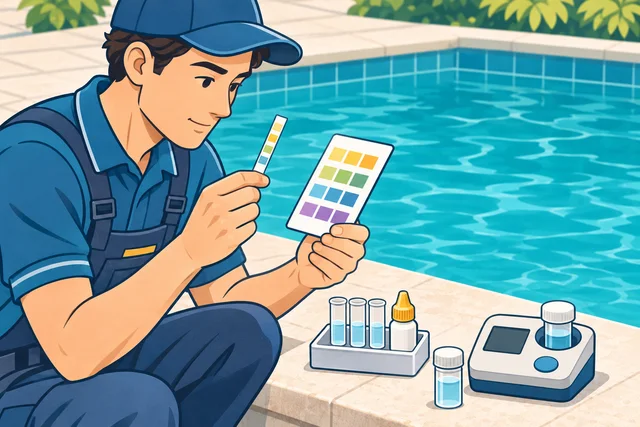
What This Testing Section Covers
PoolTradeDesk's Testing section serves pool service companies, retail water-lab operators, commercial pool managers, and trade distributors looking for practical water-testing guidance. To help you narrow down the right guide for your operation, the section is organized around the four basic testing method families illustrated in the PHTA 2024 Certified Pool & Spa Operator (CPO) Handbook: colorimetric/photometric (such as disinfection and pH), titrimetric (such as disinfection, total alkalinity, and calcium hardness), turbidimetric (such as cyanuric acid), and electronic (such as total dissolved solids and pH). PHTA presents these four families as general method examples rather than an endorsement of any specific test product.
Before choosing a tool or reading a method comparison, three industry reference baselines separate routine screening from commercial compliance testing:
- Screening strips versus titration and colorimetry: Per PHTA (2024), dip-and-read strips use reagent pads matched to a bottle chart after a set wait—commonly 15–30 seconds—so commercial operators need to verify local approval and accuracy requirements. By contrast, titration doses a measured reagent until a permanent color change occurs, giving stronger precision and repeatability than visual comparator blocks. Under NSF/ANSI 50 (2013), water quality testing devices (WQTDs) for pH, chlorine (free and total), and bromine (free and total) are graded across three precision-and-accuracy tiers, with level 1 at the top. The 2024 MAHC Annex (Section 4.7.3.5) notes that free- and combined-chlorine titration is objective to within 0.2 mg/L and preferred over visual color matching—which resolves only to half the gap between neighboring color blocks and widens in uncertainty above 1.5 mg/L—while portable colorimeters provide the highest poolside accuracy when budgets allow.
- Public-venue onsite equipment and reagent care: Where state or local rules adopt 2024 MAHC Section 5.7.3.6, public aquatic facilities must keep onsite testing gear covering at least temperature, pH, alkalinity, disinfectant residual, and CYA (when used). Operators using reagent kits must verify and log expiration dates at each test, keep reagents within manufacturer temperature limits, and follow manufacturer calibration schedules.
- Commercial testing intervals: Where adopted by state, local, or tribal authorities (actual local rules may vary), 2024 MAHC Section 5.7.5 sets daily pre-opening checks for pH and sanitizer levels (DPD free chlorine, combined chlorine, or total bromine), repeating every 2 hours during open hours on manual feed systems and every 4 hours on automated systems alongside logged in-line ORP and water temperature readings. Total alkalinity runs on a weekly cycle, while calcium hardness, saturation index, and CYA (weekly or more often when stabilized chlorine is the primary sanitizer) run monthly.
Start With Published Testing Guides
If you are deciding which testing tools to standardize across service trucks, retail water-testing counters, or commercial pool decks, start with our core method comparison:
- Pool Test Strips vs Test Kit vs Digital Testers — Compares test strips, liquid and DPD reagent tablet kits, and digital photometers across accuracy, speed, per-test cost, and operational workflow for service routes, store counters, and commercial pools.
Across the Testing section, topics span choosing between strips, drop kits, and digital meters; separating chlorine reagent chemistries; matching photometer tablets versus rapid-dissolve comparator tablets; reading digital tester accuracy specifications; checking commercial testing frequency rules; and comparing reagent kit formats—starting with the core method comparison linked here.
Editorial Disclosure and Trade Sourcing
PoolTradeDesk is operated by the Kingnod team as a practical reference for pool industry professionals, and we identify our affiliation directly whenever Kingnod products appear in our guides.
For distributors, retail chains, and private-label buyers sourcing water-testing consumables, Kingnod (our company) supplies two testing lines:
- Pool & Spa Test Strips: Seven parameters—total hardness, free chlorine, bromine, total chlorine, CYA, total alkalinity, and pH—that can be combined into different multi-parameter formats, with a customizable salinity pad. Standard use is a dip of 1 second and a horizontal hold of 15 seconds, with an unopened shelf life of 3 years and an opened shelf life of 150 days, packed in 20/50/100-strip bottles or foil pouches.
- Pool & Spa Test Tablets: DPD1, DPD3, and DPD4 tablets (6 or 6.5 mm diameter; 10 tablets per blister strip, 10 or 100 strips per box, customizable) alongside phenol red tablets, with a 2-year unopened shelf life.
Standard configurations can be tailored by parameter combination and pack format for wholesale or private-label orders. Trade buyers inquiring about bulk test strips or DPD and phenol red test tablets—as well as readers submitting editorial corrections—can use the Contact us page.