No single US retail pool salt brand meets every salt chlorine generator manual without a trade-off. Morton Professionals' Choice states no additives and carries NSF/ANSI/CAN 60 certification, yet its official Product Data Sheet (PDS) lists 99.00% typical NaCl rather than the 99.8% floor printed in Pentair and Jandy manuals. AQUASALT publishes 99.9% typical evaporated NaCl, but its Safety Data Sheet (SDS) footnotes trace yellow prussiate of soda (YPS) in sized salt.
PoolTradeDesk (operated by our company, Kingnod) audited official PDS files, SDS sheets, and live retail prices checked on 2026-11-25 alongside NSF/ANSI 50 listings checked on 2026-09-18 instead of copying affiliate rankings.4 Match the bag's documented purity and anti-caking status to your generator manual first, check NSF listing for commercial venues, and buy 40 lb bags via local pickup rather than parcel delivery.
- Morton Professionals' Choice (PDS 2685, 2024-09-19): 99.00% typical NaCl on a moisture-free ASTM basis, no additives, and NSF/ANSI/CAN 60 certified.
- AQUASALT (PDS & United Salt SDS v5, 2017-04-10): 99.9% typical mechanical vapor recompression (MVR) evaporated NaCl and NSF/ANSI 50 listed up to 3,000 mg/L for health effects only, with trace YPS disclosed in the SDS footnote for sized salt.4
- Diamond Crystal & Clorox: Cargill's multi-SKU NS6 family SDS (2014-11-17) lists 0.0008% Sodium Ferrocyanide Decahydrate under impurities, while Clorox's SDS v1.0 (2020-12-02) reports 100% CAS 7647-14-5 without decimal purity or mesh specs.
- Retail pickup vs. parcel freight (checked 2026-11-25): Leslie's Pool Salt (40 lb) lists at $11.99 single or $9.99 each for six or more bags, compared to $49.99 shipped online at Doheny's.
How Major US Pool Salt Brands Compare on Purity, Additives, and Price
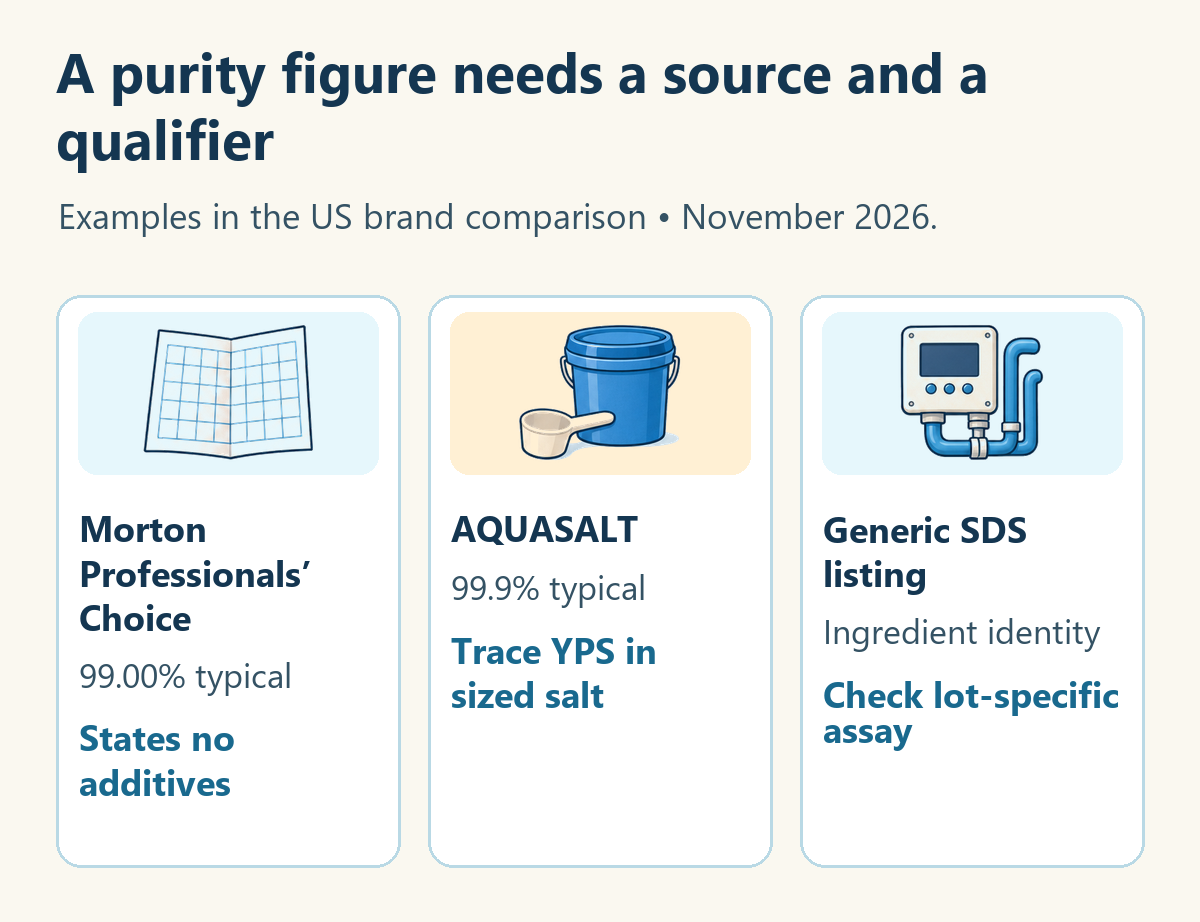
Major US pool salt brands look nearly identical on the store shelf, yet their technical files split sharply on decimal NaCl purity, screening specs, and anti-caking disclosures. Yellow prussiate of soda (YPS, or sodium ferrocyanide) is a trace anti-caking compound added to keep salt crystals from clumping into hard bricks, which salt generator makers warn can discolor pool fittings and surfaces. NSF/ANSI 50 is a third-party recreational-water health standard that sets maximum certified dosage limits without certifying purity or dissolve speed.4
What Official PDS and SDS Sheets Disclose for Five Major US Brands
The table below places five widely sold US pool salt brands on identical documentation criteria pulled from manufacturer PDS files, SDS sheets, and retail listings checked on 2026-11-25, alongside NSF/ANSI 50 listings checked on 2026-09-18.4
| Brand (US Retail Pool Salt) | Published NaCl Purity | Anti-Caking / YPS Disclosure | Particle Size / Screening | NSF Certification Scope | Observed Price (2026-11-25) |
|---|---|---|---|---|---|
| Morton Professionals' Choice (40 lb) | 99.00% typical (ASTM) | States no additives | Up to 51% retained (1.7 mm) | NSF/ANSI/CAN 60 | Local store ZIP (varies) |
| AQUASALT (40 lb) | 99.9% typical (>99%) | Trace YPS in sized salt | Screened; no mesh given | NSF 50: 3,000 mg/L4 | Parcel $49.99; local varies |
| Diamond Crystal Splash Ready | 100% generic SDS only | 0.0008% YPS (family SDS) | Not published in SDS | Not in 2026-09-18 lookup | Local store ZIP (varies) |
| Clorox Pool&Spa (40 lb) | 100% CAS 7647-14-5 only | None listed in SDS v1.0 | Not published in SDS | None shown on SDS/page | Local store ZIP (varies) |
| Aqua Joe Pool Salt | At least 99.5% (99.52%) | Not stated in SDS | 0-2 mm grain size | NSF 50: 3,400 ppm4 | Local store ZIP (varies) |
Counter pickup benchmark (checked 2026-11-25): Leslie's Pool Salt (40 lb) lists at $11.99 single or $9.99 each for six or more bags, showing typical local store pickup pricing compared to Doheny's $49.99 parcel-shipped rate for AQUASALT. Standard 40 lb retail packaging is confirmed on Morton, AQUASALT, and Clorox records, whereas Cargill's multi-SKU SDS and Aqua Joe's SDS omit bag weight.
Four document nuances matter immediately when reading this matrix:
- Morton's 99.00% figure contradicts common blog claims. Many review sites cite 99.8% purity for Morton Professionals' Choice, yet Morton PDS 2685 (v05, 2024-09-19) lists 99.00% typical NaCl on a moisture-free ASTM basis. Morton pairs that figure with an explicit no-additives statement, screening of at most 51% retained on U.S.S. 12 Mesh (1.7 mm opening), and NSF/ANSI/CAN 60 certification.
- Diamond Crystal's YPS listing comes from a multi-SKU family sheet. Cargill's SDS NS6 (issued 2014-11-17) covers Diamond Crystal Splash Ready alongside Premium, Ocean Waves, and Pro's Pick lines, listing 0.0008% Sodium Ferrocyanide Decahydrate (CAS 13601-19-9) and 0.01% Glycerin in its Section 3 impurities table. Because NS6 spans multiple SKUs, buyers requiring zero YPS must check the current bag or lot SDS.
- Clorox and Aqua Joe publish different levels of detail. Clorox Pool & Spa Pool Salt SDS v1.0 (2020-12-02, responsible party Scotwood Industries LLC) lists 100% CAS 7647-14-5 under non-hazardous GHS-US rules with no decimal NaCl assay or sieve mesh. Aqua Joe's SDS (All Season Power LLC) states at least 99.5% NaCl (99.52% reported), roughly 0.10% moisture, and 0-2 mm grain size, though it does not include an additive-free warranty.
- NSF/ANSI 50 is a health cap, not a purity badge. Official NSF/ANSI 50 listings (checked 2026-09-18) certify AQUASALT up to 3,000 mg/L (250 lbs per 10,000 gallons) and Aqua Joe up to 3,400 ppm explicitly for health effects only, not for performance or purity claims.4
PDS vs. SDS Contrast (AQUASALT): AQUASALT's Product Data Sheet highlights evaporated food-quality brine at 99.9% typical NaCl and does not mention anti-caking additives. However, United Salt Baytown LLC's SDS v5 (2017-04-10) Section 3 footnotes that trace yellow prussiate of soda is used as an anti-caking agent in the sized salt. Buyers who read only the PDS miss that disclosure.
In-Store Pickup vs. Online Parcel Pricing on 40 lb Bags (Data as of 2026-11-25)
Channel logistics drive far more price difference than brand names on 40 lb pool salt bags. On 2026-11-25, Leslie's Pool Supplies listed its house-brand Leslie's Pool Salt (40 lb bag) at $11.99 ($0.30/lb) single and offered a multi-bag tier of $9.99 per bag ($0.25/lb) when buying six or more bags. By contrast, ordering a single 40 lb bag of AQUASALT shipped via parcel delivery on Doheny's Pool Supplies cost $49.99 ($1.25/lb), with two-bag bundles at $89.98.
That freight penalty hits immediately during spring startup or routine top-ups. Per Morton PDS 2685, each 40 lb bag adds 480 ppm of salt to 10,000 gallons of pool water. A ~500 ppm seasonal top-up in a 10,000-gallon pool therefore takes roughly one 40 lb bag, costing under $12 at a retail counter benchmark versus nearly $50 delivered by parcel. Because big-box chains (Home Depot, Lowe's, and Ace Hardware) price pool salt dynamically by local store ZIP code without fixed national online shelf prices, check local counter pickup inventory before ordering heavy bags online. For side-by-side audits of other pool treatment products, browse our Brands and Alternatives hub.
Knowing what each brand actually discloses on its PDS and SDS sets up the critical next check: how those specs line up against Pentair, Jandy, and Hayward generator rules.
What Salt Chlorine Generator Manuals Require—and How YPS and Impurities Cause Stains or Scale
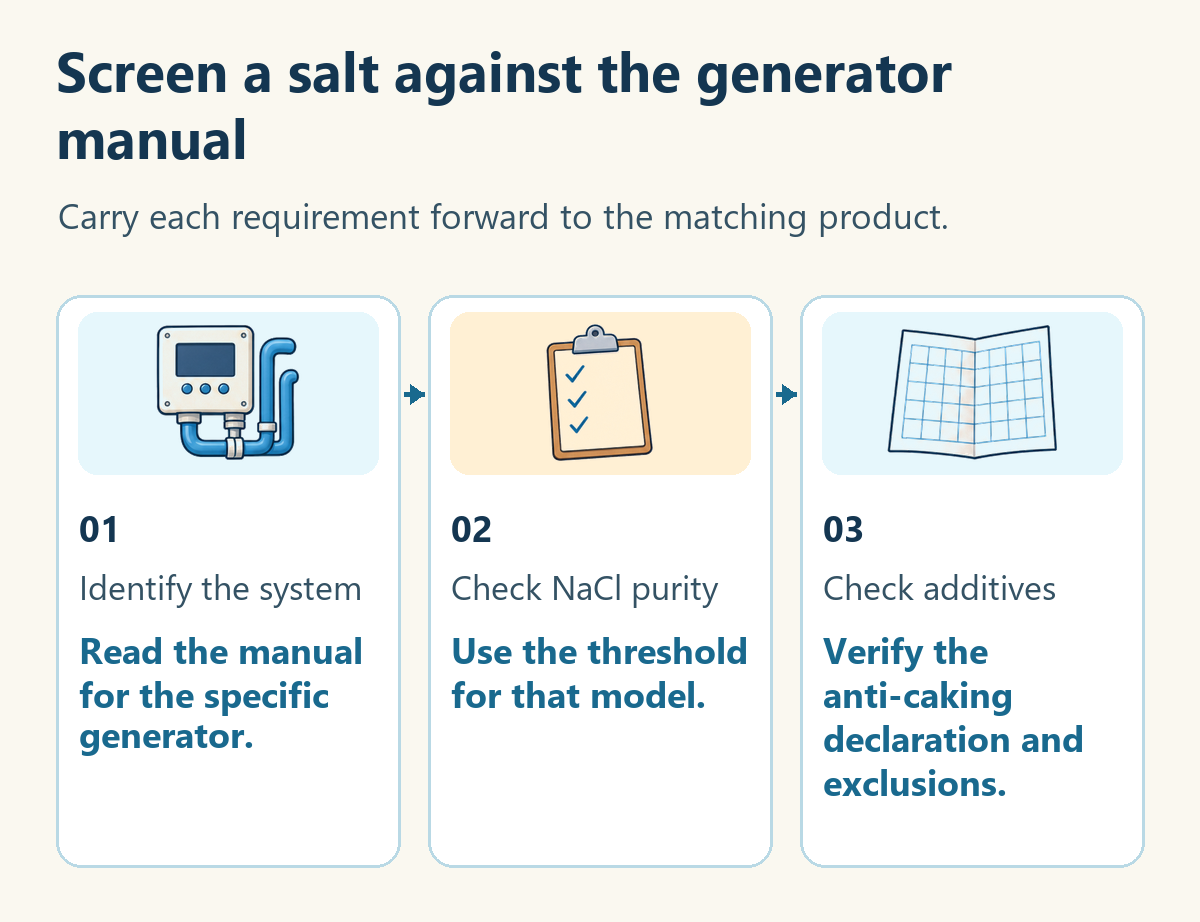
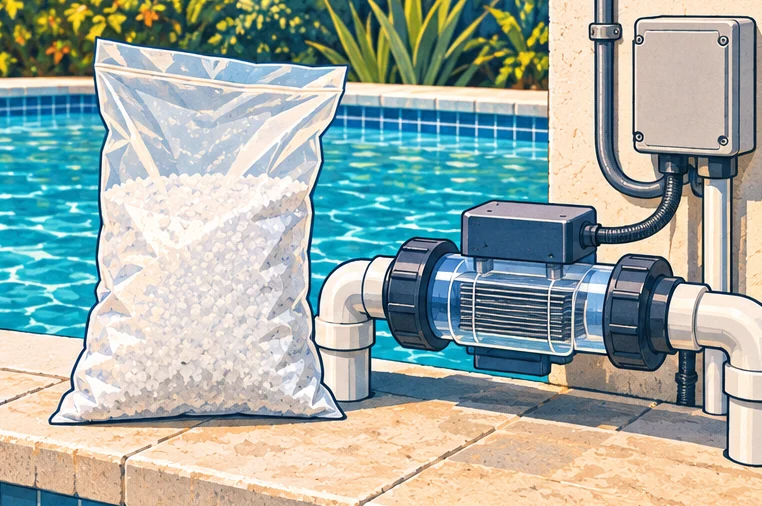
Pentair, Jandy, and Hayward manuals all warn against rock salt, iodized salt, and yellow prussiate of soda (YPS), but they split on minimum NaCl purity. A saltwater chlorine generator (SWG) is an electrolytic cell that converts dissolved sodium chloride into hypochlorous acid sanitizer inside your return plumbing. Understanding both the written OEM salt thresholds and the real chemistry of scaling and metal staining keeps you from blaming the wrong input when pool surfaces discolor.
Pentair vs. Jandy vs. Hayward Official Salt Specifications
Major US generator manuals set two distinct purity floors and operating salinity ranges:
- Pentair IntelliChlor SCG: Requires salt at least 99.8% pure NaCl (specifically evaporated, granulated, food-quality, non-iodized salt with no additives) and sets an operating band of 3,600 to 4,500 ppm (3,600 ppm ideal). The manual instructs owners to avoid anti-caking agents (sodium ferrocyanide / YPS), stating they can discolor pool fittings and surface finishes.
- Jandy AquaPure (Section 4.7.2): Also requires at least 99.8% pure NaCl (evaporated, granulated, food-quality, non-iodized) and warns to avoid YPS anti-caking agents due to fitting and finish discoloration risk.
- Hayward AquaRite (2009-04-01): Requires sodium chloride greater than 99% pure at an ideal operating range of 2,700 to 3,400 ppm (3,200 ppm optimal). Hayward explicitly bans rock salt, salt with yellow prussiate of soda, salt with anti-caking additives, and iodized salt.
OEM Threshold Split and Warranty Scope: Pentair IntelliChlor and Jandy AquaPure print an at-least 99.8% NaCl purity floor, whereas Hayward AquaRite specifies strictly greater than 99% pure NaCl. That boundary explains why an additive-free retail salt reporting 99% typical purity in the brand matrix above sits right at Hayward's 99% threshold (rather than strictly above it) and below Pentair and Jandy's 99.8% printed wording, while a higher-purity evaporated brand can carry a trace-YPS SDS footnote. The audited Pentair, Jandy, and Hayward salt-specification sections establish purity floors, additive bans, and surface or cell damage warnings rather than separate warranty-void clauses, so owners auditing strict warranty compliance should verify their generator's warranty booklet alongside its salt-spec text.
How YPS, Source-Water Metals, and Cathode pH Cause Stains or Cell Scale
Not every stain or crusty cell plate comes from bad salt. Trace ferrocyanide additives, such as the 0.0008% Sodium Ferrocyanide Decahydrate listed in Cargill's NS6 family SDS impurities table, explain why Pentair, Jandy, and Hayward warn about discoloration of fittings and finishes even when a bag reports 100% NaCl on the main SDS line.
White flaky scale inside the chlorinator cell follows a different mechanism. According to the Pool & Hot Tub Alliance (PHTA), high localized pH right at the cathode plate surface makes mineral scaling (chiefly calcium carbonate, along with calcium phosphate, calcium sulfate, and barium sulfate) highly likely inside an electrolytic chlorine generator even when bulk pool water tests balanced.5
Ruthenium cell plate coating is the thin catalytic precious-metal layer bonded to titanium blades that actually generates chlorine. PHTA warns that while acid washing and polarity reversal clear scale, both remove small amounts of that ruthenium coating and shorten effective cell life, yet leaving scale uncleaned insulates plates from cooling water and can permanently ruin the unit.5 CDC's 2024 MAHC Annex (5.7.3.1.1) adds that cell lifespan depends heavily on daily run hours, water pH, calcium hardness, low salt levels, and cold water operation.2
Brown, purple, or green stains after dosing salt point toward dissolved metals rather than sodium chloride itself. PHTA's 2024 CPO manual (page 80) describes binding copper, iron, or manganese using sequestration or chelation, filtering out suspended material, and retesting metals after 24 hours.6 High oxidizer levels or spiked alkalinity can precipitate copper stains, so avoid blindly superchlorinating clear green water before testing metals.6 When your saltwater pool genuinely needs supplemental shock treatment without upsetting water balance, review our saltwater pool shock guide.
Once you know what your chlorinator manual forbids, the next question is how salt manufacturing methods (evaporated, solar, and mined) and common substitutes like water softener pellets behave in real pools.
Evaporated vs. Solar vs. Mined Pool Salt—and Why Water Softener Salt Is Risky
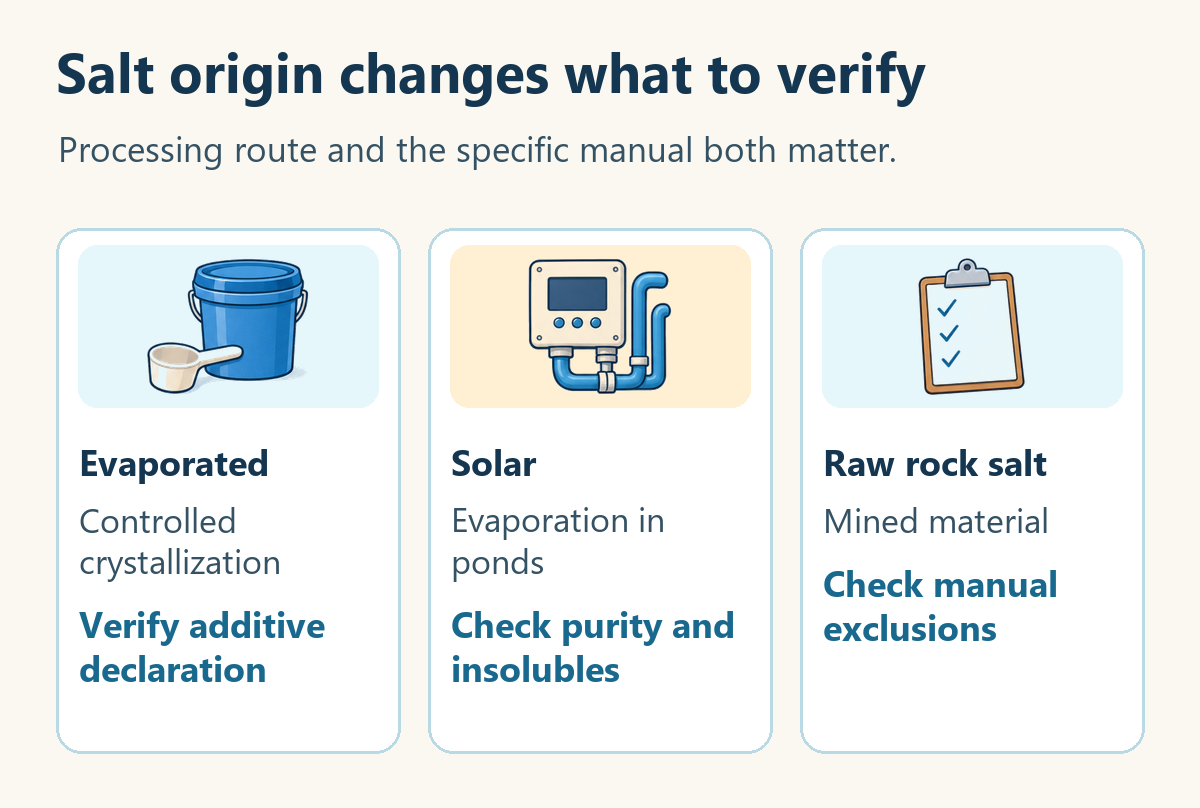
Mechanically evaporated pool salt produces the highest typical NaCl purity and uniform fast-dissolving crystals, additive-free coarse solar salt works where manuals allow >99% purity, and unrefined raw rock salt is explicitly banned by Pentair, Jandy, and Hayward. Insolubles (water-insoluble residue) are tiny mineral grit particles, such as clay, gypsum, or silica, that never dissolve in pool water, settle as floor dirt, and abrade or foul salt chlorinator cells.
Evaporated vs. Solar vs. Mined Salt: Why Screening Differs from Raw Rock Salt
Manufacturing method controls crystal uniformity, dissolve speed, and insoluble grit:
- Mechanically evaporated salt: AQUASALT's PDS describes mechanical vapor recompression (MVR) evaporation from saturated brine, producing dried, screened crystals with a bulk density of 76 to 80 lb/ft³. Because the brine is purified before recrystallization, evaporated salt dissolves quickly with minimal insoluble sediment.
- Solar salt: Produced by evaporating seawater or brine ponds under sun and wind, coarse solar salt works in systems whose manuals allow >99% NaCl without additives. Hayward's AquaRite manual specifically notes that common food-quality or water softener salt (>99% pure NaCl, free of YPS and additives) is available in 40 to 80 lb bags labeled "Coarse Solar Salt."
- Raw rock / mined salt: Despite some online review blogs claiming mined rock salt is best, both Pentair IntelliChlor and Jandy AquaPure manuals explicitly prohibit rock salt because insoluble impurities mixed with rock salt can shorten chlorinator cell life.
Screened Natural Pool Salt vs. Raw Rock Salt: Morton PDS 2685 discloses that its screened natural pool salt crystals can originate from rock, solar, or vacuum pan evaporation plants depending on region, screened across a 1.7 mm (U.S.S. 12 Mesh) opening with no additives. That refined, screened pool grade differs from unscreened raw rock or de-icing salt, which Pentair and Jandy prohibit for insoluble mineral grit.
Water Softener Pellets, Potassium Chloride, and New-Plaster Waiting Periods
Trying to save a dollar per bag with hardware-store substitutes creates predictable damage risks:
- Potassium chloride and calcium chloride: Never substitute potassium chloride water softener bags (mistakenly recommended on some online blogs) or calcium chloride. Pentair strictly prohibits both calcium chloride and potassium chloride, directing owners to use sodium chloride only.
- Water softener salt pellets: Compressed evaporated salt pellets dissolve far slower than fine pool crystals. Pentair's manual warns that slow-dissolving water conditioning pellets could damage pool plaster and other pool surfaces. AyerGuides (2026) further notes that water softener salt frequently contains YPS anti-caking agents, while iodized table salt stains plaster and vinyl liners and road salt damages cells.
- New-plaster curing waits and seasonal loss: Do not pour salt onto freshly poured or uncured plaster. Hayward's AquaRite manual requires waiting 10 to 14 days on new plaster pools before adding salt, while Pentair's IntelliChlor guide requires waiting at least one month on newly poured or resurfaced plaster. Walk the deep end while pouring and brush any settled granules until dissolved so salt never piles on plaster. Once established, seasonal salt loss from rain and backwash runs 200 to 500 ppm per AyerGuides (2026); evaporation concentrates salt rather than lowering it.
With manufacturing processes and substitute red lines clear, the right purchase comes down to your exact operating role: commercial venue, route truck, retail shelf, or residential backyard.
Which Pool Salt Fits Your Situation: Route Service, Retail Shelf, Commercial Pool, or Homeowner
Skip subjective "best overall" badges and match pool salt to your operating constraints: health-code certification for commercial venues, zero-additive fast-dissolve paperwork for service trucks, pallet efficiency for retail warehouses, and steady ppm maintenance for homeowners.
Commercial & Public Pools (2024 MAHC & NSF/ANSI 50 vs. 60)
- Verify local MAHC adoption and NSF listing: Under 2024 Model Aquatic Health Code (MAHC) Section 5.7.3.1.5.1, public and commercial aquatic facilities using salt electrolytic chlorine generators must use pool-grade salt certified, listed, and labeled to NSF/ANSI 50 or NSF/ANSI 60 (and/or EPA FIFRA registered where applicable).1 Remember that 2024 MAHC is a CDC model code rather than a uniform federal law, so confirm whether your state, county, or tribal health authority has adopted it, and note it does not impose NSF certification mandates on private residential pools.3
- Check product-specific dose caps and certification scope: When relying on NSF/ANSI 50, verify the exact brand name, plant, and maximum use level on the live NSF database. For example, AQUASALT is listed up to 3,000 mg/L and Aqua Joe up to 3,400 ppm, strictly for health effects only and not performance claims.4 Notice that AQUASALT's 3,000 mg/L NSF 50 cap sits below the higher operating salinity bands specified by some chlorinators (such as Pentair's operating range in the generator-rules section), so verify both the NSF listing cap and your unit's required target band before ordering. Where inspectors accept NSF/ANSI/CAN 60 alongside an explicit additive-free spec sheet, Morton Professionals' Choice PDS 2685 documents both no additives and NSF/ANSI/CAN 60 certification.
Route Technicians, Retail Shelves, and Residential Maintenance
- Route service companies: Technicians running Pentair, Jandy, and Hayward pools on tight stops prioritize fast-dissolving fine-screened crystals and clean zero-YPS documentation. If your fleet strictly enforces OEM no-YPS clauses, note that AQUASALT's SDS v5 footnotes trace YPS in sized salt, meaning you must confirm additive-free lots or choose a brand whose PDS states no additives.
- Retail stores and regional distributors: Warehouse profitability on 40 lb salt depends on pallet density, bag durability, and dry indoor storage. For example, AQUASALT ships 63 forty-pound recyclable PE film bags with built-in soft handles per pallet (9 tiers of 7, 2,600 lb gross weight on a 40" × 48" × 34" footprint). Store additive-free salt indoors off bare concrete, cover yard stacks with opaque UV-resistant plastic so film bags do not degrade in sunlight, and rotate older pallets first to prevent moisture caking.
- Residential saltwater pool owners: PHTA notes that in-line salt chlorine generator pools operate around 3,000 to 5,000 ppm (far below seawater's 31,000 to 38,000 ppm), and because generated chlorine reverts to chloride, salt only requires replacement after backwashing, splash-out, or partial draining.7 Buy locally at pickup pricing, stay inside your specific generator's target ppm band, and avoid parcel shipping fees.
Whichever category fits your operation, you still need a repeatable way to verify what is actually inside the bag, or inside a bulk export shipment, before paying for it.
How to Verify Pool Salt Quality from Bag Labels, SDS, and Export COAs
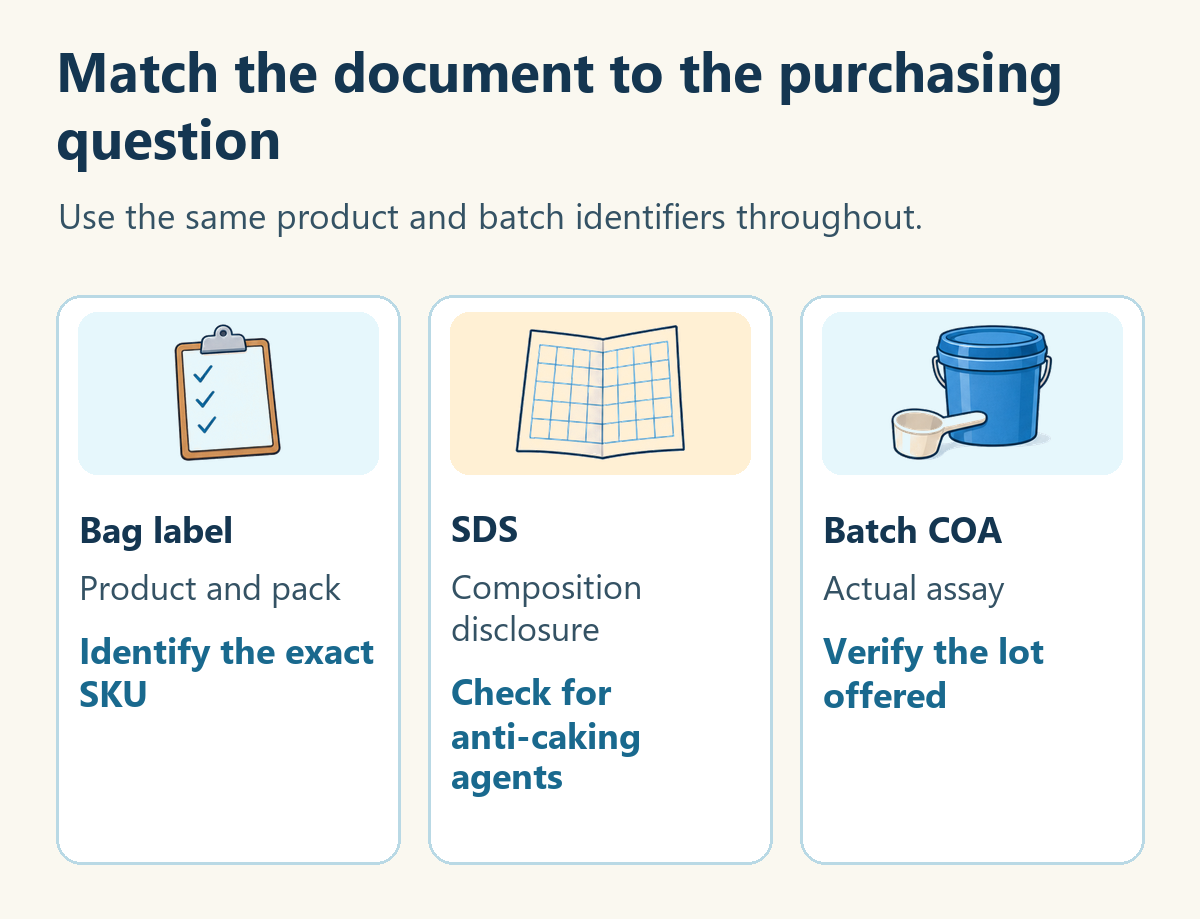
Never judge pool salt by the front bag label or a generic "100% Sodium Chloride" SDS header alone. A Certificate of Analysis (COA) is a batch-specific laboratory report issued by the manufacturer that verifies exact chemical assay, grain screening, and additive limits for the lot you actually receive. Use the four-step checklist below for retail bags, and apply stricter standard-vs-lot verification whenever sourcing bulk export pallets.
Four-Step Retail Bag, PDS, SDS, and Post-Dosing Verification Checklist
- Check the front bag and Product Data Sheet (PDS): Confirm the bag says "Pool Salt" (non-iodized NaCl) and request the PDS to verify moisture-free NaCl %, sieve screening, additive statement, NSF/ANSI 50 or 60 listing, and dosing baseline. For example, Morton PDS 2685 explicitly lists 480 ppm per 40 lb bag in 10,000 gallons alongside its mesh and NSF/ANSI/CAN 60 details.
- Understand why an OSHA SDS alone is incomplete: Under OSHA 29 CFR 1910.1200 (as stated on Clorox Pool & Spa Pool Salt SDS v1.0), sodium chloride is not classified as hazardous, so manufacturers are not legally required to print decimal purity percentages or grain size on an SDS. Pair the SDS with a PDS or COA.
- Read SDS Section 3 footnotes and impurities tables: Scan below the "100% Sodium Chloride" main row for footnotes and trace impurity tables. AQUASALT's SDS v5 discloses trace yellow prussiate of soda in its Section 3 footnote for sized salt, showing why skimming only the headline table misses critical additives.
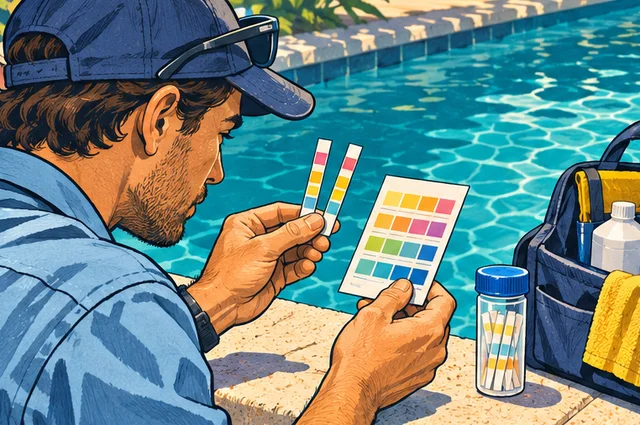
- Verify dissolution, salinity, and post-salt TDS in the water: Brush newly added salt across the floor so crystals never pile on plaster, and follow Hayward's AquaRite instruction to run the filter pump for 24 hours before trusting stabilized salinity readings. When tracking Total Dissolved Solids (TDS) with test kits or strips (see our pool test strip comparison), follow PHTA's ANSI/APSP/ICC-11 2019 criterion: partial drain and refill in a saltwater pool is triggered when TDS climbs 1,500 ppm above the post-salt baseline, not 1,500 ppm above tap water.8
Reading Bulk and Export Pool Salt COAs: What to Confirm Before Ordering
Importers, regional distributors, and private-label buyers ordering bulk woven-bag salt must inspect the standard specification column separately from single-lot test numbers, and verify whether export-grade anti-caking limits clash with destination SWG manual rules.
Bulk Export COA Boundary Example (Kingnod, Our Company): To illustrate how export pool salt specifications read on paper, our company (Kingnod) supplies iodine-free Refined Pool Salt (refined granular sea salt). Its historical COA C20130727 standard column (QB/T2606-2003, analyzed 2013-07-27) sets a minimum NaCl specification of 98.50%, a grain-size distribution of at least 90% within 0.15 to 0.85 mm, and an anti-caking agent (
[Fe(CN)6]4−) maximum limit of 5.0 mg/kg, packed in 25 kg PP woven bags with a 1-pallet minimum order quantity confirmed on 2026-11-08.
Four procurement boundaries stand out immediately in that example:
- Standard column vs. current lot COA: Historical standard specs (such as C20130727 from 2013-07-27) define minimum reference tolerances rather than a current batch laboratory report or NSF listing. Request a fresh lot-matched COA tied to the lot code printed on your shipment.
- Anti-caking limit vs. zero-YPS markets: A standard export specification allowing up to 5.0 mg/kg of ferrocyanide (
[Fe(CN)6]4−) is not anti-caking-agent-free. Importers serving strict zero-YPS retail or OEM-compliant pool markets must explicitly contract additive-free production and verify zero-ferrocyanide test results on the pre-shipment COA. - Interval grain sizing: A specification of at least 90% within 0.15 to 0.85 mm leaves a permitted tail outside that band, so confirm screen tolerances and water-insolubles limits in your purchase order.
- Product scope isolation: Granular refined pool salt COAs and 25 kg PP woven-bag specs apply solely to granular refined sea salt, never to compressed water softener salt tablets. For current lot COAs, additive-free custom specs, or pallet inquiries, reach out via Contact PoolTradeDesk and Kingnod.
With a four-step verification checklist for retail bags and an exact COA boundary review for bulk lots, you can audit any salt supplier on paper before a single bag hits the water.
Frequently Asked Questions About Pool Salt
How long should you run the pump after adding pool salt before testing salinity?
Brush settled salt across the deep end so crystals never pile on the pool floor, and run the filter pump for 24 hours per Hayward's AquaRite manual before relying on stabilized salinity readings or restarting full chlorine generation.
How long should you wait before adding salt to a newly plastered pool?
Do not add salt to fresh plaster right away. Hayward's AquaRite manual directs waiting 10 to 14 days for new plaster to cure, while Pentair's IntelliChlor guide specifies waiting at least one month on newly poured or resurfaced plaster before adding salt.
What should you do if you accidentally add too much pool salt?
Partially drain and refill the pool with fresh water until salinity returns inside your chlorinator manual's operating range (for example, 2,700 to 3,400 ppm on Hayward AquaRite).7 Do not wait for hot weather to lower salt: evaporation removes pure water and concentrates remaining salt rather than reducing it.
Bottom Line: Matching Pool Salt Specs to Your System
Every major US retail pool salt brand involves a documented specification trade-off between explicit additive-free drinking-water certifications on one side and higher typical evaporated purity paired with trace-YPS SDS footnotes and health-effects-only NSF pool-chemical caps on the other. Lock down your non-negotiable constraints first: your salt chlorine generator manual's purity and YPS clauses, local commercial MAHC certification rules where applicable, and local pickup versus parcel-freight costs.
Use the four-step bag, PDS, SDS footnote, and NSF or COA audit checklist before buying your next pallet or seasonal refill, and verify local store counter pricing before paying heavy parcel shipping on retail salt bags.
References
- CDC 2024 Model Aquatic Health Code (MAHC) Section 5.7.3 — Treatment Chemicals & Pool Salt — 2024
- CDC MAHC Annex — Saline Chlorination Electrolysis and Cell Lifespan Factors — 2024
- CDC 2024 MAHC — Halogen Generators and Pool-Grade Salt Requirement — 2024
- NSF/ANSI 50 Listings — Certification Scope for AQUASALT and Aqua Joe Pool Salt — 2026-09-18
- PHTA Technical Guidance — Salt Cell Scaling Mechanism and Ruthenium Coating Wear
- PHTA CPO Handbook (2024) — Metal Staining Sequestration and Retesting — 2024
- PHTA Technical Guidance — Electrolytic Chlorine Generator Salt Concentration (3000–5000 ppm)
- PHTA Technical Guidance — Saltwater Pool TDS Replacement Baseline (ANSI/APSP/ICC-11 2019) — 2019
How this guide was prepared
Prepared by Martin. Based on 8 cited sources listed in References. Content date: 2026-11-25.