Pick HTH calcium hypochlorite shock when your outdoor pool already holds stabilizer from chlorine tablets and you want zero added stabilizer 2. Pick a copper-free Clorox sodium dichlor shock when your calcium hardness runs high and your stabilizer still has room to climb 1. Retail counter staff and pool techs can jump straight to the verified 2026-11 label table and worked cost math below.
- HTH flagship strength: HTH Shock Advanced lists 56.44% calcium hypochlorite and 54% minimum available chlorine with 0% cyanuric acid (CYA) 2.
- Clorox flagship blend: Clorox Shock XtraBlue lists 63.05% sodium dichlor, 39% available chlorine, and 0.26% metallic copper 3.
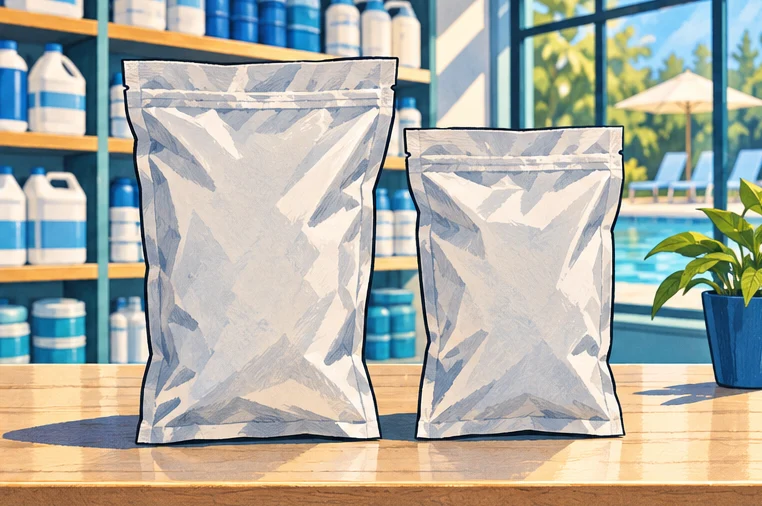
- Bag-size catch: Entry-tier HTH Pool Care Shock comes in 13.3 oz bags rather than full 1 lb pouches, per HTH's official product page.
- Shared safety line: Never mix cal-hypo with dichlor or trichlor, and test free chlorine back down to safe limits before swimming.
HTH vs. Clorox Pool Shock: Active Ingredients, Chlorine Strength, and Bag Labels Compared
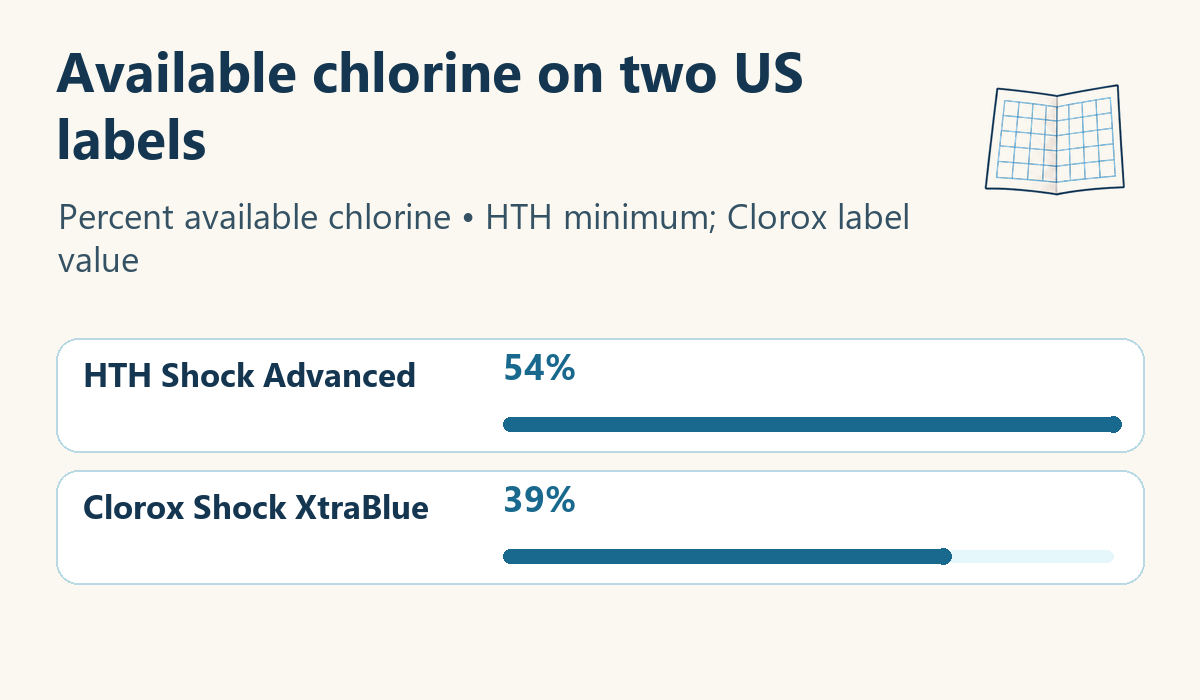
Front-of-bag branding hides the real choice between HTH and Clorox pool shock. The back-panel active ingredient decides both chlorine yield and long-term water balance.
Side-by-Side US Retail Label Table (Data as of 2026-11)
Two chlorine families split these flagship shelves. Calcium hypochlorite (cal-hypo) is an unstabilized granular chlorine that delivers high chlorine strength without adding stabilizer. Sodium dichlor (printed as sodium dichloro-s-triazinetrione) is a fast-dissolving stabilized chlorine that adds stabilizer with every dose. Available chlorine is the chlorine-equivalent oxidizing strength by weight (expressed as Cl₂), which matters more than total active percentage alone.
| Label Field (Data as of 2026-11) | HTH Shock Advanced (EPA 1258-1343) | HTH Pool Care Shock (Basic) | Clorox Shock XtraBlue (EPA 67262-35) | Clorox Vinyl Pool Shock (EPA 67262-27-90106) |
|---|---|---|---|---|
| Active Ingredient | 56.44% cal-hypo 2 | 52% cal-hypo (HTH page) | 63.05% sodium dichlor 3 | 58.2% sodium dichlor 1 |
| Available Chlorine | 54% min (56% claim) 2 | No reliable public data | 39% available chlorine 3 | No reliable public data |
| Bag Weight & Dose | 1 lb / 13,500 gal (p. 9 chart: 12 oz / 10k) 2 | 13.3 oz / 12,500 gal | 1 lb / 12,000 gal (or 13.4 oz pouch / 10k) 3 | 1 lb / 12,000 gal 1 |
| Metallic Copper | None listed | None listed | 0.26% metallic copper 3 | Copper-free 1 |
| Byproduct Tradeoff | Adds calcium, 0% CYA | Adds calcium, 0% CYA | Adds CYA and copper | Adds CYA, no calcium |
Neither brand uses one uniform formula across its lineup. HTH's official US product page lists HTH Pool Care Shock Ultra at 56% calcium hypochlorite with a weekly dose of 1 lb per 16,750 gallons. For a full breakdown of HTH's internal shock tiers, see HTH Shock Ultra vs Advanced vs Super, or read Who Makes HTH Pool Chemicals for brand ownership and catalog context.
Two products in the table omit a standalone available chlorine line. HTH's official product page for basic Pool Care Shock prints 52% calcium hypochlorite without a separate minimum available chlorine figure. Clorox Pool&Spa Vinyl Pool Shock's 2024 Washington registered label prints 58.2% sodium dichlor without a separate available chlorine percentage, and notes it is neither a sanitizer nor an algaecide 1. For comparison, Recreational Water Products' copper-free 6-in-1 dichlor dihydrate master label (EPA Reg. No. 67262-46) lists 72% active ingredient and 40% available chlorine at 1 lb per 12,000 gallons 4.
Two Label Traps Most Shoppers Miss: Bag Weight and Copper Additives
First, bag sizes are not standardized across retail shock aisles. HTH's official product page shows standard HTH Pool Care Shock ships in 13.3 oz pouches treating 12,500 gallons per bag, while HTH Shock Advanced uses 1 lb pouches treating 13,500 gallons 2. Comparing box prices without checking net weight skews your cost math immediately.
Second, not every Clorox shock bag contains copper. Clorox Shock XtraBlue adds 0.26% metallic copper derived from copper citrate 3. By contrast, Clorox Pool&Spa Vinyl Pool Shock (EPA Reg. No. 67262-27-90106) contains no metallic copper 1. We cover how copper interacts with plaster and hair in the byproducts section below.
Flip every shock bag over and check net weight before comparing shelf prices. When comparing entry-tier HTH multi-packs against standard pound-weight shock bags, verify whether the pouch is a lighter value pouch or a full pound, then divide by the gallons treated per bag. That quick check prevents mistaking a lighter bag for a cheaper per-dose deal.
Label Contrast (Data as of 2026-11): Standard HTH Pool Care Shock is a 13.3 oz cal-hypo pouch (52% active, per HTH's product page). Clorox Shock XtraBlue adds 0.26% metallic copper (EPA 67262-35), while Clorox Vinyl Pool Shock (EPA 67262-27-90106) is copper-free 31.
How to Calculate Your Real Cost per 10,000-Gallon Dose
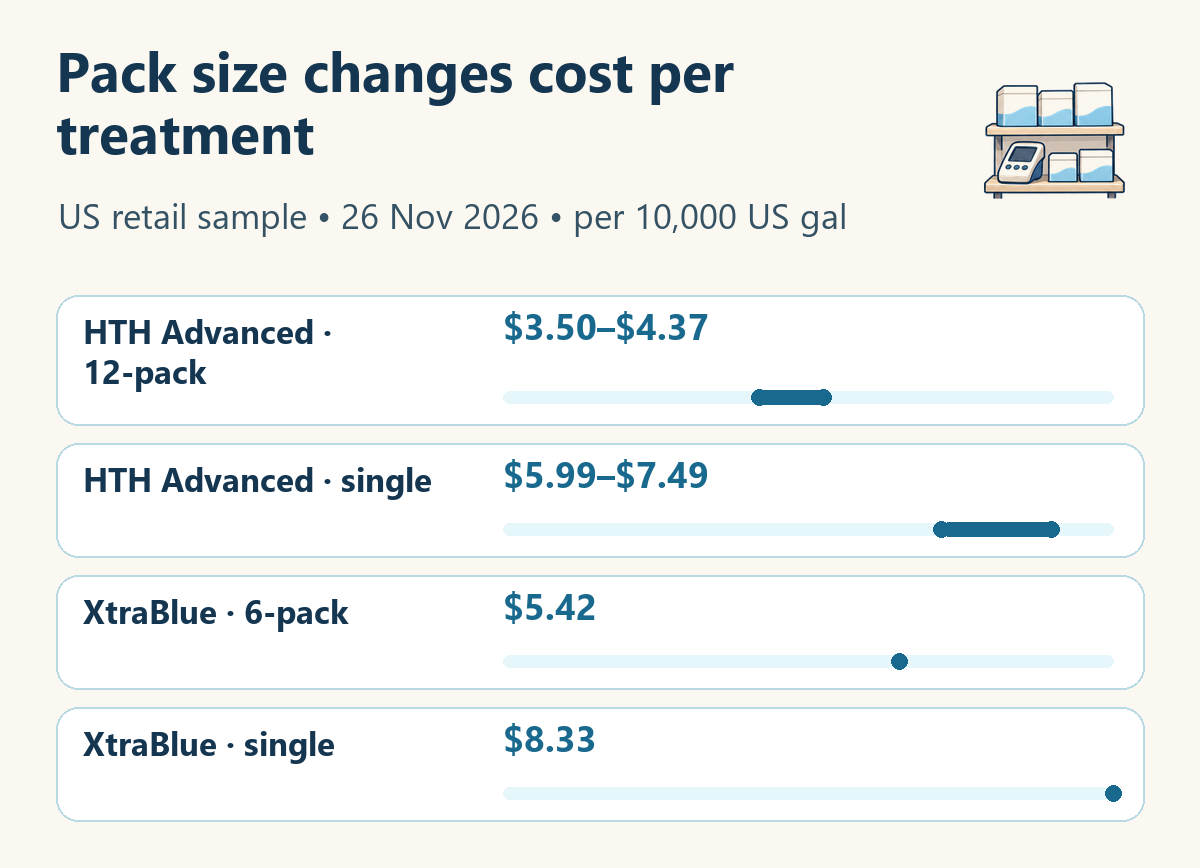
Shelf sticker price does not tell you which shock costs less to run. Across a selected sample of live US retail listings checked November 26, 2026—conditional on verifying the EPA Reg. No. on the physical bag—an HTH Shock Advanced 12-pack runs $3.50 to $4.37 per 10,000-gallon dose, compared with $5.42 for an exact-title Clorox Shock XtraBlue 6-pack.
Two-Step Formula: Cost per 10,000-Gallon Dose and Cost per Pound of Available Chlorine
Cost per 10,000-gallon dose converts any box size, bag weight, and label coverage into one fair number. Pair it with cost per pound of available chlorine to compare actual oxidizing strength rather than total bag weight.
- Cost per 10,000-gallon dose (direct label dosage chart):
Price per lb × (Chart oz per 10,000 gal ÷ 16)when the EPA label prints a direct 10,000-gallon chart. Table 2 uses EPA 1258-1343's direct p. 9 chart of 12 oz (0.75 lb) per 10,000 gallons for HTH Shock Advanced; scaling its separate p. 8 bag coverage (1 lb per 13,500 gallons) gives 11.85 oz (0.7407 lb) per 10,000 gallons 2. - Cost per 10,000-gallon dose (proportional bag coverage):
(Pack Price ÷ Bags in Pack) × (10,000 ÷ Gallons Treated per Bag)when scaling from a 1 lb bag coverage figure. Table 2 uses Clorox Shock XtraBlue's EPA 67262-35 1 lb per 12,000-gallon coverage (13.33 oz or 0.8333 lb per 10,000 gallons); the label's 13.4 oz (0.8375 lb) listing is a separate premeasured pouch option 3. - Cost per pound of available chlorine:
Price per lb ÷ Available Chlorine %(written as a decimal, such as 0.54 for 54%).
Higher available chlorine requires fewer ounces per part per million delivered. As a dosing cross-check, the Lake County Health Department manual (Table 4) lists 1.3 oz of 67% calcium hypochlorite versus 2.1 oz of 56% dichlor to raise free chlorine by 1 ppm in 10,000 gallons 19. Follow your specific bag's EPA label for actual dosing.
Worked US Retail Comparison (Data as of 2026-11) and Hidden Water-Balance Costs
The worked table below pairs EPA master-label dosing (EPA 1258-1343 p. 9 direct 12 oz chart for HTH; EPA 67262-35 1 lb per 12,000-gallon coverage for Clorox) with live US retail listings checked November 26, 2026. Because Google Shopping tiles omit EPA Registration Numbers, every pairing assumes you confirm EPA 1258-1343 or EPA 67262-35 on the physical bag. For HTH 12-packs, we use a selected hardware-retail sample ($56.00–$69.99; lower listings of $45.84 at Walmart, $47.99 at Meijer, and $50.35 at Koopman Lumber also appeared in the same snapshot). For Clorox, we include only exact-title Shock XtraBlue listings and exclude distinct variants such as XtraBlue2 (tied to copper-free EPA 67262-46-90106 on a listing in the same snapshot) and XtraBlue+.
| SKU & Pack (US Retail Sample, 2026-11-26) | Retail Pack Price | Price per 1 lb Bag | Routine Dose per 10,000 gal | Cost per 10,000-gal Dose | Cost per lb Available Cl |
|---|---|---|---|---|---|
| HTH Shock Advanced 12-pack (12 × 1 lb, sample) | $56.00–$69.99 | $4.67–$5.83 | 12 oz (0.75 lb, p. 9 chart) 2 | $3.50–$4.37 | $8.64–$10.80 (54% min) 2 |
| HTH Shock Advanced single (1 lb) | $7.99–$9.99 | $7.99–$9.99 | 12 oz (0.75 lb, p. 9 chart) 2 | $5.99–$7.49 | $14.80–$18.50 (54% min) 2 |
| Clorox Shock XtraBlue 6-pack (6 × 1 lb) | $38.99 | $6.50 | 1 lb / 12,000 gal (0.8333 lb) 3 | $5.42 | $16.66 (39% Cl) 3 |
| Clorox Shock XtraBlue single (1 lb) | $9.99 | $9.99 | 1 lb / 12,000 gal (0.8333 lb) 3 | $8.33 | $25.62 (39% Cl) 3 |
Plug in two sample multi-pack listings from our November 26, 2026 snapshot to see the spread. At $65.99 for a 12-pack of HTH Shock Advanced ($5.50 per 1 lb bag), EPA 1258-1343's direct 12 oz (0.75 lb) chart dose costs $4.12 per 10,000 gallons and $10.18 per pound of available chlorine 2. At $38.99 for a 6-pack of exact-title Clorox Shock XtraBlue at Fry's Food Stores ($6.50 per 1 lb bag), treating 10,000 gallons at 1 lb per 12,000 gallons costs $5.42 per dose and $16.66 per pound of available chlorine 3.
Retail channel and pack size still move sticker prices sharply. On November 26, 2026, Walmart listed Clorox Pool & Spa 32712clx Shock Clear Chemical at $42.98 ($3.58 per count). That retail snippet and the official Shock Clear page omit net bag weight, active ingredient percentage, and EPA Reg. No., so we exclude it from the worked table above. Read the physical bag before plugging any store multi-pack into the formula.
Factor in hidden water-balance costs before calling any bag cheaper. Cal-hypo raises pH and can add pH-reducer spend over a season, while stabilized dichlor pushes CYA upward and can force partial water replacement later. Explore broader brand and pricing comparisons in our Brands and Alternatives hub.
Always price shock in multi-packs rather than single emergency pouches. When stocking up for weekly summer shocking at a hardware store or big-box retailer, divide the multi-pack price by bag count, check the bag weight and gallons treated per bag on the back panel, and compare against single-bag pricing. That habit avoids paying steep single-pouch retail markups over a full swim season.
Pricing Note (Data as of 2026-11): Retail prices sampled November 26, 2026 vary by store, region, pack count, and season. Treat the table above as a worked example and re-run the two-step formula with your local shelf tag and the EPA Reg. No. printed on your bag.
Calcium, CYA, and Copper: How Each Shock Changes Your Water
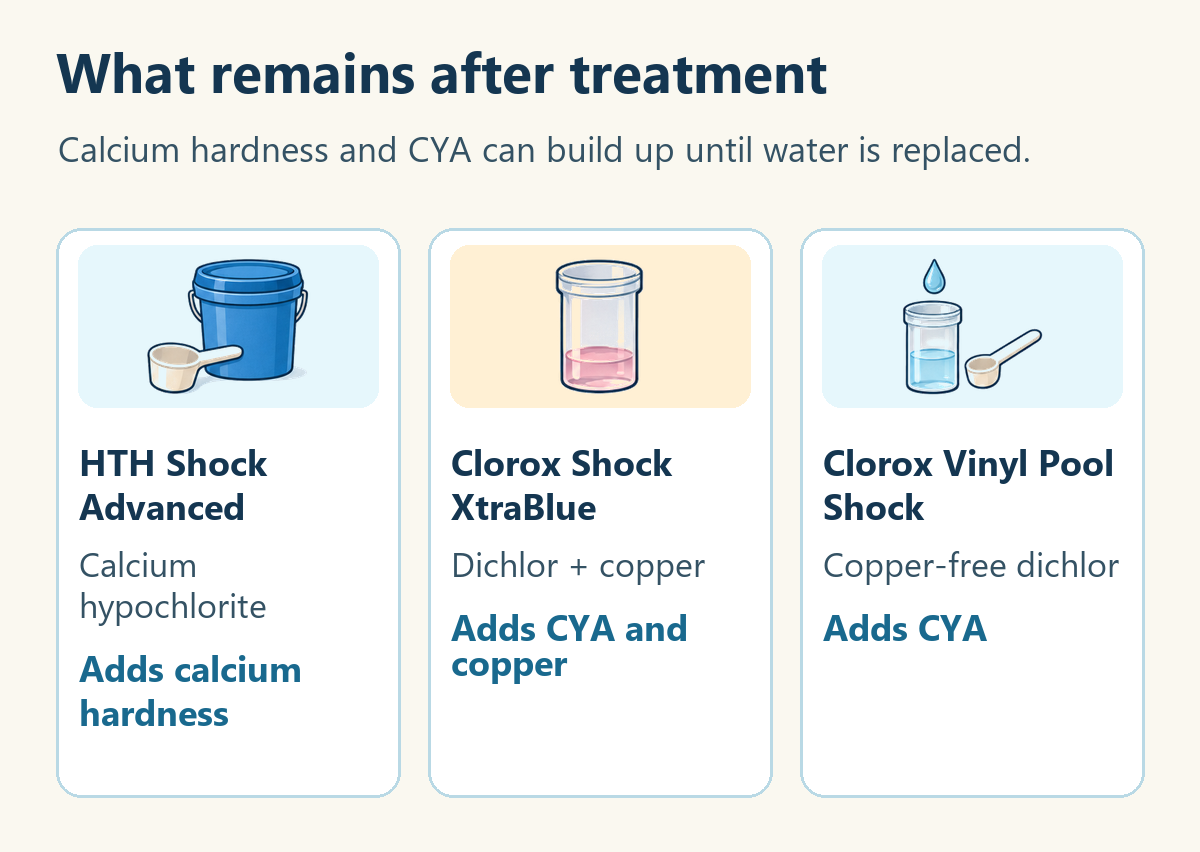
Side-by-side comparison of HTH cal-hypo versus Clorox dichlor byproducts, showing why calcium hardness and cyanuric acid accumulate until water is replaced.
After chlorine clears contaminants, the leftover carrier stays in your pool. Calcium hardness (CH) is the dissolved calcium level in water, and cyanuric acid (CYA) is the UV stabilizer that shields chlorine from sunlight. Neither evaporates; both drop only when you drain and replace water.
Cal-Hypo vs. Dichlor Byproducts: Calcium Hardness and pH vs. CYA Buildup
As a chemical class, unstabilized calcium hypochlorite provides 47–78% available chlorine with a 1% solution pH of 8.5–11, which raises pool pH 5. Pure sodium dichlor runs 56–63% available chlorine with a 1% solution pH of 6.5–6.8, keeping pool pH near neutral. Retail multi-function blends drop lower in available chlorine when clarifiers or fillers are added.
Pool & Spa News explains that cal-hypo raises pool pH, total alkalinity, and calcium hardness, whereas stabilized chlorine builds up cyanuric acid. Because neither byproduct leaves through evaporation, your choice of shock compounds across an entire swim season.
Source water also tilts the chemistry. UK Pool Water Treatment Advisory Group (PWTAG) guidance notes that alkaline hypochlorite disinfectants pair better with soft fill water. Hard fill water requires closer watch over alkaline calcium donors, while dichlor and trichlor continuously raise CYA 15.
How High CYA Masks DPD Test Readings and When Copper Additives Stain
Every bag of dichlor adds CYA alongside chlorine. Peer-reviewed pool chemistry research shows that CYA binds hypochlorous acid into chlorinated cyanurates, introducing measurement bias into standard free chlorine (FC) (active sanitizing chlorine) tests 13.
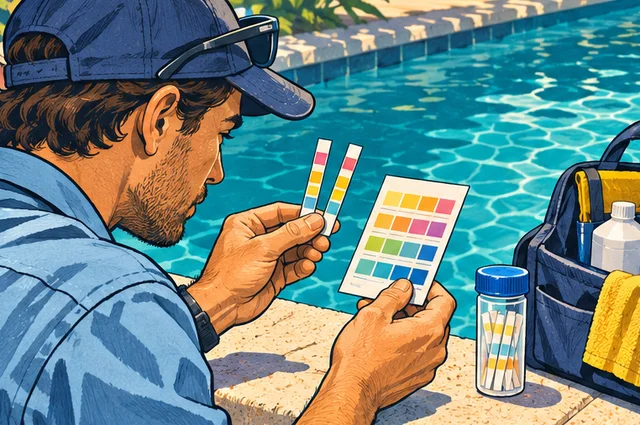
The 2024 CDC Model Aquatic Health Code (MAHC) glossary makes that gap explicit. Standard DPD Free Chlorine (DPD-FC) measures both true free available chlorine and cyanurate-bound chlorine together (DPD-FC = FAC + CBC), so the two are interchangeable only when CYA is absent 17. In a high-CYA pool, your test strip or DPD kit can read normal even while sanitation slows down.
Multi-function additives introduce a second long-term variable. Clorox Shock XtraBlue contains 0.26% metallic copper 3. The PHTA Certified Pool Operator (CPO) manual cautions that metallic copper algaecide blends can stain pool walls when pH, alkalinity, or cyanurate levels shift and can discolor hair, whereas copper-free shocks avoid metal accumulation 18.
Testing and Staining Watchout: Because DPD-FC includes cyanurate-bound chlorine whenever CYA is present 17, track CYA alongside free chlorine. Per PHTA CPO guidance, check for copper additives before dosing light plaster or pools used by light-haired swimmers 18.
Which Shock Should You Pick? Four Pool Conditions Compared
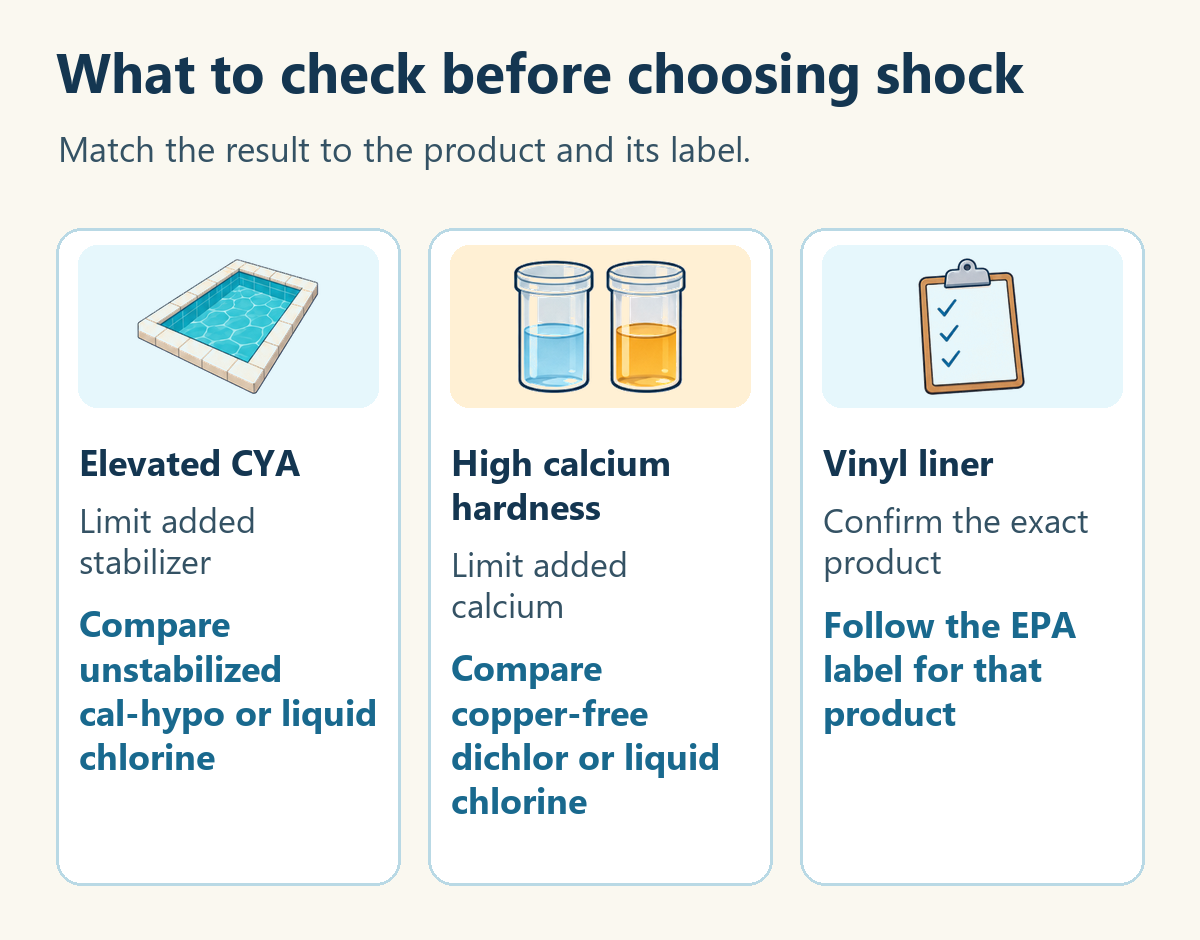
Decision flowchart matching pool water test readings and vinyl-liner EPA dosing rules to unstabilized cal-hypo, copper-free dichlor, or liquid chlorine.
Run a basic water test before picking up a bag. Four concrete pool conditions decide whether HTH cal-hypo or Clorox dichlor fits safely.
High CYA Outdoor Pools (Trichlor-Tab Pools and Algae Cleanup)
Choose unstabilized HTH cal-hypo shock when your outdoor pool uses trichlor tablets or shows active algae. As a benchmark from regulated public swimming facilities, Illinois rules (77 Ill. Adm. Code 820, summarized in the Lake County Health Department manual) require weekly CYA checks with stabilized chlorine and mandate draining at least half the pool whenever CYA exceeds 100 ppm until it falls to 50 ppm or less, encouraging dilution well before 100 ppm 14. UK PWTAG Technical Note 23 (non-routine public-pool superchlorination guidance, not a US statute) likewise specifies unstabilized sodium or calcium hypochlorite rather than cyanurates for 10 mg/L for 24 hours algae superchlorination 16.
High Calcium Hardness Pools (Above 400 ppm CH)
Pause on cal-hypo when calcium hardness climbs past target limits. The CDC MAHC Annex recommends keeping calcium hardness at 200–400 ppm (100–200 ppm above 90°F / 32°C) and the Langelier Saturation Index (LSI) (a scale-versus-corrosion balance score) within -0.3 to +0.3, noting that excess calcium causes cloudiness and scale 12. If calcium exceeds 400 ppm and CYA is still low, a copper-free dichlor bag avoids adding calcium. If both calcium and CYA run high, switch to pool-grade liquid chlorine.
Saltwater Pools (SWG): Balancing Scale, CYA, and Copper
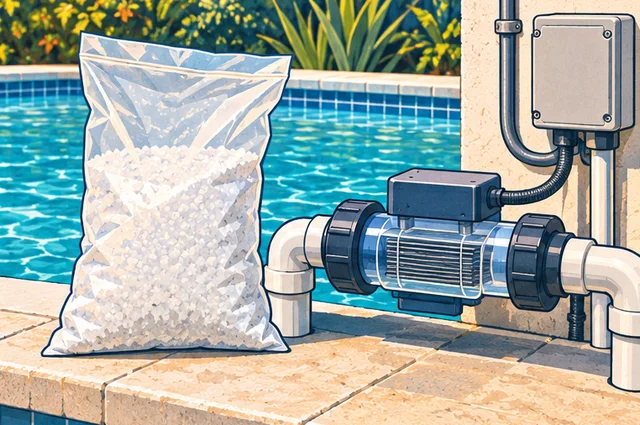
A saltwater pool (SWG) uses a salt-chlorine generator cell to produce chlorine from dissolved salt. Both HTH Shock Advanced (EPA 1258-1343) and Clorox Shock XtraBlue (EPA 67262-35) carry EPA-approved compatibility claims for saltwater pools 23. Decide by water balance rather than the front badge: watch calcium scale on salt cells if hardness runs high, watch CYA if stabilizer is elevated, and skip copper blends if you want zero metal buildup. For a full cross-brand saltwater comparison, see Best Pool Shock for Salt Water Pools.
Vinyl Liner Pools: Why Neither Flagship Label Allows Routine Bucket Pre-Mixing
Many online threads tell vinyl liner owners to pre-dissolve cal-hypo in a bucket before pouring. Check the federal label first. HTH Shock Advanced's EPA PPLS master label (1258-1343, p. 4) explicitly warns not to pre-mix or add water to this product, because small amounts of water can trigger violent heat, toxic gases, and spatter 2. On vinyl-lined or painted pools (p. 6), EPA 1258-1343 directs deep-end broadcast with immediate brushing of any settled granules (which can bleach liners), or optional slow dosing into a completely empty, residue-free skimmer when no automatic chemical dispensing device (feeder) is installed on the system—only after verifying the filter pump is running and properly recirculating through the skimmer so material does not accumulate and generate toxic gases.
Only HTH Shock Ultra's official product page mentions bucket pre-dissolving, and strictly for severe 2–3 lb algae treatments per 16,750 gallons rather than routine weekly shocking. Clorox dichlor EPA labels (67262-35 p. 14, WA 67262-27-90106, and RWP 67262-46 p. 17) share the same bucket prohibition (do not pre-dissolve or add water) and also forbid skimmer or chemical-feeder addition, directing application directly into the pool per the bag's label (for example, around pool edges under EPA 67262-35 Option A) 134.
Follow the exact dosing method on your specific bag rather than generic forum advice about bucket pre-mixing. When applying granular shock to a vinyl-lined or painted pool, never add water to dry shock. Broadcast directly into the pool per your bag's directions with the pump running and brush settled calcium hypochlorite granules immediately, or follow your EPA label's skimmer restriction or allowance. That prevents both dangerous bucket heat or toxic-gas reactions and bleached vinyl liner spots.
EPA Vinyl Dosing Difference: Neither HTH Shock Advanced (EPA 1258-1343) nor Clorox dichlor (EPA 67262-35 / 67262-27-90106) permits routine bucket pre-mixing 213. HTH 1258-1343 relies on deep-end broadcast plus immediate brushing (or slow addition into an empty, residue-free skimmer when no automatic chemical dispensing device is installed on the system, only with the filter pump running and properly recirculating through the skimmer), whereas Clorox dichlor forbids skimmer addition too and directs direct application into the pool per the bag's label.
Mixing Safety, Swim Wait Times, and a 30-Second Label Check
Switching between HTH and Clorox shock is safe inside a properly circulated pool on different days, once the prior treatment has fully dissolved. Contact between concentrated dry granules or tablets is a serious chemical hazard.
Never Mix Cal-Hypo With Dichlor or Trichlor (Scoops, Buckets, Skimmers, Storage)
NOAA CAMEO Chemicals warns that trichloroisocyanuric acid (in the same chlorinated isocyanurate group as dichlor) triggers an explosive reaction when combined with calcium hypochlorite and moisture (per NFPA 49), releasing toxic chlorine gas and unstable nitrogen trichloride 7. NSF likewise warns that placing the wrong chlorine type into a chemical feeder can cause an explosion 8. Clorox Shock XtraBlue's 2024 EPA master label (67262-35) prints that rule directly: do not mix with calcium hypochlorite or any other product, and never add shock through a skimmer or feeder 3.
Keep both chlorine families strictly separated in storage too. HSDB and NFPA guidance directs storing sodium dichlor dry in its original closed container away from calcium hypochlorite, soda ash, ammonia, and combustibles 9. 2024 MAHC Section 5.9 adds that chemical storage must keep packages dry and arranged by Safety Data Sheet incompatibility so leaking bags cannot touch 10.
What 'Swim in 15 Minutes*' Really Means Under EPA's 4 ppm Rule
Fast-dissolving dichlor bags often print Swim in 15 minutes* on the front panel. That asterisk points to a mandatory federal legal limit on the back of Clorox Shock XtraBlue (EPA 67262-35): swimmers are barred from re-entering a treated pool whenever free chlorine remains above 4 ppm because higher levels pose an injury hazard 3. Both HTH (EPA 1258-1343) and Clorox require testing free chlorine back down to 1–4 ppm before anyone swims. Separately, the 2024 CDC MAHC 5th Edition Annex (scientific model-code guidance, not a federal statute) recommends 2–4 ppm DPD-FC for pools and confirms EPA has not approved pool use above 4 ppm with bathers present 11.
The 30-Second Five-Field Label Check (HTH, Clorox, Leslie's, or Any Store Brand)
Brand names do not lock in one formula. As the label table above shows, the same registrant markets both copper-bearing dichlor and copper-free 72% dichlor dihydrate (EPA Reg. No. 67262-46), while HTH sells multiple cal-hypo strengths across different pouch weights 4. Do not confuse granular shock with liquid chlorine (sodium hypochlorite) either. The Oregon Pool Manual notes commercial liquid pool chlorine runs 10–12% available chlorine, whereas household bleach is roughly 5.25% with extra solids or metals. Scented bleach must never go into a pool 6. Use this five-field back-panel check on HTH, Clorox, Leslie's, or any store brand:
- Active Ingredient: Confirm calcium hypochlorite (unstabilized, adds calcium) versus sodium dichlor (stabilized, adds CYA).
- Available Chlorine %: Compare chlorine-equivalent oxidizing strength by weight (expressed as Cl₂), not just active ingredient percentage.
- Net Weight & Gallons Treated: Check exact pouch ounces and routine gallons treated per bag before comparing price.
- Copper or Multi-Function Additives: Look for listed metallic copper if you have light plaster, high metals, or light-haired swimmers.
- EPA Reg. No.: An EPA Reg. No. is the federal pesticide registration ID printed on US sanitizer and algaecide labels; matching it verifies the exact registered formula behind any store or brand pouch 4.
To dive deeper into specific lines, jump to HTH Shock Ultra vs Advanced vs Super, Who Makes HTH Pool Chemicals, Best Pool Shock for Salt Water Pools, or browse our Brands and Alternatives hub.
Keep clearly labeled separate scoops and buckets for calcium hypochlorite and dichlor or trichlor products. Whenever a service truck, store backroom, or home shed stocks both unstabilized and stabilized chlorine, store each chlorine family dry in its original sealed container on separate shelves so leaking bags can never touch. That simple separation eliminates accidental cross-contamination, toxic gas release, and fire hazards.
Non-Negotiable Safety Redlines: Never mix cal-hypo with dichlor or trichlor in any scoop, bucket, skimmer, or feeder 73. Never rely on a 15-minute headline alone: mandatory EPA labels prohibit swimming above 4 ppm free chlorine, matching CDC MAHC 2–4 ppm pool guidance 311.
Quick Answers on Clorox Bleach, Liquid Chlorine, and Shock Storage
Is Clorox Pool&Spa shock the same product as Clorox household bleach?
No. Clorox Pool&Spa granular shock is dry sodium dichlor, not laundry bleach. Liquid pool chlorine (sodium hypochlorite) is typically 10–12% available chlorine, whereas household bleach sits around 5.25% and can carry extra solids or metals. Scented household bleach must never be used in a swimming pool 6.
How should you store leftover HTH or Clorox shock bags so they stay active and safe?
Dry shock stays strongest when kept sealed in its original container inside a cool, dry, well-ventilated space out of direct sunlight and heat 910. Calcium hypochlorite and sodium dichlor belong on separate shelves so moisture or a torn pouch can never mix incompatible chemicals. Any damp, caked, or contaminated bag should be disposed of per label instructions rather than forced into a skimmer or bucket.
Where can you compare HTH's own shock tiers, saltwater shocks, or HTH's manufacturer?
Use HTH Shock Ultra vs Advanced vs Super to compare formulas inside HTH's shock lineup. For cross-brand saltwater options, read Best Pool Shock for Salt Water Pools, and see Who Makes HTH Pool Chemicals for Solenis ownership and catalog details.
Pick by the Back-Panel Chemistry and Per-Dose Math, Not the Brand Logo
HTH and Clorox flagship retail shocks solve different water-balance jobs. Unstabilized HTH calcium hypochlorite fits best when your outdoor pool already carries cyanuric acid from chlorine tablets or when you want lower cost per pound of available chlorine in multi-packs. A copper-free Clorox sodium dichlor formula fits best only when calcium hardness is already elevated and stabilizer still has room to rise. When both calcium and stabilizer sit high, pool-grade liquid chlorine avoids adding either byproduct.
Before buying any pack, flip the pouch over to check active ingredient, available chlorine percentage, net weight, copper additives, and the EPA registration number, then plug your local shelf price into the two-step dose formula. Both flagship EPA labels forbid pre-mixing routine shock in a bucket and forbid mixing cal-hypo with dichlor or trichlor, and both require free chlorine to return to the safe label range before swimming. Explore more label-first comparisons in Brands and Alternatives.
References
- Washington State / U.S. EPA Registered Product Label: Clorox Pool&Spa Vinyl Pool Shock (EPA Reg. No. 67262-27-90106, WA 2024) — 2024
- U.S. EPA PPLS Approved Master Label: Innovative Water Care AW52 / HTH Pool Care Shock Advanced (EPA Reg. No. 1258-1343, accepted 2021-07-21) — 2021-07-21
- U.S. EPA PPLS Approved Master Label: Recreational Water Products Swimming Pool Product Z / Clorox Pool&Spa Shock XtraBlue (EPA Reg. No. 67262-35, accepted 2024-04-12) — 2024-04-12
- U.S. EPA PPLS Approved Master Label: Recreational Water Products T-0072 / 6-in-1 Fast Dissolving Pool Shock (EPA Reg. No. 67262-46, accepted 2025-02-07) — 2025-02-07
- Lake County Health Department — Swimming Facility Manual: Disinfectant Available Chlorine and 1% Solution pH (Table 3) — 2026-09-19
- Oregon Health Authority — Pool Operator Manual: Chlorine Types, Household Bleach Differences, and Misuse Warnings — 2026-09-19
- NOAA CAMEO Chemicals — Trichloroisocyanuric Acid Reactivity with Water and Calcium Hypochlorite (NFPA 49) — 2026-09-18
- NSF International — Chemical Feeder Safety: Chlorine Type Mismatch Hazards — 2026-09-18
- PubChem / HSDB — Sodium Dichloroisocyanurate (Troclosene Sodium): Storage Conditions and Chemical Incompatibilities — 2026-09-18
- U.S. CDC — 2024 Model Aquatic Health Code (5th Edition): Section 5.9 Chemical Storage and Handling — 2026-09-18
- U.S. CDC — 2024 Model Aquatic Health Code (5th Edition) Annex: Recommended Free Chlorine Range and EPA 4 ppm Ceiling — 2026-09-19
- U.S. CDC — 2024 Model Aquatic Health Code (5th Edition) Annex: Calcium Hardness, TDS, and Langelier Saturation Index (LSI) Targets — 2026-09-19
- PMC / PubMed Central — Chlorinated Isocyanurates (Dichlor/Trichlor) and Cyanuric Acid Interference in Free Chlorine Measurement — 2026-09-18
- Lake County Health Department — Illinois Swimming Facility Manual: Cyanuric Acid (CYA) 100 ppm Limit and Dilution Requirements — 2026-09-19
- UK Pool Water Treatment Advisory Group (PWTAG) — Code of Practice: Chlorine Donor Selection, Water Hardness, and Stabilizer Buildup — 2026-09-22
- UK Pool Water Treatment Advisory Group (PWTAG) — Technical Note 23: Superchlorination of Swimming Pool Water (Unstabilized Chlorine) — 2026-10-11
- U.S. CDC — 2024 Model Aquatic Health Code (5th Edition): Glossary Definitions of Available Chlorine, FAC, CBC, and DPD-FC — 2026-09-18
- Pool & Hot Tub Alliance (PHTA) — Certified Pool & Spa Operator (CPO) Handbook: Quaternary Ammonium, Polyquat, and Metallic Copper Algaecide Staining Risks — 2026-10-10
- Lake County Health Department — Swimming Facility Manual: Chemical Dosing Rates per 10,000 Gallons (Table 4) — 2026-09-19
How this guide was prepared
Prepared by Martin. Based on 19 cited sources listed in References. Content date: 2026-11-26.