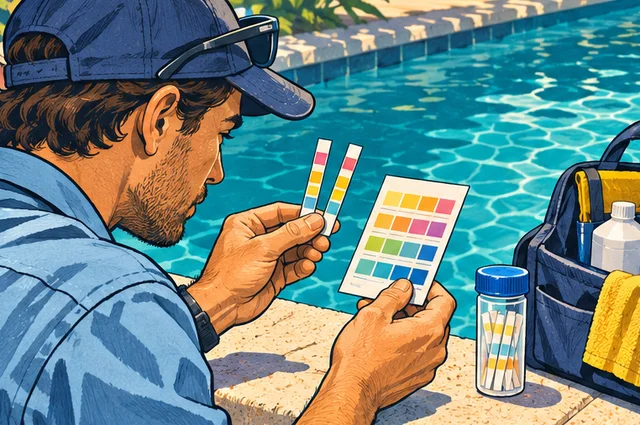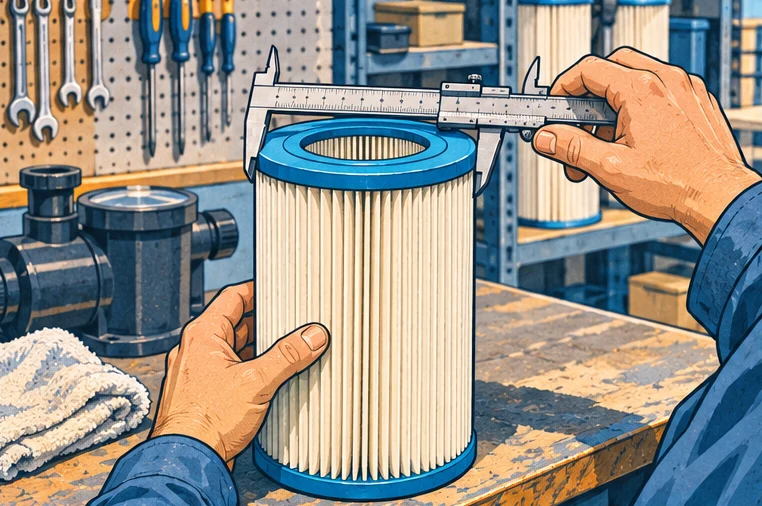
To match a replacement pool filter cartridge without fit errors, start with the stamped OEM, Unicel, Pleatco, or Filbur code to narrow your shortlist, then confirm four physical checkpoints before ordering: the filter housing model, physical dimensions (outside diameter and cap-to-cap length excluding handles), both top and bottom end-cap styles, and pack count.
This four-point check applies to residential and commercial cartridge replacements across North American OEM and aftermarket catalogs. Where state, local, or tribal health codes adopt NSF/ANSI 50 or the CDC MAHC, commercial and public aquatic venues add a separate legal step: verifying an active NSF/ANSI 50 (the North American public-health standard for pool equipment) listing before installation, covered in the commercial compliance section below.
- Readable stamp or housing label: Start with the cross-reference chart, then confirm end-cap bore style and pack count before ordering.
- Faded or missing label: Skip guessing from a brand prefix (multi-catalog audits flag 236 field-level conflicts across 474 Unicel rows) and measure the physical element first.
- Commercial or public pools: Check the official NSF directory by manufacturer and model before approving aftermarket replacements.
How to Match a Pool Filter Cartridge by Part Number and Physical Measurements
Part numbers speed up counter lookups across our broader Brands and Alternatives reference hub, but physical measurements decide whether a cartridge actually seals inside the tank.
How to Read OEM, Unicel, Pleatco, and Filbur Part Numbers
Aftermarket cross-reference charts map four separate code systems to one physical cartridge: the equipment maker OEM part number, Unicel C- or size-series CH- numbers (such as C-6430 or 6CH-940), Pleatco P- numbers (such as PWK30-4 or PRB35-IN), and Filbur FC- numbers (such as FC-3915).
Equipment-maker OEM part numbers from Hayward, Pentair, and Jandy follow proprietary alphanumeric sequences (such as Hayward CX-series codes, Pentair numeric or R-prefix replacement codes, and Jandy A/R-prefix codes) rather than a shared dimensional coding system. Because OEM codes do not directly encode outside diameter or length and manufacturers retire or supersede older numbers over time, treat an OEM code strictly as a cross-reference lookup key rather than a physical specification.
Unicel serves as a common cross-reference pivot in North American supply houses because the company began aftermarket cartridge production in 1985 and reports offering nearly 500 replacement filter products. Unicel groups C- replacement elements into numeric series by outside diameter (OD, the widest width measured straight across the end cap): the 2000 series spans 2 through 2.99 inches OD, scaling up to the 9000 series starting at 9 inches OD. In Unicel's size-series CH- codes (like 6CH-940), the leading digit flags the approximate inch OD class for top-handle and threaded spa/pool elements.
Pleatco P- prefixes often point toward an equipment family (PA frequently maps to Hayward, PRB and PWW to Waterway, and PJ to Jacuzzi), followed by series digits and variant or pack suffixes (such as -4 or -IN for specific media/configuration variants and -PAK4 for boxed 4-packs), while Filbur assigns distinct FC- SKUs for single units and multi-packs. Yet a single Pleatco prefix still spans multiple diameters, lengths, and end-cap styles. Treat any brand prefix as a search filter only, never as proof that two cartridges are compatible.
Common assumption vs. catalog evidence: Matching a brand prefix does not confirm interchangeability. PoolFilterLab's parse of Pleatco catalog entries notes that prefixes vary across dimensions and end caps, and its audit across 474 Unicel rows flags 236 field-level catalog conflicts.
The Four-Step Physical Measurement Method for Unlabeled Cartridges
When end-cap stamps wash off on a service route, measure the spent cartridge directly instead of relying on catalog descriptions alone.
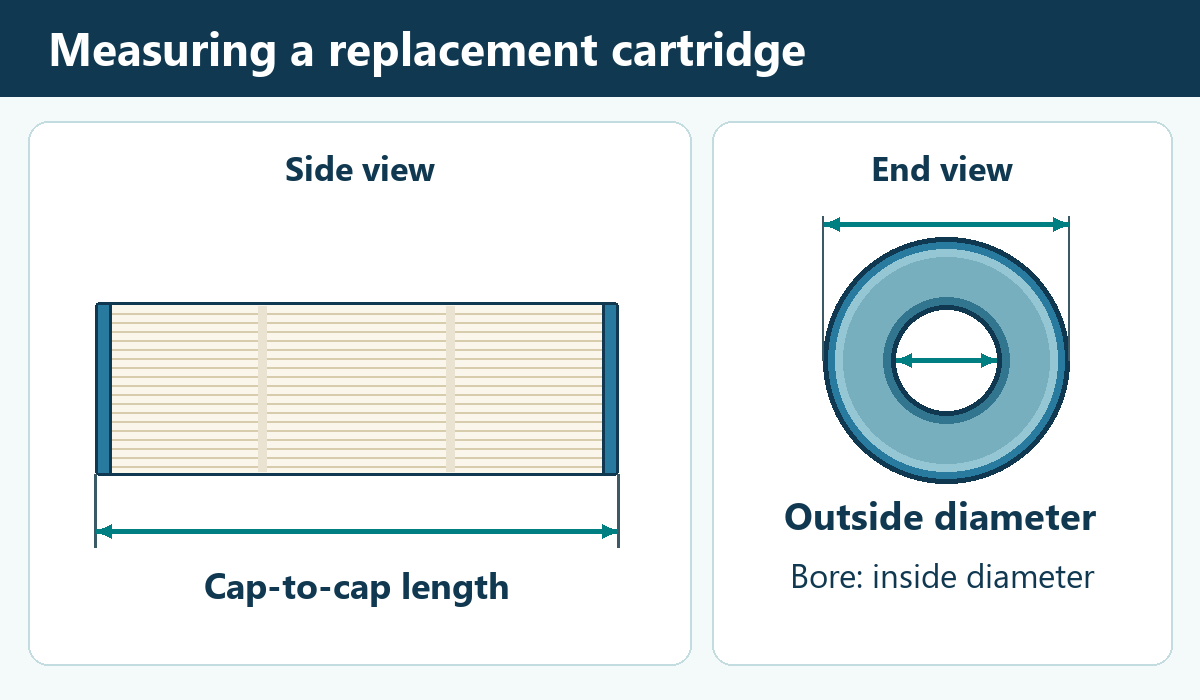
- Measure outside diameter (OD). Lay a tape measure or caliper flat across the widest edge of the circular end cap to the nearest fraction of an inch.
- Measure cap-to-cap length. Measure strictly between the outer faces of the top and bottom end caps, excluding top handles, string loops, and bottom threaded extensions.
- Inspect both end caps and inside diameter (ID). Record whether the top and bottom are open, closed, slotted, handled, or threaded. For open end caps, measure the inside diameter (ID, the open center hole that slips over the manifold standpipe). For threaded bottoms, distinguish fine-pitched MPT (Male Pipe Thread) from coarse-pitched SAE thread (a wide-spaced spa thread).
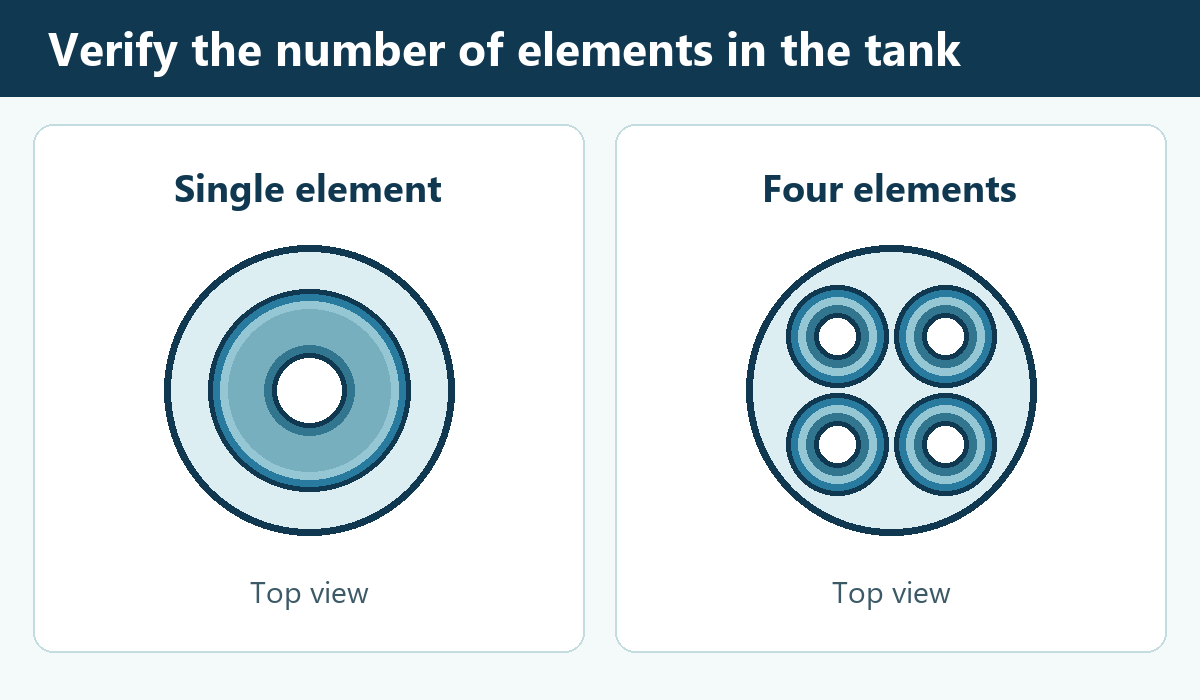
- Confirm housing model and pack count. Check the tank nameplate to verify whether the filter holds a single element or a multi-cartridge set.
Because public manufacturer sheets do not publish one universal dimensional tolerance across all Unicel and Pleatco housings, treat physical measurement as the final gate rather than assuming a fixed clearance margin. Never force a tight cartridge onto a manifold or accept loose play that allows dirty water to bypass the seal.
Cross-Reference Chart for High-Volume Pool Cartridges
High-volume Pentair Clean & Clear Plus, Hayward Star-Clear Plus and SwimClear, and Jandy CL/CV housings map cleanly across OEM, Pleatco (including Pleatco Ultra), Unicel, and Filbur codes, provided you verify pack count and treat blank aftermarket columns on full catalogs as non-matches.
Pentair Clean & Clear Plus, Hayward, and Jandy Reference Table
Use the chart below to shortlist compatible replacement cartridges for the highest-turn residential and light-commercial filter tanks, then verify physical dimensions and end caps before ordering.
| Filter Housing | OEM Part # | Pleatco Ultra / Standard | Unicel | Filbur (Single / 4-Pack) | Size (OD x L) & Pack |
|---|---|---|---|---|---|
| Pentair CCP240 | Not listed | PCC60 | C-7469 | FC-1975 (single) | 7" x 14-1/8" (4-pack) |
| Pentair CCP320 | 179134 / 178580 / R173573 | ULTRA-A5 / PCC80 | C-7470 | FC-1976 / FC-6465 | 7" x 20" (4-pack) |
| Pentair CCP420 | 178584 / R173576 | ULTRA-A6 / PCC105 | C-7471 | FC-1977 / FC-6470 | 7" x 26-1/16" (4-pack) |
| Pentair CCP520 | 178585 / R173578 | ULTRA-A7 / PCC130 | C-7472 | FC-1978 / FC-6475 | 7" x 32-1/16" (4-pack) |
| Hayward SwimClear C4025/C4030 | CX880XRE | ULTRA-A1 / PA106 | C-7488 | FC-1226 / FC-6430 | 7" x 25-1/2" (4-pack) |
| Hayward SwimClear C5025/C5030 | CX1280XRE | ULTRA-A2 / PA131 | C-7494 | FC-1227 / FC-6435 | Measure cap-to-cap (4-pack) |
| Hayward Star-Clear Plus C900 | Not listed | PA90 | C-8409 | FC-1292 | 8-15/16" x 17-3/8" (1-pack) |
| Hayward Star-Clear Plus C1200 | Not listed | PA120 | C-8412 | FC-1293 | 8-15/16" x 23-5/16" (1-pack) |
| Jandy CL340 / CV340 | A0557900 / R0554500 | ULTRA-A8 / PJAN85 | C-7459 | FC-0800 / FC-6405 | 7" x 27" (4-pack) |
| Jandy CL460 / CV460 | A0558000 / R0554600 | ULTRA-A9 / PJAN115 | C-7468 | FC-0810 / FC-6410 | 7" x 27" (4-pack) |
Source: PoolFilterLab Pleatco Filter Cartridge Cross-Reference Chart; Excel Filters Pool Filter Cartridge Cross-Reference Chart.
Note: All aftermarket mappings represent dimensional compatibility (compatible with), not OEM equivalence. "Not listed" means the OEM part number is omitted from this summary table (unlike blank aftermarket brand columns on full cross-reference catalogs, which mean no matching equivalent exists). Always confirm physical OD, cap-to-cap length, end-cap bore, and pack quantity against the actual housing before purchase.
How to Read Pack Counts, Pleatco Ultra Codes, and Blank Cells
Four-cartridge housings—such as the Pentair CCP, Hayward SwimClear, and Jandy CL/CV models above—use a multi-cartridge 4-pack (four identical elements installed together in parallel inside one filter tank; other multi-element housings can use a different element count) to deliver their total effective filtration area (sq.ft., the total unfolded surface area of pleated filter fabric). Always check whether a supplier line item sells one cartridge or a full 4-pack before quoting a customer.
Pay attention to suffix and pack-code conventions across brands:
- Pleatco standard vs. Ultra and
-PAK4: Standard codes likePCC105,PA106, andPJAN115identify the single-element specification, while-PAK4suffixes designate a boxed 4-pack andULTRA-A1throughULTRA-A9identify Pleatco Ultra series equivalents. - Filbur single vs. 4-pack SKUs: Filbur assigns separate numbers for single cartridges (
FC-1976,FC-1226,FC-0810) versus boxed 4-packs (FC-6465,FC-6430,FC-6410). - Shared physical cartridges with different pack counts: A cartridge like
C-7488/PA106/FC-1226fits Hayward SwimClear C4025/C4030 as a 4-pack, yet the same physical element also serves other housings that require a different cartridge count. Always confirm the tank model, not just the cartridge number.
Why cross-reference charts leave blank cells: Not every cartridge has a valid equivalent across every brand. MySpaFilter notes that deliberate blank columns appear whenever another catalog's closest model disagrees on physical dimensions or filtration area—for example, Unicel
C-6350has no Pleatco match because PleatcoPWK35Bdiffers in OD and rated area. Never substitute a near-match into a blank column.
Media Weight, Filtration Area, and Core Design: What Changes Performance
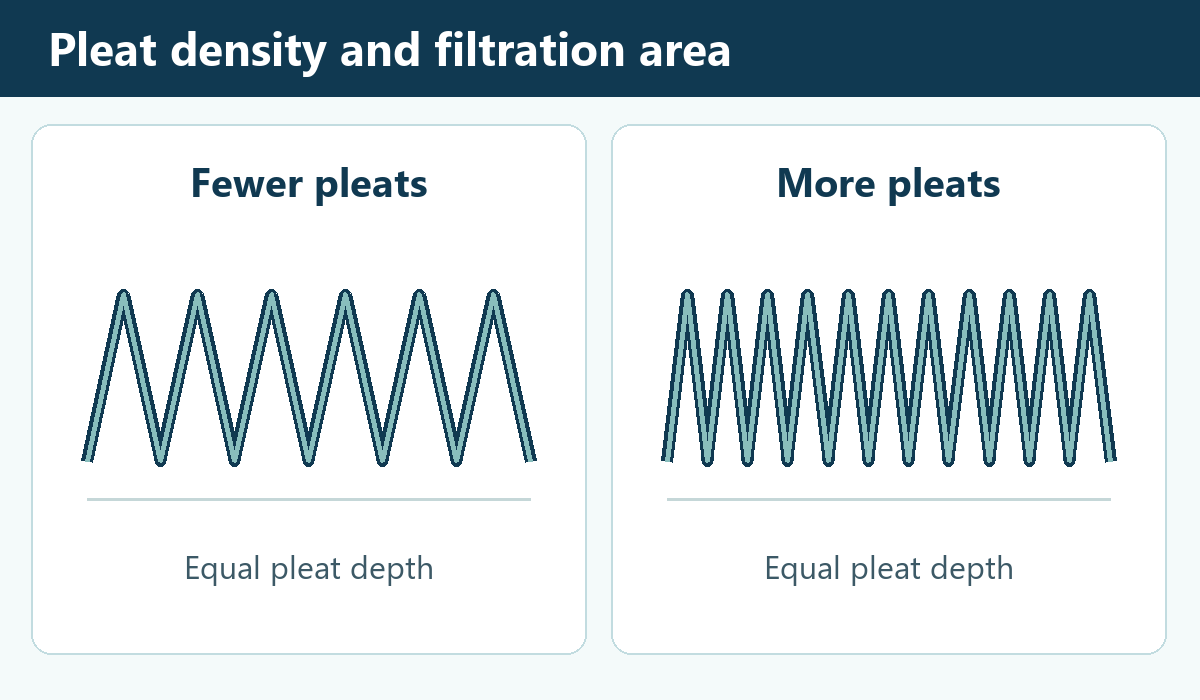
Two cartridges with identical exterior dimensions can behave very differently in service. Effective filtration area depends on pleat count and pleat depth, major swimming pool filter makers widely adopt 4 oz. spunbond polyester media, cartridges do not recover 100% of rated capacity after cleaning (for example, CDC 2024 MAHC Annex cites roughly 80% recovery and replacement once fouling exceeds 20% of rated capacity), and clogged media builds pressure that cracks end caps and collapses center cores 11.
Effective Filtration Area, Pleat Count, and Post-Cleaning Recovery
Unicel calculates effective filtration area using one straightforward formula: pleat count multiplied by 2, times pleat height, times usable media length, divided by 144 square inches per square foot. Because pleat count sits directly in the numerator, a lower-cost replacement with the same OD and length but fewer pleats delivers less usable filtration area. For the same pump flow, reducing effective filtration area increases flow velocity through the fabric, raising initial and operating pressure drop, accelerating surface loading, and shortening cleaning intervals.
That area loss matters directly for cleaning cycles and commercial hydraulic limits:
- Cleaning does not restore full factory capacity: CDC's 2024 Model Aquatic Health Code (MAHC) sets a 0.30 GPM per sq. ft. surface-type cartridge design cap in adopting jurisdictions (below the 0.375 GPM per sq. ft. listed maximum), and its non-binding Annex explains the rationale: cartridges do not recover 100% of rated capacity after cleaning (for example, around 80%), so replacement is needed once fouling exceeds 20% of rated capacity 113.
- Clarity and replacement life depend on care and load: Oregon's Public Pool Operator Manual (printed March 2011) characterizes spun-polyester cartridge filters as delivering 10 to 25 micron clarity with no backwash requirement and a 0.375 GPM per sq. ft. public filtration rate, with typical cartridge replacement every 2 to 5 years depending on care 4.
- Textbook figures are not performance guarantees: The 2024 PHTA Pool & Spa Operator Handbook notes that textbook micron-removal ranges and multi-year replacement intervals are general educational descriptions rather than a certified performance specification or guaranteed service life 7.
When evaluating a lower-priced replacement SKU for a retail shelf or service route, count the pleats around the circumference and measure usable media length between the end caps. Verifying the actual surface area prevents early clogging, elevated pressure drop, and customer complaints.
Spunbonded Polyester Media, Support Bands, and Core Strength
Spunbond polyester media (a continuous-filament, 100% polyester nonwoven fabric manufactured without dissolvable chemical binders) is the standard filter fabric across major pool cartridge brands. Unicel explains that most filtration-grade Reemay polyester media uses 4-denier fibers roughly 28 microns in diameter, smaller than the 40-micron threshold considered the smallest particle visible to the human eye.
Unicel also reports that its 4 oz. Reemay (DuPont T-380 grade) spunbonded polyester media delivered strong filtration efficiency and dirt-holding capacity, leading virtually every major swimming pool filter manufacturer to adopt this media. Lighter-weight spunbond polyester media (commonly seen in smaller spa or economy-tier replacements) differs in fabric weight from the 4 oz. standard used in mainstream pool cartridges, yet public manufacturer documentation does not publish a standardized third-party lab comparison quantifying wash-cycle durability ratios between lighter and heavier media weights. Verify fabric grade and pleat count on physical samples rather than assuming uniform durability multipliers.
Center-core construction governs both hydraulic flow and structural durability under load. A rigid, evenly perforated center core supports the pleated media pack against inward pump differential pressure while keeping open flow passages to the filter manifold; a thin, overly flexible, or restrictively perforated core adds internal flow resistance (pressure drop) and raises the risk of collapse once debris loads the pleats. When vetting a new replacement sample, press firmly on the center core wall through the open end cap to check for rigid support and clean, uniform perforations with no flexing.
Broken pleat bands vs. real structural failure: PHTA cautions against treating generic lifespan estimates as guarantees 7, and Unicel clarifies that pleat support bands exist to space pleats and limit flutter, so a cartridge still functions even if bands break or go missing. What actually ruins a cartridge in operation is clogged media restricting flow until differential pressure cracks the end caps and collapses the center core.
For facilities weighing whether to stay on pleated cartridges or convert commercial sand housings to granular glass media, compare hydraulic backwash and filtration trade-offs in our guide to AFM filter media alternatives.
Five Cross-Reference Traps That Cause Fit Failures and Returns
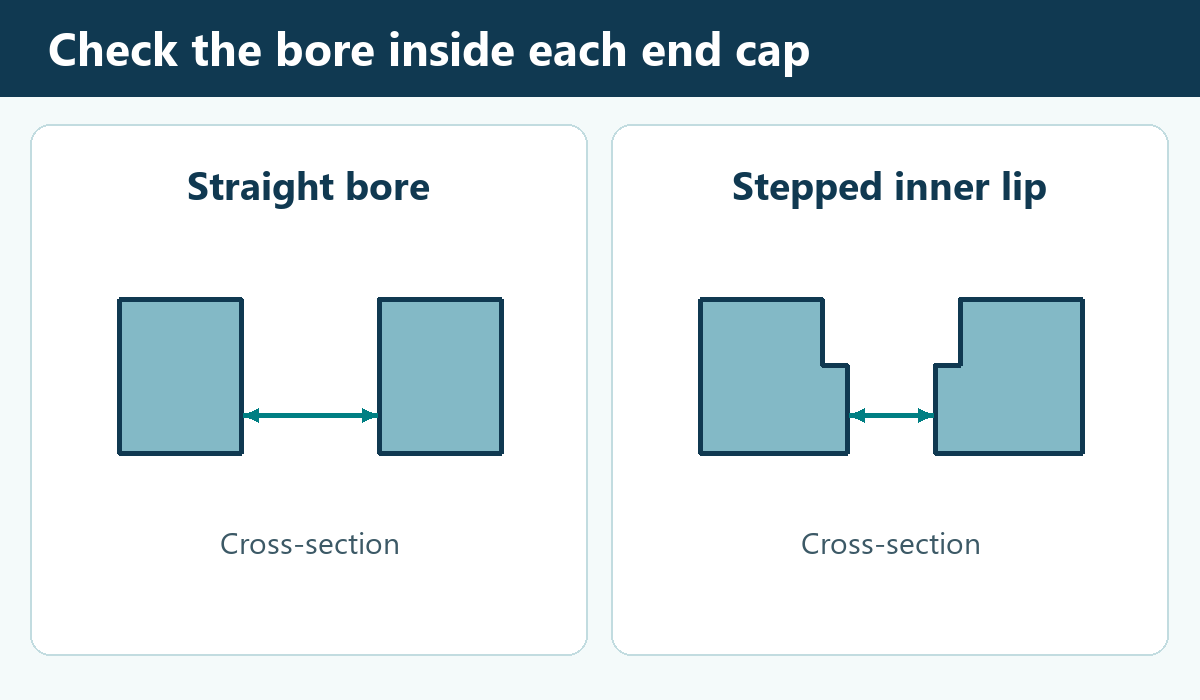
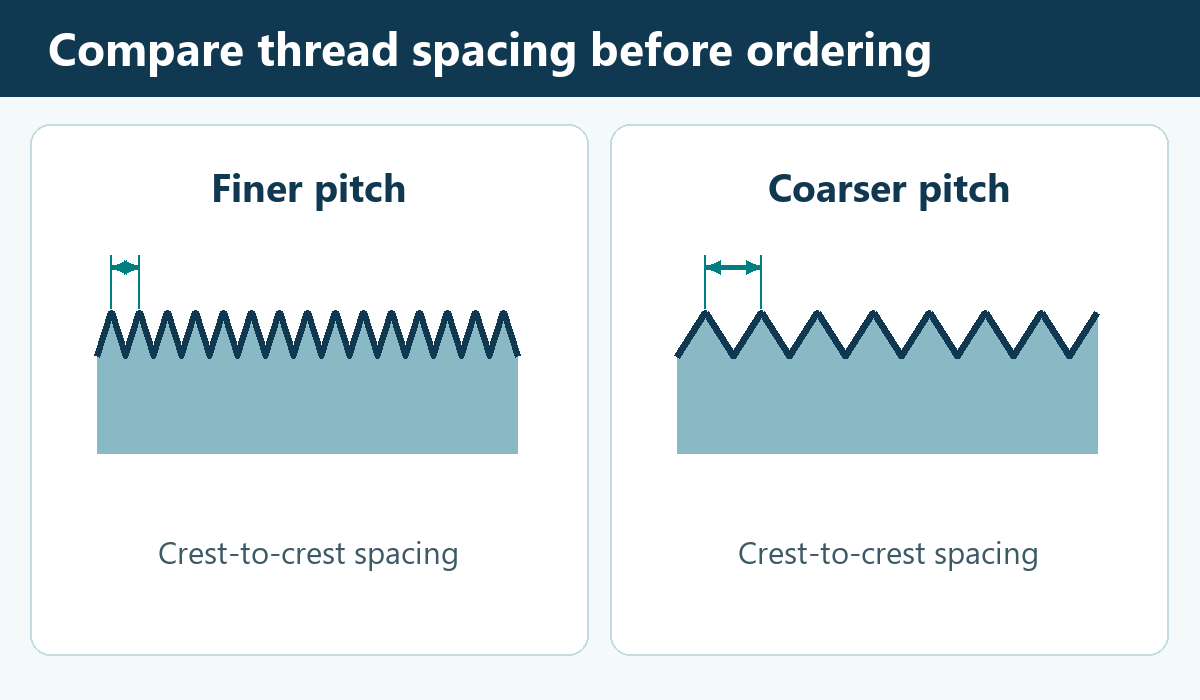
Most aftermarket cartridge returns trace back to five concrete traps: end-cap bore or inner-lip mismatches, single-versus-multi-cartridge pack errors, fine MPT versus coarse SAE thread confusion, cross-catalog dimension or area conflicts and superseded OEM codes, and reversed-flow end-cap cracks misdiagnosed as bad fit.
End-Cap Bore, Inner Lip, and MPT vs. SAE Thread Mismatches
- Matching exterior size with the wrong end-cap bore or inner lip. Two cartridges can share the exact same OD and length and still fail to seal. MySpaFilter documents that for Intex S1, Unicel
C-4317and PleatcoPIN4PAIRboth print 4-1/4 inches by 2-15/16 inches, yet disagree on the end opening (2-1/16 inches versus 1-5/8 inches). Similarly, for Master Spas6CH-352, Unicel prints 6 inches by 8 inches while FilburFC-0312prints 6 inches by 7 inches. Check whether an open end cap is a flat through-bore or has a molded inner lip or step before ordering. - Confusing MPT fine threads with SAE coarse threads. Threaded bottom fittings fail when buyers measure the outside diameter across the threads and order that inch reading as a nominal pipe size, or mix fine closely spaced MPT pipe threads with wide coarse SAE threads. Match threaded elements by thread pitch and the actual filter housing receptacle so you do not order an oversized thread or strip plastic filter manifolds.
Single vs. 4-Pack Errors, Catalog Conflicts, and Superseded OEM Numbers
- Confusing multi-cartridge housing totals with single-cartridge SKUs. Four-cartridge tanks like Pentair Clean & Clear Plus, four-cartridge Hayward SwimClear C4025/C4030/C5025/C5030, and Jandy CL/CV340/460 list total housing square footage on the tank label while each individual cartridge carries one-quarter of that area (other multi-element housings can use three elements rather than four). Verify pack quantity on both the SKU code and supplier invoice line before confirming a job.
- Trusting a single catalog row without checking conflicts or superseded OEM numbers. Published charts disagree often: PoolFilterLab's 423-row Pleatco cross-reference chart flags 305 field-level conflicts across dimensions, rated area, or mappings. Even when physical fit matches, rated area can diverge: on Softub
90-802(6 inches by 5-1/2 inches with handle and 1-1/2 inch MPT bottom), Unicel6CH-25and FilburFC-0305list 25 sq. ft. whereas PleatcoPTL20W-SV-P4rates the same OEM match at 20 sq. ft.. Equipment makers also retire codes over time: Unicel prints three Hot Spring OEM numbers (31489,71825, and71826) for oneC-6430cartridge, and Filbur sometimes lists an OEM under an alternate name such as Pacific Marquis for Marquis.
Reversed Flow Cracks Mistaken for Bad Cartridge Fit
- Blaming cartridge fit when reversed plumbing cracked the end cap. Not every cracked end cap is a sizing defect. Unicel explains that backward plumbing packs debris inside the gap separating the center core from the pleated media, blinding off flow and building internal pressure until the end cap cracks along the core circumference and pleats balloon outward.
Fit defect vs. reversed-flow failure: If pleats balloon outward and the end cap fractures cleanly around the center core circumference, verify pump inlet/outlet plumbing direction before installing a second replacement cartridge.
NSF/ANSI 50 Compliance: Commercial Public Pools vs. Retail Replacements
Commercial and public pools in jurisdictions that adopt NSF/ANSI 50 or the CDC MAHC face enforceable health-code certification rules—typically requiring NSF/ANSI 50 listed filters and media, tighter public design filtration caps (such as CDC 2024 MAHC's 0.30 GPM per sq. ft. surface-type limit where adopted, or listed and state public caps up to 0.375 GPM per sq. ft.), and, under adopting codes like the MAHC, a complete spare cartridge set onsite—whereas residential retail replacements focus on physical compatibility and OEM warranty terms 11035.
What NSF/ANSI 50 Actually Covers for Replacement Cartridges
NSF/ANSI 50 (the North American public-health standard governing equipment and chemicals for swimming pools, spas, and recreational water facilities) draws a sharp line between a complete certified filter housing and an aftermarket replacement element.
Under NSF's official listing footnote, a listed replacement filter cartridge component is evaluated for material health effects and effective filtration area only; overall filtration performance must still be validated with the filter housing manufacturer 1. ANSI's overview of NSF/ANSI/CAN 50 updates further notes that the 2020 revision added a definition for high-capacity cartridge filters and Cryptosporidium reduction claim language, while the 2024 revision added Section 13.3 for polymeric fiber filtration media 2.
Public-pool codes enforce tighter hydraulic margins than residential listings:
- Residential vs. public design rate split: NSF/ANSI 50 cartridge filter listings distinguish higher residential maximum rates from stricter public maximum rates—for example, the AquaStar
PLF 27000(200 sq. ft.) listing carries a 0.75 GPM per sq. ft. residential maximum versus a 0.375 GPM per sq. ft. public maximum (exact caps vary by listed model) 10. - Model code benchmark (CDC 2024 MAHC): Section 4.7.2 of CDC's 2024 Model Aquatic Health Code requires filters and all filter media in recirculating public aquatic venues to be certified, listed, and labeled to NSF/ANSI 50, caps surface-type cartridge filter design rates at 0.30 GPM per sq. ft., and requires one complete set of spare cartridges onsite (enforceable where adopted by state, local, or tribal jurisdictions) 3.
- State enforcement example (Illinois): Under Illinois public-pool rules (
77 Ill. Adm. Code 820, summarized in Lake County's August 2024 manual), public pool filters must be certified to NSF Standard 50, cartridges are removed and cleaned rather than backwashed, and commercial elements last roughly six months under regular operation 5.
How to Verify an Active Listing Before Commercial Installation
Never rely on a catalog icon or verbal claim when sourcing for a municipal, hotel, HOA, or commercial pool. Search NSF's official public directory at info.nsf.org/Certified/Pools/ by manufacturer legal name, trade name, and product type—checking both Cartridge and High Permeability Type Filters and Materials and Components to confirm whether the exact company and model hold an active listing 9.
Listing scope reminder: Confirm both the legal certificate holder and whether the listing covers a full filter assembly or a replacement component evaluated only for material health effects and effective filtration area 19.
Remember also that an aftermarket cross-reference entry is the aftermarket maker's statement of dimensional and fitting compatibility, not an OEM endorsement. Equipment manufacturers such as Watkins (Hot Spring) and Jacuzzi advise using genuine OEM parts and checking warranty terms before switching.
For a parallel cross-brand verification workflow covering water-testing consumables when major brands are backordered, see our guide to branded test strip alternatives.
Incoming Verification Checklist for Service Teams, Stores, and Distributors
Run a five-point verification check on every incoming shipment (physical dimensions, end-cap crack diagnostics, pleat and carton condition, pack count, and compliance documentation) and store spare sets upright in dry cartons before putting cartridges into service trucks or pick bins 6.
Five-Point Dock Inspection and Warehousing Rules
- Spot-check OD, cap-to-cap length, and end-cap bore or threads. Measure sample units from each incoming lot against your order sheet before shelving, confirming open bore IDs, inner lips, and MPT or SAE thread pitch.
- Inspect end caps for curing defects versus freight drop damage. Unicel notes a clear visual distinction at receiving: a small crack extending inward from the outer edge signals an end-cap curing defect present out of the box (a supplier claim), whereas cracks arching across the end-cap outside diameter or radiating from the center core indicate transit or warehouse drop damage (a carrier claim).
- Check carton stacking and pleat integrity. Do not stack heavy cartons or equipment on top of filter cartridges in the warehouse, because top loads crush new pleats before installation. Unicel notes that minor pleat crushing does not hinder performance unless excessive, so reject visibly flattened or kinked elements at the dock.
- Verify single-unit versus 4-pack labeling. Confirm master carton quantities and inner box barcodes match the order line so counter clerks do not pull a single cartridge for a 4-pack invoice.
- Segregate residential stock from verified commercial NSF/ANSI 50 inventory. Keep a dedicated spare set ready for high-use commercial accounts. As an adjacent high-use aquatic benchmark, CDC's 2025 Vessel Sanitation Program (VSP) Environmental Public Health Standards for international cruise-ship recreational water facilities require weekly cartridge inspection for whirlpool spas and spa pools, checking all other recreational water facilities (RWFs) every 2 weeks or more often when the equipment manufacturer specifies a shorter interval, and keeping at least 1 spare replacement cartridge onsite (this cruise-ship standard serves as an operational benchmark rather than land-based pool code) 6.
Dock triage tip: Photograph damaged end caps on arrival. Outer-edge inward fractures point to factory curing issues, while arching or core-radiating cracks point to drop damage in transit or handling.
Stocking High-Turn Compatible Models and Specifying Custom Orders
Service teams and retail stores cut emergency downtime by stocking verified compatible replacements for high-turn Pentair, Hayward, and Jandy tanks while routing regulated commercial pools strictly to models verified in the active NSF/ANSI 50 public directory.
For residential retail or wholesale sourcing, Kingnod (our company) supplies more than 600 replacement filter cartridge models compatible with Pleatco, Unicel, Filbur, Intex, Waterway, Hayward, Pentair, and Watkins, along with size and fabric customization, OEM service, and export neutral carton packaging 8.
All brand references indicate dimensional compatibility (compatible with) only and do not imply OEM endorsement; for regulated public venues requiring NSF/ANSI 50 certification, buyers must confirm an active listing directly in the public NSF directory for the specific certificate holder and model. Stock availability, batch measurements, and order specifications vary by order. For dimensional cross-checks or wholesale inquiries with Kingnod (our company), use our contact page.
Common Cartridge Cross-Reference Questions
Can you swap two cartridges that share the same physical size but differ slightly in rated square footage?
In residential pools, two cartridges with identical OD, cap-to-cap length, and end-cap geometry can often install cleanly even when pleat count creates a small difference in rated square footage. In commercial or public pools, do not drop effective filtration area if doing so pushes system flow above the jurisdiction's maximum design filtration rate.
Why do cross-reference charts leave blank columns or list several OEM numbers for one cartridge?
Blank columns mean no model in that brand's lineup matches all physical dimensions and filtration area—leaving the cell empty prevents forced near-matches that fail to seal. Multiple OEM numbers point to one physical cartridge whenever an equipment manufacturer retires and supersedes legacy part numbers over time.
Use the Chart to Shortlist, Then Verify Every Dimension Before Ordering
Treat every pool filter cartridge cross-reference chart as a fast shortlist, not a guarantee of fit. Decode the stamped OEM, Unicel, Pleatco, or Filbur number when readable, then verify outside diameter, cap-to-cap length excluding handles, top and bottom end-cap styles and threads, and single versus multi-cartridge pack count before placing the order.
For residential service trucks and retail counters, checking pleat count, spunbonded polyester media quality, and end-cap cure integrity at the dock prevents most fit failures and returns. For regulated public and commercial pools, add one final non-negotiable step: confirm an active NSF/ANSI 50 listing for the exact manufacturer and model in the official NSF directory before installation.
References
- NSF/ANSI 50 Cartridge Filter Listing Scope and Replacement Component Boundary — 2026-09-18
- ANSI Overview of NSF/ANSI/CAN 50 Revisions (2020 to 2024) — 2025
- CDC 2024 Model Aquatic Health Code (MAHC) Section 4.7.2 Filtration Requirements — 2024
- Oregon Public Pool Operator Manual: Cartridge, Sand, and DE Filter Comparison — 2011-03
- Lake County Illinois Pool Manual: Cartridge Filter Cleaning and NSF 50 Requirement — 2024-08-26
- CDC Vessel Sanitation Program (VSP) 2025 Environmental Public Health Standards: Cartridge Inspection and Spares — 2025
- PHTA Pool and Spa Operator Handbook: Cartridge Media Filtration Mechanism — 2024
- Kingnod Swimming Pool and Spa Filter Cartridges Product Page — 2026-09-18
- NSF Official Listings for Swimming Pools, Spas, and Hot Tubs (NSF/ANSI 50) — 2026-11
- NSF/ANSI 50 Listing Example: Residential vs Public Design Filtration Rate — 2026-09-18
- CDC MAHC Annex: Cartridge Filter Design Rate and Cryptosporidium Boundary — 2024
How this guide was prepared
Prepared by Martin. Based on 11 cited sources listed in References. Content date: 2026-11-25.