Do not drop a third-party or Rapid tablet into a Lovibond or Palintest photometer just because the carton prints DPD 1, DPD 3, or Phenol Red. Both brands calibrate their electronic meters to specific crushing-required photometer formulations. Safe switching requires separating Photometer from Rapid grades, clearing six pre-order checks, and passing a split-sample test against published meter tolerances.
These checks apply to electronic pool photometers such as Lovibond MD or Scuba instruments and Palintest Lumiso or Pooltest meters used by stores, service fleets, and importers in supply-constrained markets. Regulated commercial pools bound by NSF/ANSI 50 listings must keep paired certified OEM reagents for official logs. Below are the verified OEM tablet baselines, optical error mechanisms, six pre-order checks, split-sample bench steps, interference and compliance limits, and bulk evaluation criteria.
- Separate Photometer from Rapid tiers: Lovibond electronic photometers require black-printed foil packs (and PHOTOMETER-marked Phenol Red, per legacy Lovibond 9V manuals), excluding fast-dissolving Rapid comparator tablets.
- Match standard vs. extended ranges: Palintest splits standard DPD 1, DPD 3, and DPD 4 (0.01-5 mg/L Cl2) from extended DPD XF and DPD XT (0.01-10 mg/L Cl2), each tied to its own meter program.
- Use published tolerances, not guesswork: Lovibond's operating manual publishes chlorine tolerances from plus or minus 0.05 mg/L (0-1 mg/L) up to plus or minus 0.40 mg/L (above 4-6 mg/L) and plus or minus 0.1 pH, giving an auditable bench benchmark.
- Verify bulk candidates on your own meter: Request lot-specific paperwork and run two-lot split-sample checks on your target instrument before committing volume.
Lovibond and Palintest DPD Tablet Baseline: Photometer vs. Rapid Grades
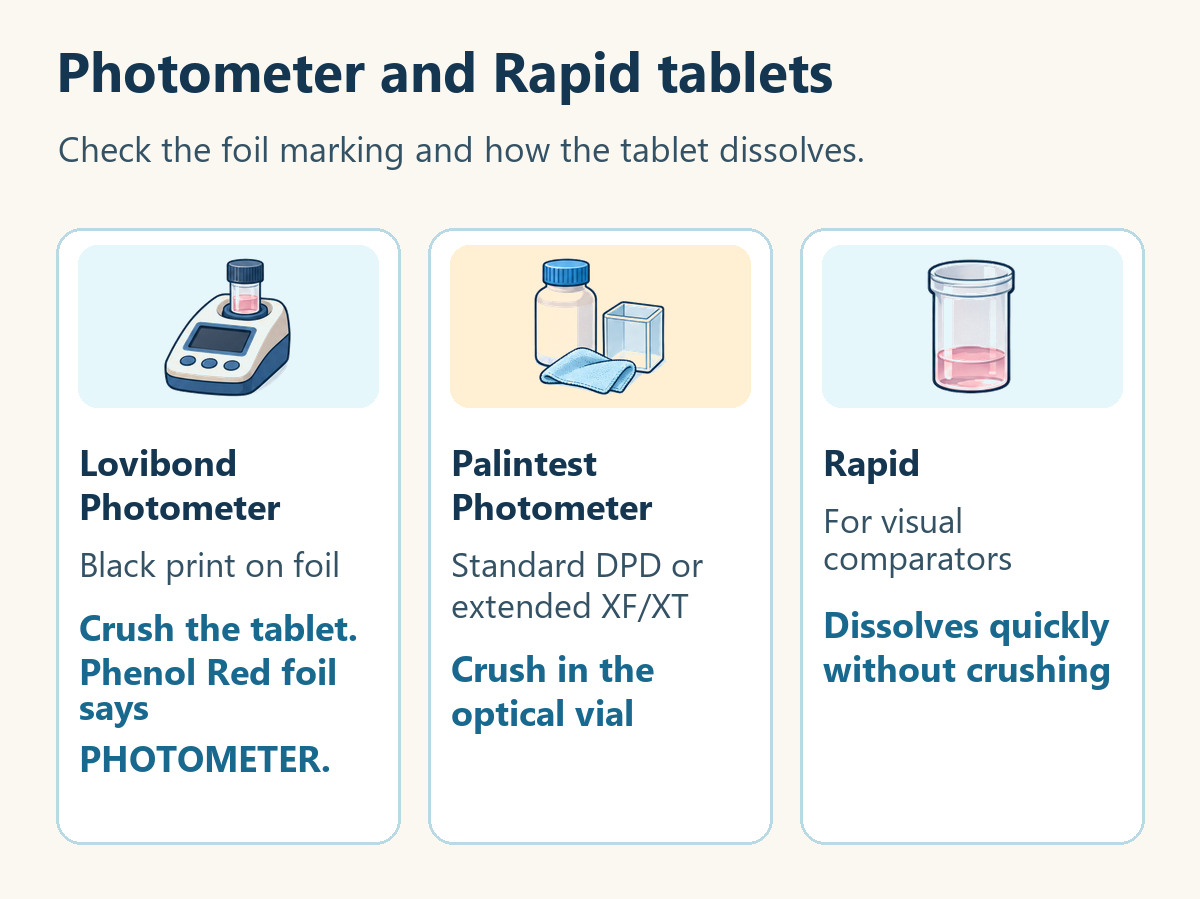
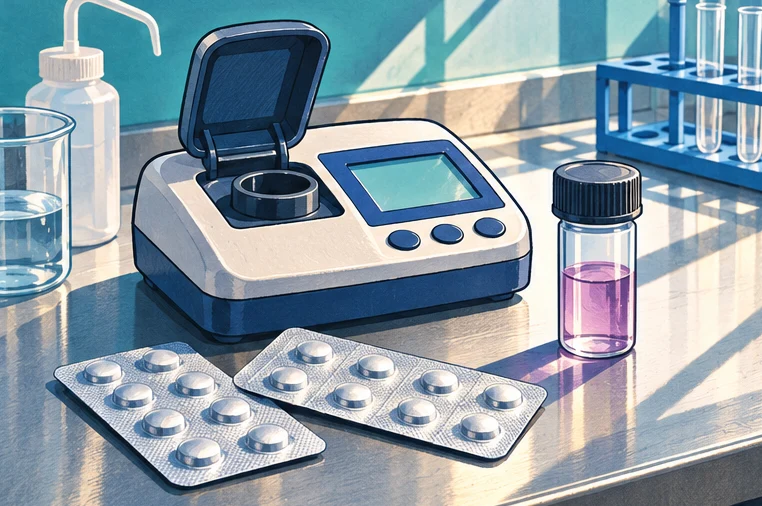
Visual comparison of crushing-required Lovibond and Palintest photometer tablets, foil markings, and fast-dissolving Rapid visual comparator grades.
Evaluating replacement pool reagents starts with a clear baseline, part of the broader specification framework across our Brands and Alternatives hub. Before reviewing any substitute quote, match the exact Lovibond or Palintest tablet grade, part family, foil print, and range your photometer expects.
Lovibond vs. Palintest Public Tablet Baseline (Data as of 2026-11)
Online dealer listings mix electronic photometer refills and visual comparator refills under near-identical DPD (N,N-diethyl-p-phenylenediamine, the colorimetric chlorine indicator) names. The table below maps each brand's public photometer and Rapid tablet lines side by side (public manufacturer documentation, Data as of 2026-11).
| Brand & Tablet Line (Data as of 2026-11) | Target Instrument | Chlorine / pH Range | Key Foil / Format Notes | Reference Codes & Edition |
|---|---|---|---|---|
| Palintest DPD1, DPD3, DPD4 Photometer | Lumiso & compatible Palintest photometers | 0.01-5 mg/L Cl2 (standard range) | Crush-required photometer grade; packs of 250 tests | AP011, AP031, AP031/1, AP041 (PDF metadata 2026-09-07) |
| Palintest DPD XF / DPD XT Extended Range | Palintest photometers on high-range mode | 0.01-10 mg/L Cl2 (extended range) | Separate high-range program; packs of 250 tests; catalog also lists DPD Oxystop (AP017) | AP013, AP033, AP033/1, AP017 (PDF metadata 2026-09-07) |
| Palintest Phenol Red Photometer | Lumiso & compatible Palintest photometers | pH 6.5-8.4 (pH 6.8-8.4 in pool brochure) | Crush-required photometer tablets in packs of 50 or 250 tablets | AP130 (PDF metadata 2026-09-07; brochure BR-LPTX-04/22-EN) |
| Palintest Rapid Tablets | Residential visual Pooltesters | Visual block comparator scale | Formulated to dissolve quickly without crushing; not for electronic photometers | Pool & Spa Brochure V8.6 (2022-04) |
| Lovibond DPD No. 1, DPD No. 3 & Phenol Red Photometer | Lovibond electronic photometers (10 mL vial) | Cl2 0.05-6.0 mg/L; pH 6.5-8.4 | Black-printed foil pack required; Phenol Red foil must be marked PHOTOMETER; crush required | Legacy 9V manuals f98105_usa-en (03/11) & f98167_usa-en (11/98) |
| Lovibond DPD No. 1, DPD No. 3 & Phenol Red Rapid | Visual comparator Pooltester (151900) | Cl2 0.1-3.0 mg/L; pH 6.8-8.2 | Fast-dissolving visual comparator grade (packs of 20 tablets in starter kits); excluded from photometers | Pooltester Cl LR-pH datasheet (151900, Data as of 2026-11) |
Sources: Palintest Photometer Tablet Reagents PDF (PDF metadata 2026-09-07), Palintest Pool & Spa Brochure V8.6 (BR-LPTX-04/22-EN, 2022-04), Lovibond Photometer Operating Manuals (legacy 9V editions f98105_usa-en 03/11 and f98167_usa-en 11/98), and Lovibond Pooltester Cl LR-pH Datasheet 151900 (Data as of 2026-11).
Even inside one manufacturer's catalog, visual and electronic refills stay separated. As an adjacent UK catalog example (lovibond-ukleisure.com, captured 2026-09-22), Lovibond supplies DPD No. 1 Rapid and Phenol Red Rapid tablets for Compact/PoolTester packs, whereas Scuba3s electronic photometer refill packs supply DPD No. 1, DPD No. 3, and Phenol Red Photometer tablets (exact retail pack SKUs vary by region).
Photometer Grade vs. Rapid Grade and DPD 1-4 Numbering
Photometer-grade tablets are pressed to dissolve cleanly after mechanical crushing in a 10 mL optical vial without leaving light-scattering residue. Rapid tablets dissolve quickly without crushing for eye-read color blocks across narrower visual ranges (0.1-3.0 mg/L Cl2 and pH 6.8-8.2 on Lovibond's Pooltester 151900).
Foil-coding boundary: Lovibond's legacy 9V photometer manuals (03/11 and 11/98) specify using only tablets in black-printed foil packs for electronic photometers and explicitly require Phenol Red photometer foil to carry the word PHOTOMETER. Visual Rapid tablets cover narrower block-comparator scales (0.1-3.0 mg/L Cl2) and must stay out of electronic chambers.
Confirm exact DPD numbering before matching any alternative line. Under standard DPD testing conventions, DPD 1 measures free available chlorine (and free bromine plus bromamine together in bromine pools), while DPD 3 added to the reacted DPD 1 sample measures total chlorine so combined chlorine equals total minus free. DPD 2 (used with DPD 1) targets combined chlorine fractions, and DPD 4 measures total available chlorine or ozone in one tablet. Verify whether a supplier's DPD 4 targets total chlorine or active oxygen before ordering.
Practical check for buyers: Check the foil backing print and crushing requirement before stocking any replacement chlorine or pH tablet for electronic meters. Match the blister print against your meter manual and reject fast-dissolving visual comparator grades whenever the instrument calls for crushed photometer tablets. Catching grade mismatches upfront prevents cloudy optical chambers and avoidable counter returns.
For store buyers and distributors stocking refills for Lovibond MD/Scuba or Palintest Lumiso/Pooltest meters, tracking exact OEM part codes and splitting Photometer from Rapid SKUs adds minor catalog work upfront while stopping returns. For service fleets running both residential visual Pooltesters and commercial electronic photometers, separate bin labels keep fast-dissolving Rapid tablets out of commercial photometer kits.
Knowing which OEM tablet grade and range your meter expects is the first filter, but to catch subtle third-party drift you also need to see why same-name tablets behave differently inside an optical chamber.
Why Same-Name DPD and Rapid Tablets Bias Photometer Readings
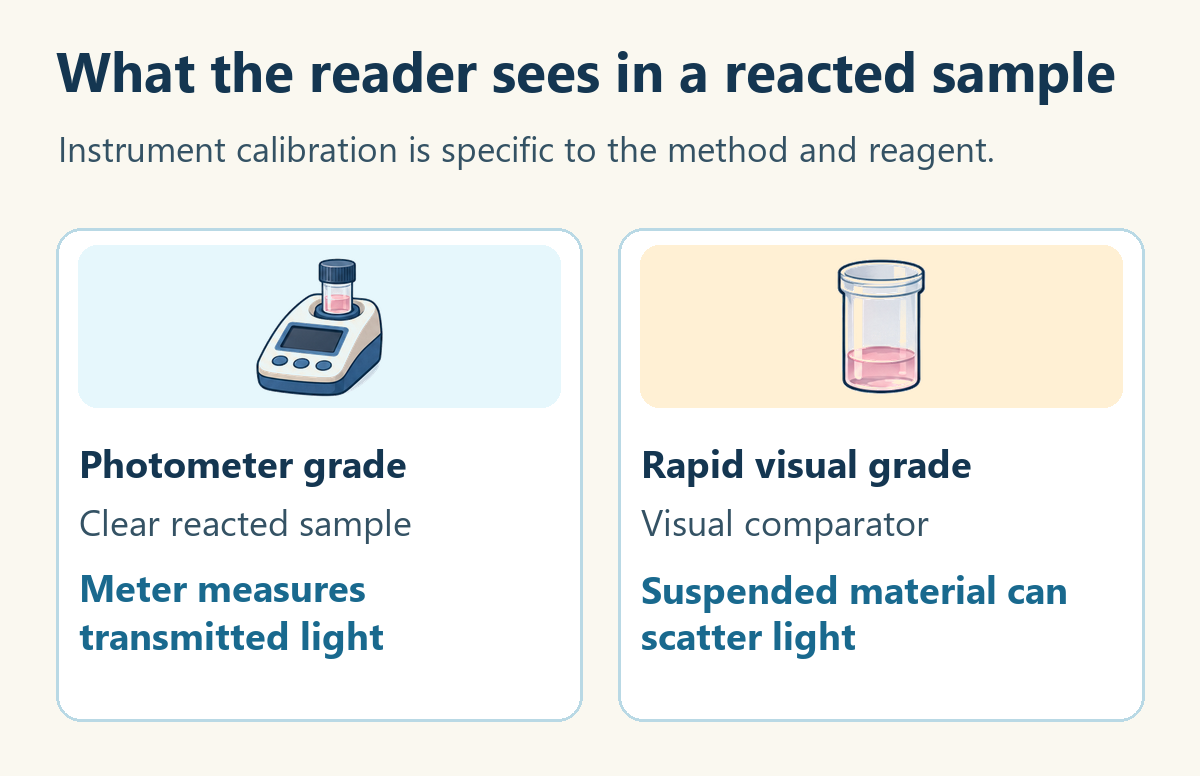
Electronic photometers calculate sanitizer and pH values from narrow-band LED light transmittance using a factory calibration curve (the meter's stored math table that converts light absorbance at fixed wavelengths into a mg/L or pH reading) built around one specific reagent formulation. Changing tablet binders, disintegrants, buffer strength, or indicator dosing weight shifts absorbance and light scatter even when the foil still reads DPD or Phenol Red.
Optical Wavelengths and Factory Calibration Curves
Palintest states in its May 8, 2025 compatibility notice that each photometer is calibrated against its own reagent formulations and optical geometry. Although DPD reagents share the same core indicator compound, dosing weight and excipient formulas differ across makers, so stated accuracy is not guaranteed with other tablets.
Even the two leading pool photometer platforms do not share identical optics:
- Lovibond 2-LED pool photometer (f98105_usa-en, 03/11 legacy 9V manual): Measures sample absorbance using fixed narrow-band LEDs at 528 nm and 605 nm, and flags excessive turbidity or out-of-range optical readings with an error code.
- Palintest Lumiso Pooltest 3, 4, and 6 (BR-LPTX-04/22-EN, 2022-04): Operates as a dual-light-source colorimeter at 530 nm and 575 nm with a factory optical specification of ±1.0% T (percent transmittance) accuracy and an IP67 enclosure.
Because each meter converts transmittance at its specific LED wavelengths through a curve tuned to its own reagent weight, a tablet engineered for another optical path or for visual eye matching can produce plausible-looking numbers that sit systematically high or low. For the broader foundational breakdown of crushing-required versus fast-dissolving reagent design, see our photometer tablets vs rapid tablets guide.
Disintegrant Turbidity, ISO 7393-2 Buffering, and Indicator Strength
Three chemical factors drive cross-brand error even when the indicator name matches:
- Disintegrant haze and high-calcium turbidity. Fast-dissolving Rapid tablets rely on disintegrants meant to break apart without crushing, which can scatter light at the photometer's fixed LED wavelengths (such as 528 nm and 605 nm on Lovibond's 2-LED meter). Water chemistry can trigger turbidity too: Lovibond's 11/98 legacy manual notes that standard DPD No. 1 tablets can cloud high-calcium or high-conductivity water (requiring a specialized DPD No. 1 High Calcium tablet), and strongly alkaline or acidic water can overwhelm the tablet's built-in pH 6.3-6.5 buffer.
- Buffer pH and metal chelation under ISO 7393-2:2017. ISO 7393-2:2017 (the international colorimetric DPD chlorine standard) requires ready-made commercial DPD tablets, powders, and liquids to include essential reagents, suitable acid, disodium EDTA (suppressing copper below 8 mg/L and iron below 20 mg/L), and a buffer system that holds the measurement solution at typically pH 6.2-6.5 1. Manufacturers cannot cite ISO 7393-2:2017 without providing buffer and composition suitability details; if a kit uses a modified pH window, the user must validate suitability 1.
- Indicator strength and sample-volume mismatch. Taylor Technologies notes across pool testing reagents that identically named products such as phenol red cannot be interchanged across kit manufacturers because indicator concentration and dosing volume are matched to a specific comparator cell.
Optical & chemical mismatch summary: Lovibond (528 nm / 605 nm) and Palintest Lumiso (530 nm / 575 nm, ±1.0% T) pair fixed wavelengths to proprietary tablet curves, while ISO 7393-2:2017 requires a buffer holding the solution at typically pH 6.2-6.5 and EDTA chelation (copper below 8 mg/L, iron below 20 mg/L) 1. Any drift in haze, pH buffer, or dye mass changes the number on the screen.
Practical check for technicians: Hold the crushed sample vial up to bright light before inserting it into the meter chamber to check for faint cloudiness or floating specks. Watch whether the solution turns crystal clear after gentle crushing and swirling; persistent haze points to visual-grade disintegrants or high-calcium precipitation. Catching turbidity early prevents false-high absorbance readings caused by scattered light rather than real sanitizer color.
When a technician sees erratic readings after switching lots, checking for visual haze takes seconds and stops unnecessary feeder adjustments. On high-calcium or strongly alkaline commercial pools, confirm buffer capacity rather than assuming every standard DPD tablet maintains typically pH 6.2-6.5 1.
Because optical curves, disintegrants, and pH buffers drive accuracy behind the scenes, you need a concrete pre-order document and physical checklist before requesting sample boxes.
Six Pre-Order Checks Before Buying Alternative DPD Tablets
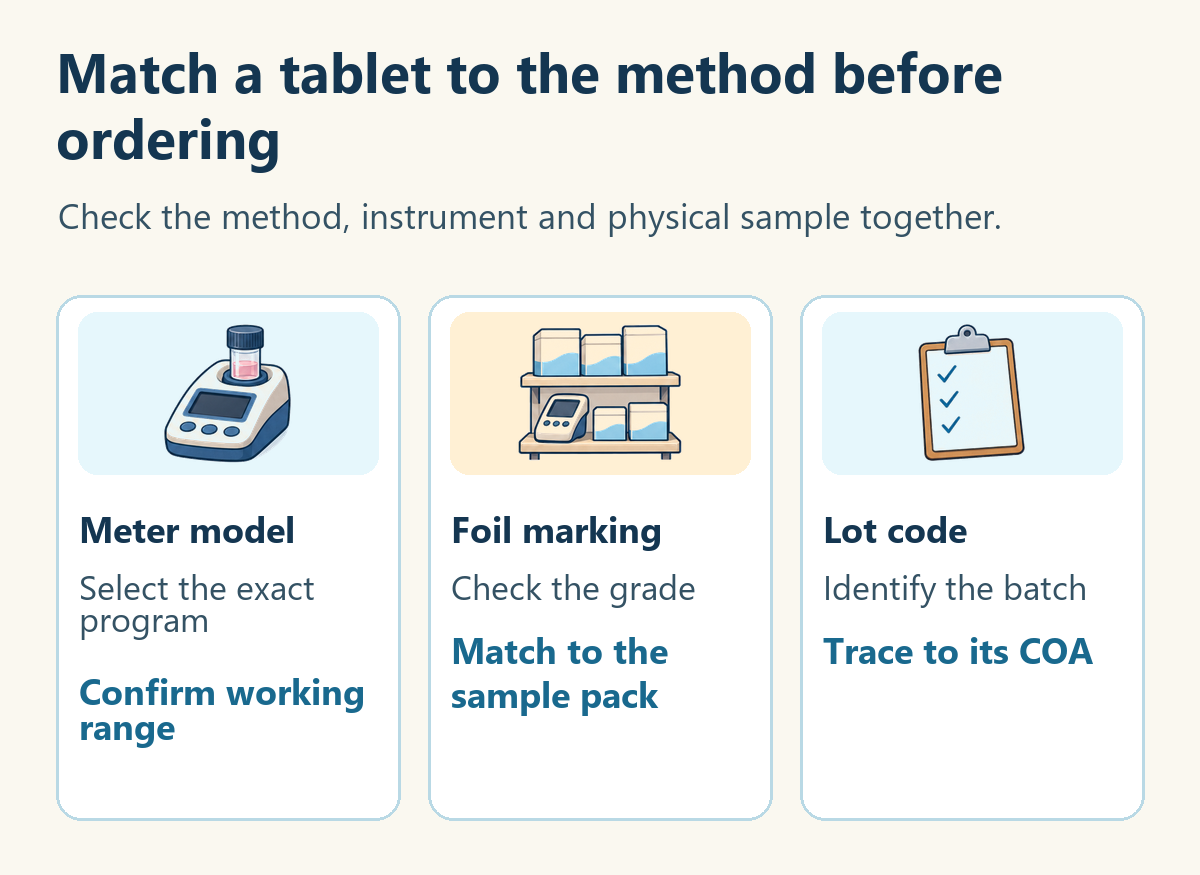
Before paying a deposit on alternative DPD or phenol red tablets, confirm six concrete items in writing and on physical sample strips. Check the exact reagent method name, measurement range and meter mode, Photometer crushing grade, lot-specific COA (Certificate of Analysis, a batch quality test sheet) 7 versus SDS (Safety Data Sheet, a chemical hazard and transport sheet), batch number with unopened expiry date, and hermetically sealed aluminum blister integrity stored at 36-85°F (2-29°C).
Checks 1-3: Method Name, Meter Range Mode, and Photometer Crushing Grade
- Exact reagent method name. Match DPD 1 (free chlorine), DPD 3 (added after DPD 1 for total chlorine), DPD 4 (confirm total chlorine versus active oxygen), or Phenol Red (photometer pH) explicitly on both the quote and the foil blister. Avoid vague "DPD chlorine tablet" line items on a proforma invoice.
- Measurement range and instrument mode alignment. Palintest's legacy 2009 Pooltest 3 manual (V3) requires pairing standard-range DPD No. 1 and DPD No. 3 tablets with the standard test mode, or DPD-XF and DPD-XT tablets with the extended high-range mode, and taking the free-chlorine reading immediately after crushing and dissolving. Loading a standard-range tablet under an extended-range meter setting skews every reading.
- Photometer grade and crushing instructions. Confirm in writing that the candidate tablet is formulated for electronic photometers and intended to be crushed in a 10 mL optical cell, not a fast-dissolving visual Rapid tablet. On sample evaluation, check that the crushed solution dissolves clear without persistent particulate haze.
Checks 4-6: Batch COA vs. SDS, Expiry/Lot Coding, and Aluminum Blister Moisture Seal
- Batch COA versus SDS documentation. Use ISO 7393-2:2017 disclosure items as your COA checklist: the standard requires recognized analytical-grade reagents, disclosure of the specific DPD salt or derivative (such as N,N-diethyl- or N,N-dipropyl-1,4-phenylenediamine sulfate), and evidence that the supplied reagent system meets standard performance 7. Keep COA and SDS roles separate, because an SDS documents safety handling and transport rather than optical calibration.
As a real example of that distinction, Kingnod's (our company) Phenol Red Tablets SDS (Article RS111, Revision 15.02.2023, Version 1) lists UN number as Not applicable for ADR/RID/ADN, IMDG, and IATA transport, while photometer measurement range and optical fit still require separate batch spec review and sample testing. As an adjacent UK commercial training reference, Stockwell Safety notes that reagent tablets must not be touched with bare hands and commercial sites hold safety documentation (UK COSHH assessments in the UK; SDS records broadly in US and international B2B trade).
- Batch lot code and unopened shelf life. Verify that every blister strip and outer carton prints a traceable lot number and expiry date. Under ISO 7393-2:2017, laboratory-prepared DPD reagent solution must be renewed after 1 month or upon discoloration (while commercial ready-to-use liquid solutions follow manufacturer stability recommendations), which helps explain why dry foil-blistered tablets dominate field routes 7. Unopened shelf life varies widely by manufacturer and packaging: Lovibond cites up to 10 years for its hermetically sealed aluminum blister tablets, while other brands list shorter windows. Evaluate stock turnover against the candidate's own printed shelf life rather than assuming an OEM timeline.
- Aluminum blister moisture barrier and storage window. Lovibond's tablet overview highlights why hermetically sealed individual aluminum pockets matter: each tablet presses straight into the vial without finger contact, shielding the DPD chemistry from ambient humidity and air. Taylor Technologies recommends keeping testing kits at steady temperatures between 36-85°F (2-29°C), shielded from direct sun and separated from pool sanitizers, and discarding any reagent showing discoloration or undissolved particles.
Practical check on incoming samples: Pop one sample tablet from the center and corner of a blister strip onto clean white paper to inspect its color before testing. Reject lots where fresh chlorine tablets show gray, brown, or purple speckling, soft crumbling edges, or pinholes in the foil backing. Inspecting dry tablets first catches moisture ingress from ocean transit or humid warehouses before bad strips reach technicians.
For importers reviewing multiple quotes, asking for lot-specific COAs, transport SDS paperwork, and physical blister samples adds upfront qualification lead time while preventing container-level write-offs. For pool stores in hot, humid climates or fleets storing test kits in unconditioned vans, enforcing cool dry storage protects accuracy even when cartons still have years left on their printed date.
Passing all six paper and packaging checks only earns a candidate tablet a spot on your bench; before switching daily pool testing, run one controlled split-sample comparison on your actual photometer.
How to Run a Split-Sample Parallel Test on Your Photometer
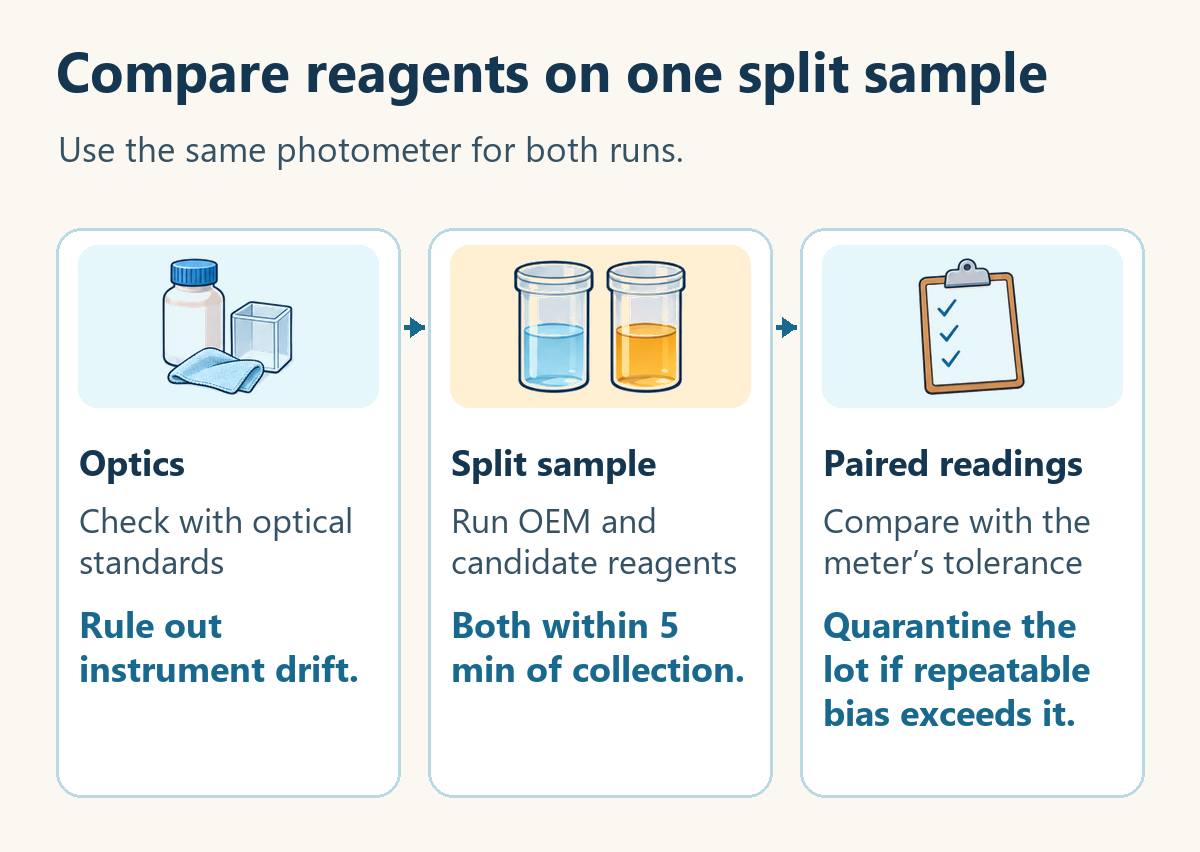
Step-by-step split-sample photometer comparison workflow from optical standard verification to tolerance review and lot quarantine.
Before deploying any alternative tablet lot across customer accounts, run a split-sample parallel comparison (testing OEM and candidate tablets back-to-back on water drawn from one mixed container on the exact same photometer) 2. Verify the meter's optics first with optical Check Standards, finish both paired runs promptly within 5 minutes of sampling to avoid free-chlorine decay using dedicated aligned 10 mL vials for free chlorine versus total chlorine, screen the paired delta across low, mid, and upper pool chlorine levels against published single-meter tolerances as an operational benchmark, and repeat the bench check on every new production lot 2.
Step-by-Step Split-Sample Bench Validation SOP
Follow this exact sequence so glass variance, chlorine decay, or cross-contamination does not corrupt your judgment:
- Verify the photometer optics first. Run optical Check Standards before testing any candidate tablet so you do not blame a reagent lot for a drifting meter. Separately, if your meter supports user calibration, Lovibond's legacy 03/11 manual (f98105_usa-en) lists recommended user-calibration (cAL) target ranges of 0.5-1.5 mg/L for chlorine and pH 7.6-8.0 (or the values listed in reference standard kits, with cAL resettable to factory CAL).
- Draw one well-mixed sample away from return inlets. Collect enough pool water in a clean bucket or sample jug, sampled away from pool inlets per RLSS UK's adjacent Lovibond MD100/MD110 bench guide, so both the OEM test and candidate test draw identical water.
- Complete paired checks promptly within 5 minutes of collection. ISO 7393-2:2017 covers roughly 0.03-5 mg/L total chlorine (requiring sample dilution above 5 mg/L), measures at 510 ± 20 nm or 550 ± 20 nm, and specifies on-site sample analysis within 5 minutes of collection (otherwise in chlorine-demand-free dark glass bottles) 2. As operational bench practice, completing both paired OEM and candidate runs inside that 5-minute window prevents free-chlorine decay between readings.
- Assign dedicated, aligned 10 mL vials for free chlorine versus total chlorine. Lovibond's 03/11 manual requires carrying out zero calibration and measurement with the exact same vial aligned to the housing's Δ/∇ marks because slight optical differences exist between glass vials. To avoid iodide carryover from DPD No. 3 into free-chlorine checks, dedicate one labeled 10 mL vial and stirring rod to paired free-chlorine runs, a second labeled 10 mL vial and stirring rod to paired total-chlorine runs, and a third clean vial to Phenol Red pH.
- Run paired free-chlorine checks first, then paired total-chlorine checks. Zero the free-chlorine vial with sample water, crush one OEM DPD No. 1 tablet cleanly, read free chlorine immediately, rinse the same free-chlorine vial and rod thoroughly with sample water, re-zero aligned to the Δ/∇ mark, and repeat with the candidate DPD No. 1 tablet. Then use the separate total-chlorine vial and rod to run the OEM DPD No. 1 plus DPD No. 3 pair (waiting 2 minutes after dissolving DPD No. 3 before reading total chlorine so combined chlorine equals total minus free), rinse thoroughly with sample water, and run the candidate total-chlorine pair on that same total-chlorine vial. Complete a separate paired run for Phenol Red pH.
- Test across low, normal, and upper pool concentrations. Checking only a 1.0 mg/L pool sample can hide slope drift at 3.0-5.0 mg/L. Run split samples across at least two or three chlorine brackets within your meter's working range, plus one pH check.
Published Tolerance Benchmarks and Per-Lot Re-Verification Limits
Do not invent an arbitrary pass/fail cutoff. Use published single-instrument measuring tolerances—such as the chlorine and pH tolerance table printed in Lovibond's legacy 03/11 operating manual (f98105_usa-en)—strictly as a conservative operational bench screening benchmark rather than an official OEM-vs-third-party acceptance criterion. Palintest's public pool documentation publishes optical transmittance accuracy (±1.0% T, noted in Section 2) rather than a public mg/L tablet-tolerance table, so Palintest operators pair their instrument manual and optical Check Standards with Lovibond's published 0-6 mg/L single-meter brackets strictly as an operational reference benchmark:
| Parameter & Bracket (Lovibond f98105_usa-en, 03/11) | Published Meter Tolerance | Split-Sample Action Trigger |
|---|---|---|
| Chlorine 0-1 mg/L | plus or minus 0.05 mg/L | Verify zero alignment and vial clarity; quarantine lot if repeatable low-end bias exceeds 0.05 mg/L |
| Chlorine above 1-2 mg/L | plus or minus 0.10 mg/L | Check dissolution clarity on normal pool water; hold lot if paired gap exceeds 0.10 mg/L |
| Chlorine above 2-3 mg/L | plus or minus 0.20 mg/L | Re-test promptly on fresh sample water for mid-range slope drift; reject lot if repeatable delta exceeds 0.20 mg/L |
| Chlorine above 3-4 mg/L | plus or minus 0.30 mg/L | Confirm fresh sample draw without chlorine decay; quarantine lot if bias exceeds 0.30 mg/L |
| Chlorine above 4-6 mg/L | plus or minus 0.40 mg/L | Rule out bleaching or dilution need above 5 mg/L; reject lot if repeatable gap exceeds 0.40 mg/L |
| pH (working range pH 6.5-8.4) | plus or minus 0.1 pH | Check chlorine neutralization and sample clarity; quarantine lot if pH offset exceeds 0.1 pH |
Source: Lovibond Photometer Operating Manual (legacy 9V edition f98105_usa-en, printed 03/11).
Scope limit of self-run bench tests: Palintest's water-testing guide (published 2024-12-09, modified 2025-03-19) states explicitly that only Palintest reagents keep readings within Palintest's guaranteed accuracy ranges. Lovibond's published table specifies single-meter measuring tolerances rather than an official third-party qualification pass rule; passing a split-sample comparison against those brackets validates only that tested batch on that specific instrument as an operational screen, never transfers OEM reagent warranty, and requires a fresh bench check on every new production lot. For extended-range chlorine above 5-6 mg/L (such as Palintest DPD XF/XT up to 10 mg/L), dilute samples above 5 mg/L per ISO 7393-2:2017 to bring verification back inside the standard reference window 2. If OEM tablets are completely out of stock, remember that optical Check Standards verify meter optics only and cannot test tablet chemistry; benchmark candidate tablets against a fresh chemical reference test or known reference solution instead.
Practical check to avoid false failures: Keep dedicated stirring rods and labeled vials for free chlorine versus total chlorine during every side-by-side trial. Rinse the vial and rod thoroughly with sample water between runs and never reuse a total-chlorine vial or stirring rod in a fresh free-chlorine test. Dedicated tools stop iodide carryover from turning a clean alternative free-chlorine tablet into a false-high reading.
For service companies qualifying replacement lots across residential or non-regulated light-commercial routes, running multi-point split samples requires a short bench session per arriving batch and catches nonlinear drift before trucks load stock. Whenever a candidate lot falls outside published single-meter reference brackets, quarantine that batch immediately rather than asking technicians to apply mental offsets in the field.
If a candidate tablet fails your bench comparison or suddenly gives erratic readings mid-season, rule out water chemistry interferences and stained hardware before blaming the lot, and check whether commercial rules allow third-party reagents at all.
Interferences, Hardware Errors, and Commercial Compliance Limits
Five field conditions distort readings on OEM and alternative tablets alike: DPD bleaching (fading of the pink DPD color at extreme sanitizer levels so readings drop artificially low), MPS (potassium monopersulfate, a non-chlorine shock oxidizer), cold water below 60°F (16°C), high-chlorine purple phenol red shifts, and stained vials or crush rods 456. Separately, in regulated commercial pools where health codes mandate NSF/ANSI 50 (the North American commercial pool equipment and testing-device standard), reagent certification applies only when paired with the corresponding certified device 3.
Water Chemistry and Hardware Interferences Often Blamed on Tablets
Check these five culprits before rejecting a reagent box or adjusting chemical feeders:
- High-sanitizer DPD bleaching (above 10 mg/L Cl2 on Lovibond photometers; 6 mg/L top-of-disc on UK visual comparators). Lovibond's 11/98 legacy photometer manual warns that chlorine above 10 mg/L (or bromine above 13 mg/L) can bleach DPD back into the displayed measuring range all the way down to 0 mg/L, requiring sample dilution and retesting. Historical UK HPA/HSE spa-pool guidance (March 2006, later superseded by UK HSG282; adjacent colorimetric reference) notes the same visual behavior near 6 mg/L chlorine or 10 mg/L bromine, where pink color flashes then disappears or hits the top of the disc, and documents repeating the test on diluted water (3 volumes of tap water to 1 volume of sample for a 4x multiplier) 4.
- Cold water samples (below 60°F / 16°C). CDC's 2024 MAHC Annex (5th Edition, model public-health guidance) advises warming pool water chilled below 60°F (16°C) up to at least 60°F prior to adding tablets so reactions complete accurately 5.
- MPS non-chlorine shock interference. Under CDC's 2024 MAHC Annex, potassium monopersulfate (MPS) shock inflates combined chlorine results whenever any residual remains, and triggers false free-chlorine readings at elevated levels above 25 ppm 5.
- High-chlorine purple phenol red shift and over-neutralization. CDC's 2024 MAHC Annex notes that chlorine near 10 ppm can convert phenol red into purple chlorophenol red at pH 6.6 or above 5. PHTA's 2024 CPO Handbook warns that this dark purple shade is easily mistaken for high pH, and while manufacturer-directed dechlorination is required, adding excess sodium thiosulfate neutralizer can itself bias pH readings upward 6.
- Stained tubes, discolored crush rods, bubbles, and detergent residue. Palintest's best-practice guide (published 2024-12-09, modified 2025-03-19) advises discarding discolored crushing rods and stained or scratched test tubes to prevent cross-contamination and optical scatter, and removing air bubbles from the sample tube by using a crushing rod. Lovibond's 11/98 manual adds that household dish detergents leave reducing residues in vials that depress chlorine readings unless chlorine vials are conditioned and dedicated solely to chlorine testing.
Bleaching & compliance quick warning: Seeing 0 mg/L free chlorine right after shock treatment can mean above 10 mg/L Cl2 has bleached the DPD dye rather than a dead tablet, while MPS above 25 ppm produces false-positive free chlorine 5. On commercial pools governed by NSF/ANSI 50, uncertified third-party tablets never inherit the photometer's listing 3.
NSF/ANSI 50 Commercial Compliance and Recalibration Controls
Official NSF/ANSI 50 Water Quality Test Device (WQTD) listings (current as of 2026-10-11) classify certified meters into accuracy tiers (L1, L2, or L3; for example, Palintest Lumiso 3 and 6 listed at L1 for pH 6.5-8.4 and combined chlorine 0.02-10 ppm). Listings mandate testing both before and after a shelf-life test, and state explicitly that reagent certification applies only when used with the corresponding certified device 3.
Where state or county health codes require NSF/ANSI 50 listed testing systems for public or commercial pools, swapping in uncertified alternative tablets breaks the paired reagent certification 3. Alongside certified reagents, commercial pool safety training such as Stockwell Safety's adjacent UK pool guidance (aligned with Palintest's brochure service recommendations) advises annual photometer recalibration and immediate retesting of any unexpected water-quality result.
Practical maintenance check: Replace cloudy or scratched glass vials and stained crushing rods on a routine schedule instead of waiting for them to break. Inspect dry vials against bright light for ring stains or micro-scratches, and never wash chlorine vials with household dish detergent. Clean optics eliminate persistent baseline offset and keep every reagent comparison honest.
For commercial and public pools subject to NSF/ANSI 50 inspection logs, keep paired OEM reagents on hand and buffer reorder lead times early. For technicians seeing zero chlorine after a shock dose or dark purple pH vials, running a quick dilution check or verifying recent MPS shock takes only a quick check and prevents throwing away good tablet stock or overdosing acid.
Once you know which accounts require OEM-certified reagents and which non-regulated or supply-constrained channels can qualify alternatives, the final step is structuring bulk or custom-packaged sample orders cleanly.
Evaluating Bulk and Custom-Packaged Replacement Tablets
When OEM photometer tablets are out of stock or difficult to import, evaluate bulk or custom-packaged candidates strictly on written physical specs, transport and safety paperwork, and buyer-run two-lot split-sample bench results rather than verbal compatibility promises. Below is how a transparent B2B RFQ specification profile looks using stated product and export details from Kingnod (our company), followed by related guides across other pool consumables.
What to Request in a Bulk or Custom-Packaged Tablet RFQ (Kingnod Example)
Use the specification framework below when requesting quotes and evaluation samples from any bulk tablet manufacturer. The middle column lists Kingnod (our company) product and export specifications as a concrete B2B example (Data as of 2026-11), while the right column notes what every buyer confirms directly on sample lots.
| B2B RFQ Checkpoint | Kingnod (our company) Example Specs (Data as of 2026-11) | Buyer Verification Action Before Volume Order |
|---|---|---|
| DPD tablet models & diameter | DPD1, DPD3, DPD4 in 6 mm or 6.5 mm diameter | Confirm exact target test set (free chlorine, total chlorine, pH) and tablet grade |
| Blister & box packaging | 10 tablets per foil-backed blister strip; 10 or 100 strips per box (customizable packaging) | Inspect blister seal integrity and tablet color on two separate sample lots |
| Unopened shelf life | 2 years unopened for both DPD and Phenol Red tablets (opened shelf life not stated) | Check lot-printed expiry against warehouse turnover and cool, dry storage conditions (or general 2-29°C reagent guidance in Section 3) |
| Photometer fit & working range | Not published — confirm on sample | Run the split-sample parallel test on your actual photometer across low, mid, and upper ranges before ordering volume |
| Fulfillment & export trade terms | Typical shipment within 3 weeks after order confirmation (not a contractual guarantee); FOB, CFR, or CIF terms; 30% T/T advance + 70% against B/L copy or 100% L/C at sight; pre-shipment process photos and lab test results prior to container shipment | Confirm current order MOQ, freight routing, and lot COA/SDS bundle in writing on the proforma invoice |
Sources: Kingnod (our company) test-tablet product specifications and export trade terms (Data as of 2026-11).
Keep two practical scope boundaries in mind when evaluating bulk offers like the table above. First, the 6 mm or 6.5 mm tablet diameter and packaging of 10 tablets per strip apply to DPD1, DPD3, and DPD4, while the 2-year unopened shelf life covers both DPD and Phenol Red tablets. Second, because Kingnod (our company) states physical tablet specifications rather than instrument-specific optical validation, buyers verify optical fit, working range, and reading accuracy directly on sample strips using their target Lovibond or Palintest photometer; regulated pools requiring NSF/ANSI 50 certified systems verify certification strictly on official NSF/ANSI 50 WQTD listings rather than by sample bench testing. Trade terms, sample-lot availability, and custom packaging options can be confirmed directly via the Kingnod (our company) contact page.
Practical check for bulk buyers: Ask any bulk tablet supplier for sample strips from two separate production lots before placing a full commercial order. Confirm blister packaging specs, unopened shelf life, safety sheets, and trade terms in writing, then run the split-sample meter test on both lots before releasing deposit payment. Qualifying two lots upfront confirms batch consistency and real photometer behavior before capital is locked into inventory.
For distributors and importers in supply-constrained markets, custom-packaged supply provides flexible box counts (10 or 100 strips per box) and typical 3-week export dispatch, paired with buyer-owned bench verification on target meters. For pool stores and service operators also facing shortages in other categories, apply the exact same spec-first verification across your whole shelf.
Related Branded Pool Consumable Alternatives
- Visual test strips: Comparing multi-parameter strip panels, color-block gaps, TruTest digital reader lock-in, and moisture-barrier vials is covered in our Branded test strip alternatives guide.
- Filter cartridges: Matching outer diameter, length, top/bottom end-cap style, and filtration area across Pleatco, Unicel, Filbur, and OEM cartridges is covered in our pool filter cartridge cross reference guide.
Across DPD tablets, test strips, and filter cartridges, disciplined specification checks and physical verification beat brand-name assumptions every time.
Verify Grade, Range, and One Split Sample Before Switching Tablets
Evaluating alternative DPD and phenol red tablets for a Lovibond or Palintest photometer comes down to physical proof rather than matching a reagent name on a box. Anchor every candidate against your meter's exact Photometer grade and chlorine range, keep fast-dissolving Rapid visual tablets strictly out of electronic chambers, and screen each supplier with the six pre-order checks: method name, range mode, crushing grade, batch COA versus SDS, lot-coded expiry, and aluminum blister integrity.
For regulated public and commercial pools where NSF/ANSI 50 listings govern official inspection logs, keep paired OEM reagents intact (alongside recommended annual meter recalibration). Where stockouts or import barriers make alternative sourcing necessary for non-regulated accounts or regional B2B distribution, verify meter optics with Check Standards first, run at least one split-sample comparison before switching daily testing on a candidate lot, and qualify two separate production lots back-to-back against OEM tablets (or a verified chemical reference test) using Lovibond's published single-meter tolerances as an operational bench reference before committing to a bulk volume order—whether evaluating open-channel brands or custom-packaged supply from Kingnod (our company).
References
- ISO 7393-2:2017 Requirements for Ready-Made DPD Reagents (Liquid, Powder, Tablet) — 2017
- ISO 7393-2:2017 DPD Colorimetric Method Range, Apparatus, and Sampling — 2017
- NSF/ANSI 50 Water Quality Testing Device (WQTD) Accuracy Tiers and Reagent Pairing — 2026-10-11
- DPD Colorimetric Bleaching Thresholds and Sample Dilution Rules — 2006-03
- CDC MAHC Annex: Monopersulfate (MPS) Interference and Cold-Sample Warming (<16°C) — 2024
- PHTA Certified Pool & Spa Operator Handbook: High-Halogen Phenol Red False Purple Interference — 2024
- ISO 7393-2:2017 DPD Reagent Composition, Phosphate Buffer pH 6.5, and Storage — 2017-12
How this guide was prepared
Prepared by Martin. Based on 7 cited sources listed in References. Content date: 2026-11-26.