To choose a reliable AquaChek test strips alternative, verify five concrete specifications before ordering. Match the exact sanitizer chemistry (separating free chlorine, total chlorine, bromine, and stabilizer), range ceilings and color-block spacing, dip timing and optical-reader compatibility, moisture-barrier packaging and opened shelf life, and a split-sample check against a FAS-DPD or DPD kit.
These checks apply to visual pool and spa test strips stocked by retail counters, service routes, and distributors facing brand stockouts or import limits. Visual strips cannot feed optical digital readers, and public pools face separate local health codes that restrict test strips for official compliance logs. Below is the exact AquaChek lineup baseline, followed by the protocol, storage, bench verification, compliance, and sourcing comparisons you need to switch cleanly.
- Match the SKU, not pad count: AquaChek Silver 7-in-1 reads free chlorine up to 20 ppm, while several multi-way alternatives stop at 10 ppm.
- Separate visual strips from digital refills: Optical digital readers require dedicated refills and reject generic visual test strips.
- Check public-pool codes first: State and county public-pool rules often require DPD colorimeters or titration kits rather than test strips for official logs.
- Verify candidates on split samples: Qualify replacement retail or private-label strips side by side against a FAS-DPD or DPD reference kit before committing stock.
What to Compare First: AquaChek Lineup Specs, Parameters, Ranges, and Color Scales
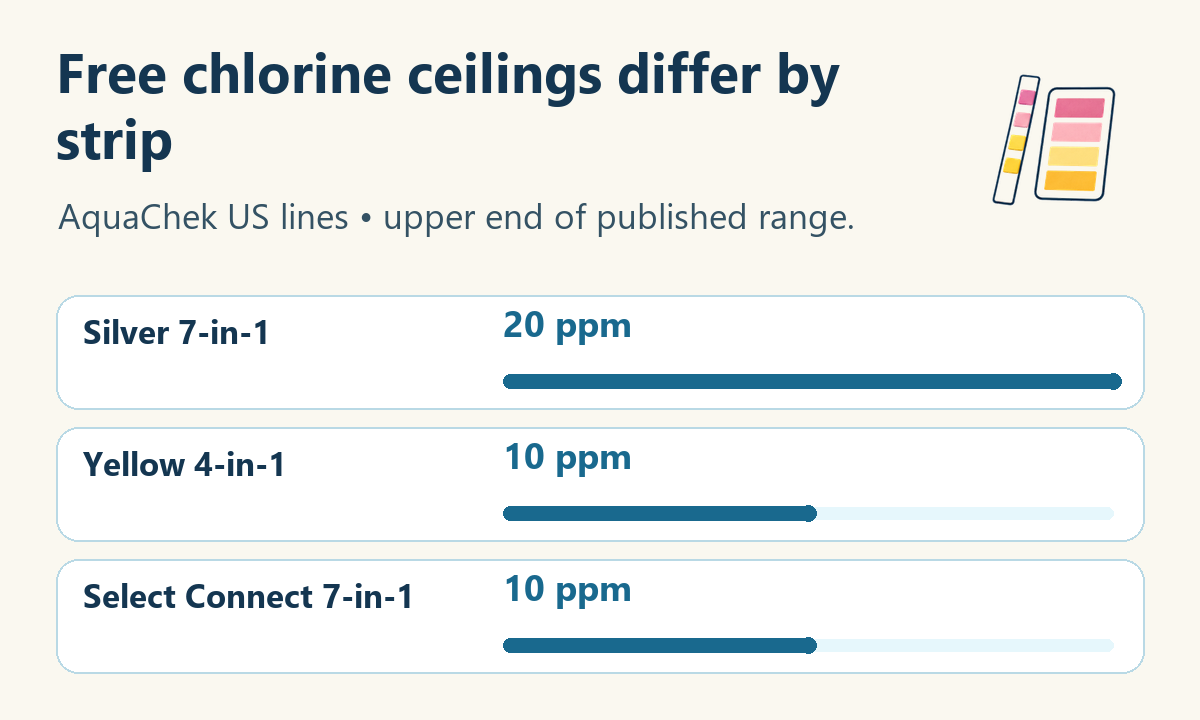
Replacing branded consumables starts with the exact specification baseline—part of the broader verification framework across our Brands and Alternatives hub. Before reviewing substitute brands, pin down which AquaChek SKU your customers or technicians currently use.
AquaChek Lineup Baseline: Parameters and Ranges by SKU
AquaChek sells distinct test strip panels for chlorine pools, bromine spas, saltwater pools, and smartphone-scanned water testing (public manufacturer specs, Data as of 2026-11). Each model targets a specific sanitizer chemistry and ceiling range, so swapping strictly by pad count creates immediate blind spots.
| AquaChek Model (Data as of 2026-11) | Target Pool / Spa | Sanitizer & Range | pH / Alkalinity / Hardness | Stabilizer (CYA) & Format |
|---|---|---|---|---|
| AquaChek Silver 7-in-1 | Chlorine or bromine pools & spas | Free Chlorine 0-20 ppm; Total Chlorine 0-10 ppm; Total Bromine 0-20 ppm | pH 6.2-8.4; TA 0-240 ppm; Total Hardness 0-1,000 ppm | CYA 0-300 ppm; visual multi-pad strip |
| AquaChek Chlorine 4-in-1 (Yellow) | Routine residential chlorine pools | Free Chlorine 0-10 ppm (no Total Chlorine or Bromine) | pH 6.2-8.4; TA 0-240 ppm (no Hardness) | CYA 0-300 ppm; flip-top visual bottle |
| AquaChek Red 4-in-1 | Bromine spas & pools | Total Bromine 0-20 ppm (no Free Chlorine) | pH 6.2-8.4; TA 0-240 ppm; Total Hardness 0-1,000 ppm | No CYA; visual single-dispense bottle |
| AquaChek Salt System Kit | Saltwater chlorine pools | Free Chlorine 0-10 ppm via Yellow 4-in-1 | pH 6.2-8.4; TA 0-240 ppm | CYA 0-300 ppm + separate White Salt Titrators (400-7,000 ppm NaCl) |
| AquaChek Select Connect 7-in-1 | Chlorine/bromine pools + app scan | Free Chlorine 0-10 ppm (lower than Silver's 0-20 ppm) | Same seven parameter names as Silver | Smartphone photo-capture scanning app |
Sources: AquaChek Silver 7-in-1 Test Strips Official Product Specifications, AquaChek Chlorine 4-in-1 (Yellow) Official Product Specifications, AquaChek Red 4-in-1 Bromine Test Strips Official Product Specifications, AquaChek Salt System Test Kit Official Specifications, and AquaChek Select Connect 7-in-1 Kit Official Product Specifications (Data as of 2026-11).
Two rows in this table catch store buyers off guard. First, AquaChek Select Connect shares all seven parameter names with AquaChek Silver 7-in-1, yet Select Connect tops out at 10 ppm Free Chlorine instead of Silver's 20 ppm ceiling. Second, AquaChek's Salt System Kit does not read salt on the multi-parameter color strip; it pairs Yellow 4-in-1 with a separate bottle of White Salt Titrators measuring 400 to 7,000 ppm sodium chloride. If you need help interpreting existing AquaChek color blocks before switching, see our AquaChek test strips chart guide.
Also watch water chemistry conditions on cyanuric acid (CYA, a UV stabilizer that shields outdoor pool chlorine from sunlight). AquaChek's Yellow 4-in-1 insert notes that stabilizer pads read best when water pH falls between 7.0 and 8.4 with total alkalinity kept at or below 240 ppm. Check each candidate strip's insert for its own pH and alkalinity operating window before comparing CYA readings.
Why Pad Count Fails: Chlorine States, Range Ceilings, and Color-Block Spacing
Counting six or seven pads on a replacement label hides three dosing traps: missing chlorine species, lower upper ceilings, and wide gaps between printed color blocks.
Free chlorine vs. total chlorine. Free chlorine is the active hypochlorous acid and hypochlorite sanitizer doing the killing, while combined chlorine consists of spent chloramines; total chlorine equals their sum. When total chlorine reads higher than free chlorine, the pool needs shock treatment. Replacing a seven-parameter strip with a strip that drops either Free Chlorine or Total Chlorine removes your ability to spot combined chlorine on route stops.
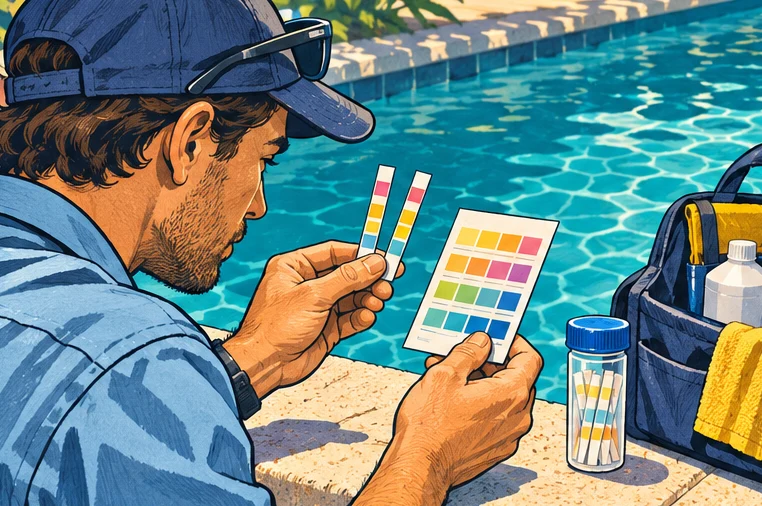
Discrete color-block spacing. Free chlorine strips rely on indicator dyes such as tetramethylbenzidine (TMB) or syringaldazine (FACTS). They act as semi-quantitative tools that give a color bracket rather than an exact decimal reading, and visual judgment shifts across operators and lighting. Because you can only read the steps printed on the vial, block spacing directly controls chemical dosing accuracy.
Compare two mainstream public multi-way scales side by side:
- LaMotte Insta-TEST 6 Plus (
3028-HB-6, updated 2025-11-27): Prints Free and Total Chlorine at 0, 0.5, 1, 3, 5, and 10 ppm; Bromine at 0, 1, 2, 6, 10, and 20 ppm; Alkalinity at 0, 40, 80, 120, 180, and 240 ppm; Total Hardness at 0, 100, 250, 450, and 800 ppm; CYA at 0, 40, 100, 150, and 250 ppm; and pH at 6.2, 6.8, 7.2, 7.8, 8.4, and 9.0—leaving no 7.4 or 7.6 intermediate pH block. - HTH 6-Way online chart (captured 2026-09-22): Prints Free Available Chlorine at 0, 1, 2, 3, 5, and 10 ppm (omitting a 0.5 ppm step), pH at 6.4, 6.8, 7.2, 7.5, 7.8, and 8.4 (including a 7.5 middle block), Total Hardness up to 800 ppm, and CYA up to 300 ppm.
Color-scale contrast: Even when two bottles advertise the same multi-way coverage, their printed scales diverge where daily adjustments happen. Dropping from AquaChek Silver's 0-20 ppm free chlorine ceiling to 0-10 ppm, losing a 0.5 ppm low-chlorine step, or jumping straight from pH 7.2 to 7.8 forces dilutions above 10 ppm or drop-kit rechecks where fine chlorine or pH steps are missing.
Practical check for buyers: Inspect the printed color chart on a physical sample bottle before approving any substitute SKU. Line up the candidate's chlorine and pH blocks against your target pool dosing ranges and flag any missing middle step that would force technicians to guess between shades. Checking the physical chart up front prevents acid or sanitizer overdosing and cuts counter returns.
For retail stores replacing chlorine or saltwater SKUs (Silver 7-in-1, Yellow 4-in-1, or Salt System), confirming free vs. total chlorine, CYA, and separate salt coverage upfront stops immediate returns from saltwater customers. For bromine spa routes or high-chlorine commercial checks, verify that the substitute preserves a 20 ppm upper range or plan to back it up with a drop kit.
Matching parameters, range ceilings, and color steps narrows your candidate list, but an alternative strip still produces bad readings if staff keep using AquaChek dip timings, old bottle charts, or a TruTest digital reader.
Dip Timing, Lot-Matched Charts, and Why Visual Strips Cannot Feed TruTest Readers
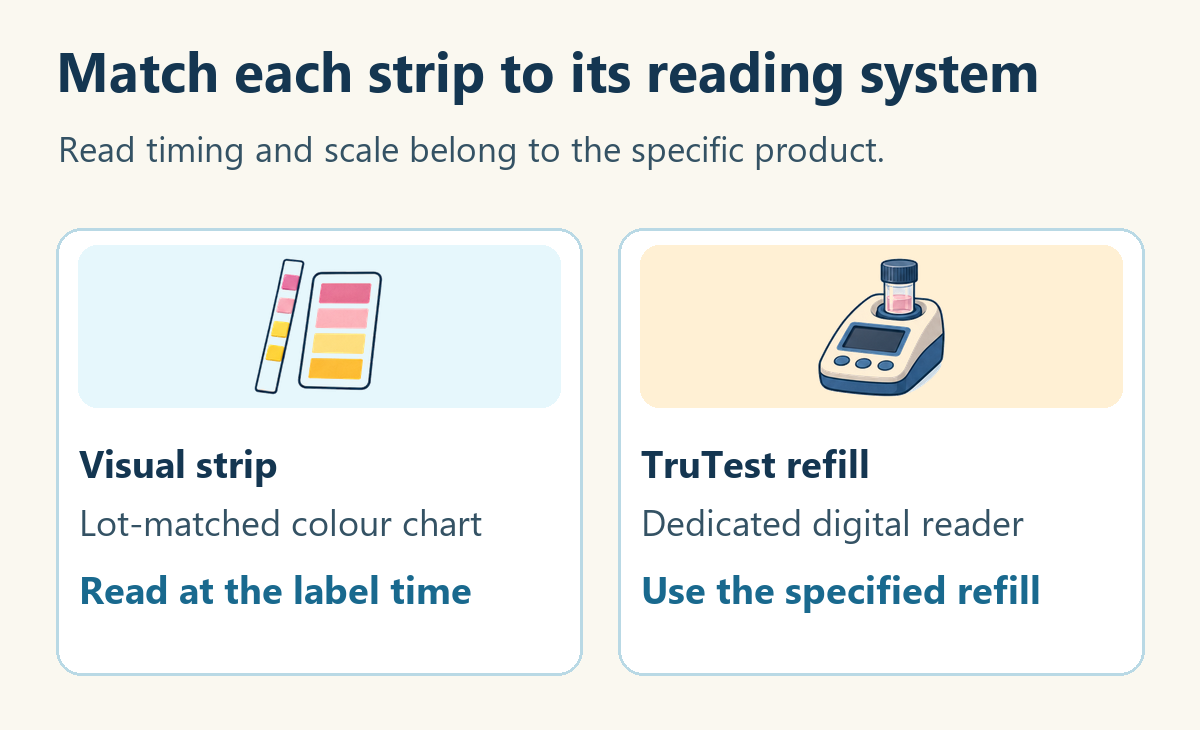
Switching visual strip brands breaks down fast when technicians keep their old AquaChek muscle memory or when retail clerks sell visual bottles to customers carrying a digital strip reader. Three operational boundaries separate clean switches from guaranteed misreads.
Why AquaChek TruTest Digital Readers Reject Generic Visual Strips
Never place third-party or standard visual pool test strips inside an AquaChek TruTest Digital Reader. AquaChek TruTest Test Strip Refills—measuring Free Chlorine (0-10 ppm), pH (6.2-8.4), and Total Alkalinity (0-240 ppm)—are built specifically for the blue AquaChek TruTest Digital Reader (Data as of 2026-11).
Optical strip readers measure reflected light across fixed pad spacing and calibrated dye wavelengths. Standard visual strips differ in pad position, backing reflectivity, and color-development curves, so feeding a visual strip into an optical reader produces invalid readings.
- When a walk-in customer owns a TruTest reader during a refill stockout: Offer a complete standalone visual strip bottle (read by eye against its own chart) or a liquid drop test kit rather than selling visual strips as digital refills.
- When training counter staff: Have clerks ask whether the customer reads strips by eye or inside a digital reader before recommending any replacement SKU. That single screening question prevents guaranteed returns and protects customer trust.
Cross-Brand Dip Timing, Shaking Rules, and Lot-Matched Bottle Charts
Even among visual-read test strips, dip duration, shaking rules, and color-development wait times vary by manufacturer. Bottle color charts are never interchangeable across brands or production lots.
- AquaChek Yellow procedure: Dip and pull the strip right back out, keep it flat for 15 seconds without shaking away excess water, and match the pH, free chlorine, total alkalinity, and stabilizer pads in order on the vial chart.
- HTH 6-Way procedure and label check: HTH instructs submerging the strip well clear of return jets for 2 seconds, lifting it pads-up without shaking, and holding it flat for 20 seconds (captured 2026-09-22). Notably, HTH's webpage mentions total chlorine in body text while labeling its interactive chart Free Available Chlorine (FAC), underscoring why you should verify the printed bottle label instead of web summaries.
- Kingnod (our company) strip procedure: Our pool and spa test strips use a 1-second dip and 15-second level hold, and because reagent pad coloration can vary across manufacturing batches, each bottle is read only against its own lot-matched color chart.
- Why charts cannot cross brands: Taylor Technologies notes that pool reagents—including test-strip pads—cannot be interchanged across manufacturers because identically named indicators differ in chemical strength and comparator calibration.
Hardware and chart lock-in: Optical readers require dedicated TruTest refills. Visual reagent formulations and comparator calibrations cannot be interchanged across manufacturers, and where reagent pad coloration varies by manufacturing lot, as on Kingnod (our company) test strips, each bottle must be read against its own lot-matched chart. Reading a 20-second strip at 15 seconds or holding a replacement strip up to a laminated old AquaChek bottle chart creates systematic dosing errors across every pool on the route.
For a side-by-side comparison of day-to-day visual readability across mainstream retail bottles, see our best pool test strips comparison. Once technicians retrain on the replacement bottle's exact timer and discard old bottle charts, the next threat to accuracy happens before a strip ever touches pool water: moisture and heat inside the vial.
Packaging, Desiccant Caps, and Shelf-Life Limits That Decide Store Shrinkage
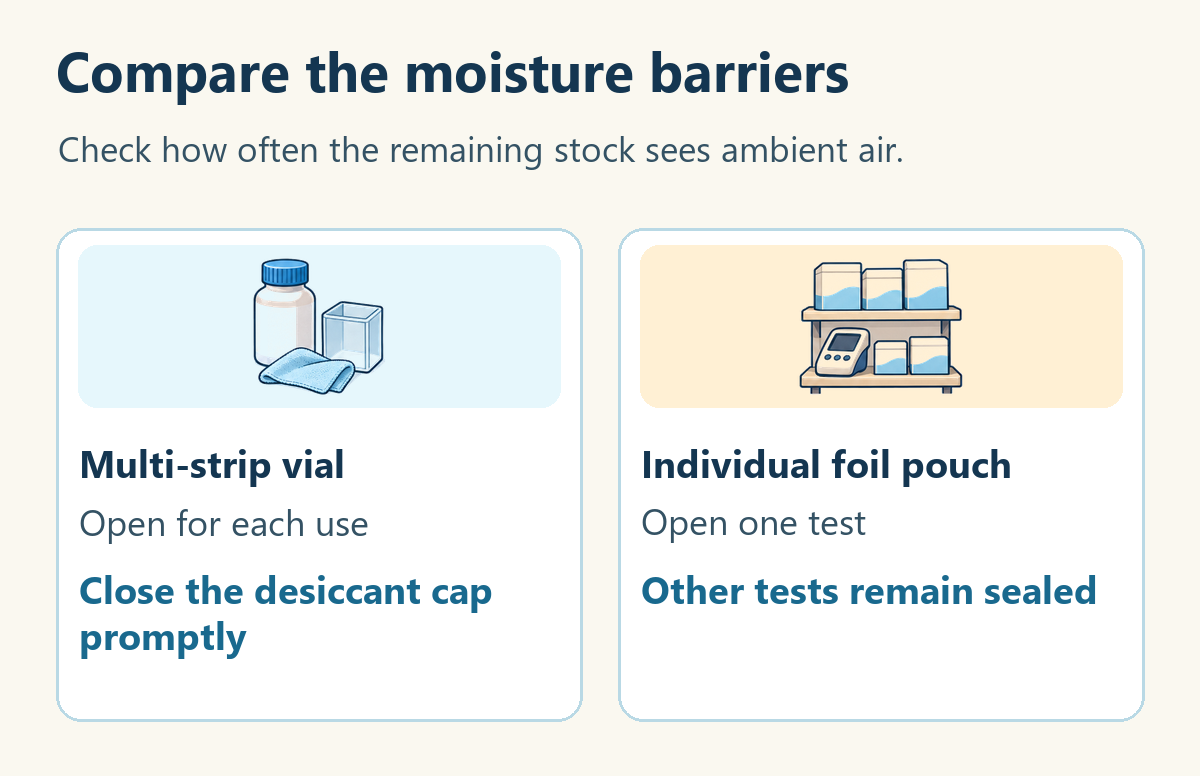
Unit cost per strip means little if half the bottle drifts out of spec from humidity or summer truck heat. Evaluate moisture-barrier vial design, storage temperature limits, and opened shelf life before placing a bulk replacement order.
Desiccant Liners, Flip-Top Caps, and Foil Pouches
Test-strip pads absorb atmospheric moisture rapidly whenever a bottle sits open beside a pool or inside a humid supply room. Packaging architecture determines how long unused pads stay dry.
LaMotte Insta-TEST 6 Plus (3028-HB-6) packs 50 strips into a waterproof PopTop bottle built with a hinged cap and a molded desiccant liner designed to shield pads from moisture and UV light (updated 2025-11-27). A molded desiccant liner eliminates loose desiccant packets that technicians accidentally dump out during poolside testing.
Single-strip dispensing matters just as much. AquaChek Red bottles use a flip-top cap shaped to dispense one strip at a time, cutting down wet-finger contact with unused strips remaining inside the vial (Data as of 2026-11). AquaChek Yellow directions likewise call for closing the cap right after pulling a strip, keeping the drying agent inside, storing the vial dry and shaded at room temperature, and discarding the bottle once it passes the cap expiration date.
In humid coastal markets or low-turnover retail counters where bottles stay open for months, foil-barrier formats change the shrinkage math. Lovibond (a UK pool-testing reference) notes that bottled strips can deteriorate over time after opening, whereas individually foil-wrapped reagent tablets isolate each dose so the last unit performs like the first. For visual strip programs facing severe humidity, choosing smaller vial counts or optional foil pouches reduces moisture exposure between tests.
Matching Bottle Size to Opened Shelf Life and Truck/Warehouse Storage
Unopened shelf life and post-opening stability are two completely different clocks. Kingnod (our company) specifies a 3-year unopened shelf life and a 150-day post-opening window for its pool and spa test strips, offered in customizable 20-, 50-, or 100-strip bottles or optional foil pouches.
Temperature and chemical fumes shorten that window even further. Taylor Technologies classifies all pool testing reagents, including test-strip pads, as perishables. Taylor advises consistent storage between 36°F and 85°F (2°C to 29°C), out of direct sunlight, and away from treatment chemicals, with caps tightened right away and fingers kept off reagent pads. Leaving a strip vial in a hot service truck bed beside muriatic acid or chlorine buckets degrades pads long before the printed expiry date.
Storage and turnover checkpoint: Keep strip vials consistently between 36°F and 85°F (2°C to 29°C) away from pool chemicals, and align bottle count to actual consumption—unopened storage can reach 3 years, while opened bottles have a much shorter active window (such as 150 days on our company's vials).
Practical habit for routes and counters: Write the opening date directly on the bottle cap with a waterproof marker the moment a vial enters a service bag or counter testing station. Store active vials inside an insulated kit box away from chemical jugs, and retire opened bottles on schedule rather than waiting for visible pad discoloration.
For distributors and retail stores stocking humid or seasonal accounts, choosing 20- or 50-strip desiccant flip-top vials—or foil pouches—typically carries a higher packaging cost per strip than 100-strip tubs yet helps reduce moisture-spoilage waste. High-volume summer routes finish 50- to 100-strip bottles well inside the opened window as long as technicians carry them inside an air-conditioned cab or cooler.
Even a well-packaged, fresh-lot strip needs proof in real pool water before you commit warehouse inventory across every store or truck—which brings you to split-sample bench verification.
How to Run a Side-by-Side Verification Against a FAS-DPD or DPD Kit Before Switching
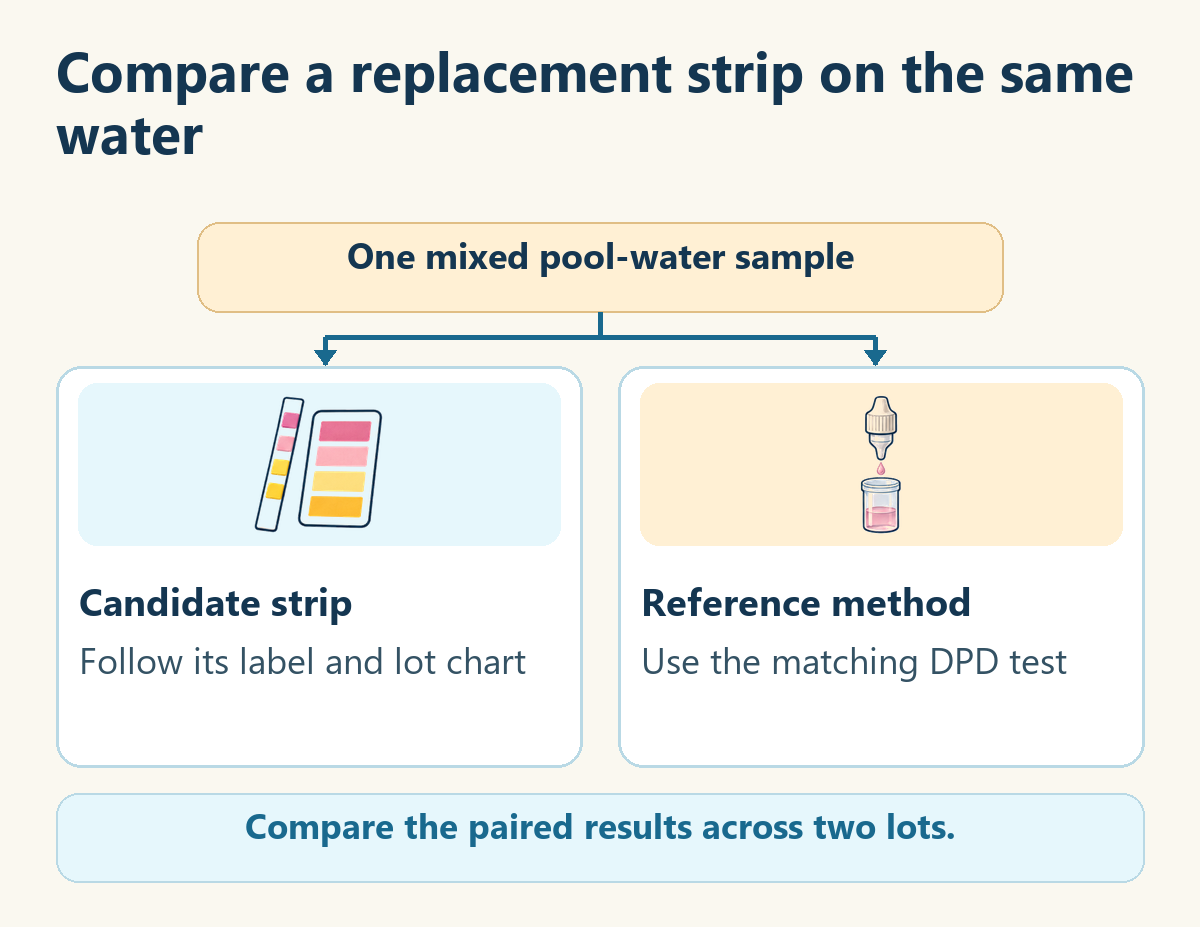
Never approve an unfamiliar replacement brand or private-label batch on catalog specs alone. Run a controlled side-by-side check on split pool water samples against a FAS-DPD titration or colorimetric DPD kit before rolling out stock.
Five-Step Split-Sample Qualification Protocol (FAS-DPD / DPD Benchmark)
Choose the right reference kit first. Pool & Spa News contrasts quick dip-and-read strips against OTO (orthotolidine, which cannot measure free chlorine), colorimetric DPD drop kits, and FAS-DPD (ferrous ammonium sulfate–DPD) titration—which counts drops to a sharp color-change endpoint instead of asking an operator to match pink shades. Always benchmark replacement strips against FAS-DPD titration or colorimetric DPD, never OTO.
Follow this five-step Pre-Switch Side-by-Side Strip Qualification Checklist for retail brand switches and incoming trade sample lots:
- Draw one shared water sample. Collect pool water elbow-deep away from return jets into a single clean cup or bucket so both the reference kit and candidate strips test the same shared water sample. Test across two real sanitizer levels (normal maintenance chlorine and elevated chlorine) rather than a single mid-range pool.
- Screen temperature and recent shock chemistry. Verify sample water is at least 60°F (16°C) and free of recent potassium monopersulfate (MPS) non-chlorine shock before running comparisons 4.
- Run the reference kit first. Measure baseline free chlorine and total chlorine with FAS-DPD titration or direct colorimetric DPD (keeping direct colorimetric DPD free-chlorine comparisons within its 10 mg/L direct measurement ceiling), and record pH, total alkalinity, and CYA using the reference kit's separate tests.
- Dip and time the candidate strip strictly per its bottle label. Follow the exact dip duration, no-shake rule, and wait seconds printed on the candidate vial, and read the pads under consistent neutral daylight against that exact bottle's printed chart.
- Repeat on a second production lot and log batch codes. For wholesale or private-label approvals, test two separate lot numbers side by side against the same reference kit and inspect lot-to-lot color consistency before releasing bulk purchase orders.
Using one shared sample cup under consistent daylight eliminates circulation pockets and indoor-vs-outdoor lighting shifts when deciding whether a candidate batch reads cleanly.
Controlling Three False-Failure Traps: High-Chlorine Bleaching, MPS Shock, and Cold Water
Even an accurate replacement strip looks broken if you test it in chemically interfering water. Control these three confounders before rejecting a candidate batch:
- High-chlorine bleaching (near 10 ppm and above): Elevated chlorine bleaches indicator dyes pale or colorless. CDC's 2024 MAHC (Model Aquatic Health Code, a voluntary US model standard) Annex Section 4.7.3.5 notes that chlorine near 10 ppm can bleach DPD reagents or turn phenol red pH indicators purple at pH 6.6 and above 4. UK PWTAG (Pool Water Treatment Advisory Group, an adjacent UK guidance reference) advises checking for an initial flash of color and diluting with chlorine-free water when an active chlorinated pool reads zero; when free chlorine reads too high, PWTAG advises a twofold dilution—mixing equal parts pool water and chlorine-free water (1:1), retesting, and multiplying the reading by 2 3.
- Potassium monopersulfate (MPS) non-chlorine shock: Per CDC's 2024 MAHC Annex Section 4.7.3.5, MPS creates false-high combined chlorine readings whenever present and false-positive free chlorine readings above 25 ppm MPS 4. Wait for MPS residuals to clear—or use an MPS interference eliminator on your reference kit—before qualifying strips.
- Cold water below 60°F (16°C): CDC's 2024 MAHC Annex advises gently warming water colder than 60°F (16°C) up to at least 60°F to ensure accurate results 4.
Bleaching and interference example: If a shocked pool reads zero free chlorine on both your strip and DPD kit—or flashes pink and disappears—do not blame the replacement strip. Follow PWTAG's chlorine-free water dilution check (and for off-scale high readings, mix equal parts pool water and chlorine-free water at 1:1 and multiply the result by 2) 3 while verifying temperature (at least 60°F / 16°C) and MPS status per CDC 2024 MAHC Annex Section 4.7.3.5 4 before scoring the sample.
For a residential service supervisor switching retail strip brands, running this protocol across low-, mid-, and high-chlorine route pools typically takes an afternoon and spots wide color-block bias early. For an importer evaluating custom strips, budgeting extra lead time to qualify two production lots with lot-matched charts protects an entire container order.
Passing a split-sample bench check confirms a strip works for routine residential or service screening, yet commercial and public pools face a separate legal boundary where no test strip may qualify at all.
Where Public Pool Codes Restrict Test Strips (NSF/ANSI 50 and Health Rules)
Switching test strip brands never overrides local public-health law. Commercial pool suppliers and operators must separate what equipment testing standards measure from what state and county health inspectors actually permit in daily compliance logs.
What NSF/ANSI 50 Section 19 Actually Tests on Water Quality Strips
NSF/ANSI 50 is the North American public-health standard covering recreational water equipment and water quality testing devices (WQTDs). Per Intertek's 2019-01-03 standards update notice for NSF/ANSI 50 (2017 Edition, effective 2019-10-01), qualifying test strips under Section 19 requires testing at least 2 manufacturing lots against one set of reference solutions. Each lot must have at least 50% of its specified shelf life remaining at the start of testing and meet Annex O precision and inter-lot reproducibility limits 1.
The standard also tests aging stability: after storage per the manufacturer's instructions, devices must be retested at their specified shelf life (plus or minus 2 weeks), with accuracy, repeatability, and reproducibility staying within 10% of initial results and test strips or comparators meeting Annex O limits 1. Always verify active certification status directly in the certifier's official public directory rather than assuming a brand or SKU is listed.
Why State and County Codes Still Mandate DPD Kits or Tablet Photometers
Even when test strips meet strong factory quality controls, local public-pool regulations frequently bar them from official disinfectant compliance logs.
In Illinois, the Lake County Health Department Swimming Pool Operator Self-Study Manual (2024-08-26, based on 77 Ill. Adm. Code 820) requires a DPD-type colorimeter test kit for public-pool disinfectant residual (and demonstrates DPD-FAS titration in its chemical test procedures), explicitly prohibiting test strips or OTO in place of the DPD kit. Under that Lake County manual, public operators must test disinfectant at least twice daily in both shallow and deep ends (away from inlets) using reagents less than 1 year old 2. Rules vary by state and county, so check your local health department's inspection code before specifying test methods for any commercial venue.
Commercial practice follows a similar line internationally. Lovibond (an adjacent UK leisure-pool reference) notes that commercial leisure operators routinely check pH and disinfectant multiple times each day with photometers or tablet comparators instead of visual strip papers, retaining water-quality logs for up to 7 years.
Compliance boundary: NSF/ANSI 50 Section 19 defines a two-lot and plus-or-minus 2-week shelf-life retest protocol after manufacturer-specified storage 1, but local health inspection rules—such as the Lake County, Illinois manual based on
77 Ill. Adm. Code 820—still require a DPD-type colorimeter test kit and forbid substituting any test strip for official public-pool logs 2.
Practical rule for commercial quotes: Ask hotel, HOA, apartment, fitness-club, and municipal pool accounts for their local health inspection checklist before quoting water-testing consumables. Position visual strips strictly for supplemental quick checks where local inspectors allow them, and route official compliance testing to DPD drop kits or tablet photometers. See our Lovibond and Palintest tablet alternatives guide when sourcing compatible photometer tablets.
With commercial compliance logs routed cleanly to DPD kits and photometers, you can match the remaining visual-strip demand to either established retail brands or custom trade supply.
Comparing Retail Strip Brands, Custom B2B Supply, and Other Branded Pool Alternatives
Once you know your exact parameter panel, range ceiling, packaging needs, and compliance boundary, your sourcing choice splits into two clear lanes: off-the-shelf retail/pro brands where Western distribution is open, or custom-packaged trade supply where brands are stock-constrained or private-label flexibility matters.
Retail/Pro Strip Alternatives vs. Custom B2B Supply (Data as of 2026-11)
The matrix below compares verified public specifications for established visual strip alternatives alongside custom trade test strips from Kingnod (our company), strictly on documented parameters, packaging, and ordering rules without supplier rankings (Data as of 2026-11).
| Option / Line (Data as of 2026-11) | Parameters & Published Ranges | Pack Format & Unit | Key Verification & Ordering Notes |
|---|---|---|---|
LaMotte Insta-TEST 6 Plus (3028-HB-6, updated 2025-11-27) |
Seven params: FC 0-10 ppm, TC 0-10 ppm, Br 0-20 ppm, TA 0-240 ppm, pH 6.2-9.0, TH 0-800 ppm, CYA 0-250 ppm | 50 strips per waterproof PopTop bottle with molded desiccant liner | Published discrete color steps; retail/pro strip with owner's handbook (verify local distributor stock) |
Taylor 7-Way (K-1403-PB-50) |
Seven params: FC, TC, Bromine, pH, Alkalinity, Hardness, CYA | Commercial 50-bottle pack + booklet (not a single retail vial) | Confirm case vs. single-vial unit before quoting commercial buyers |
Palintest 3-Way (PTJ634) & 6-Way (PTJ637, 2022 brochure, UK/EU) |
PTJ634: FC, pH, TA; PTJ637: FC, TC/Br, pH, CYA, Hardness, TA |
50 strips per pack; visual dip-and-read, no meter required | Adjacent European/international channel option for residential pools |
| Kingnod (our company) Custom Pool & Spa Test Strips | Seven configurable standard params (TH, FC, Br, TC, CYA, TA, pH) + optional custom salinity pad; numeric ranges & color steps: Not published — confirm on sample | Customizable 20-, 50-, or 100-strip bottles or optional foil pouches; lot-matched bottle chart | Small and mid-to-large orders accepted; typically ships within 3 weeks after order confirmation (not a guarantee); FOB/CFR/CIF; T/T (30% in advance, 70% against copy of B/L) or 100% L/C at sight |
Sources: LaMotte Insta-TEST 6 Plus (3028-HB-6) Official Specifications (2025-11-27), Taylor Technologies 7-Way Test Strips (K-1403-PB-50) Official Product Listing (Data as of 2026-11), Palintest Pool & Spa Brochure V8.6 (2022, UK/EU), and Kingnod (our company) confirmed test-strip specifications and order terms.
Watch unit definitions closely when comparing quotes. Taylor's K-1403-PB-50 is a 50-bottle commercial pack plus booklet—not a single 50-strip retail vial—whereas LaMotte 3028-HB-6 and Palintest PTJ634 and PTJ637 specify 50 strips per bottle or pack. In open US and European wholesale channels, LaMotte, Taylor, HTH, and Palintest offer immediate brand recognition and published chart scales, though packaging seals and color-block steps still vary by SKU.
What to Request Before Ordering Custom or Private-Label Test Strips
When branded strips face import restrictions, stockouts, or margin pressure, or when you want your own parameter mix, bottle count, or foil-pouch pack, custom trade supply becomes the practical route. Kingnod (our company) supplies configurable visual pool and spa test strips covering seven standard parameters (pH, Free Chlorine, Total Chlorine, Bromine, Total Alkalinity, Total Hardness, and CYA) with an optional customizable salinity pad. Vials come in 20-, 50-, or 100-strip counts or optional foil pouches with lot-matched bottle charts. For test strips, small through mid-to-large orders are accepted, standard shipments typically depart within 3 weeks of order confirmation (which is not a contractual guarantee), and orders run under FOB, CFR, or CIF terms with T/T (30% in advance, 70% against copy of B/L) or 100% L/C at sight.
Because exact pricing, minimum quantities, current inventory, and numeric color-block steps vary by custom configuration and batch, lock down four written items before sending a deposit:
- Exact parameter mix and bottle format: Specify which standard parameters (and whether an optional salinity pad) are required, plus 20-, 50-, or 100-strip desiccant vials or foil pouches.
- Two-lot pre-shipment sample bottles: Request sample vials from two distinct manufacturing lots together with each lot's printed bottle color chart, then run the split-sample FAS-DPD check covered earlier to confirm readable block spacing and water agreement on your target pools.
- Unopened and opened shelf-life sheet: Confirm batch expiration printing, storage temperature window, and post-opening stability (using the packaging and turnover rules detailed above) so your warehouse rotates stock cleanly.
- Written trade terms and shipping schedule: Confirm Incoterms (FOB, CFR, or CIF), payment structure (T/T with 30% advance deposit plus 70% against B/L copy, or 100% L/C at sight), and target production window for your exact order volume via the PoolTradeDesk contact page.
Replacing Other Branded Pool Consumables: Tablets, Cartridges, and Filter Media
The same discipline that governs test strips—matching measurable specs and running lot-level checks rather than relying on brand labels—applies across every supply-constrained pool consumable. Under NSF/ANSI 50 Section 19.2.6 (2017 Edition, effective 2019-10-01), water quality testing devices evaluated under the standard must retest within 10% of initial accuracy, repeatability, and reproducibility at their specified shelf life (plus or minus 2 weeks) after storage per the manufacturer's instructions, with test strips and comparators meeting Annex O limits 1, while Lovibond's UK commercial reference highlights why individually foil-wrapped tablet reagents preserve dose consistency from first tablet to last.
When your store, service company, or import catalog needs verified alternatives beyond visual test strips, use our dedicated specification guides across this cluster:
- Photometer & comparator DPD tablets: For regulated venues or commercial reagent swaps, follow the DPD tablet compatibility guide linked in the public-pool compliance section above.
- Replacement filter cartridges: Match OEM, Pleatco, Unicel, and Filbur codes by physical outside diameter, cap-to-cap length, end caps, and pack count in our pool filter cartridge cross reference guide.
- Filter cartridge maintenance vs. replacement: Decide when to degrease or retire pleated elements before reordering in our cleaning pool filter cartridges guide.
- Activated & recycled glass filter media: Compare particle sizing and published specifications in our AFM glass filter media alternatives guide.
Verify Specs and Run One Split-Sample Check Before Switching Brands
Replacing AquaChek test strips cleanly comes down to five verifiable checkpoints rather than matching pad count on a carton. Lock in the exact sanitizer chemistry and range ceiling for your current SKU, keep TruTest optical readers strictly on dedicated digital refills, and retrain staff on each replacement bottle's dip timer and lot-matched chart. Protect stock in desiccant flip-top vials or foil pouches stored at consistent room temperature away from pool chemicals, then qualify two sample lots side by side against a FAS-DPD or DPD reference kit.
Where Western retail channels are open, swap directly into published lines such as LaMotte Insta-TEST, Taylor, HTH, or Palintest once their color-block increments fit your dosing targets. For commercial venues governed by strict state or county inspection rules, follow local code mandates and stick with approved DPD liquid or tablet photometer methods for official logs. Where import limits or private-label margins point toward custom wholesale supply, including configurable test strips from Kingnod (our company), let two-lot split-sample FAS-DPD results make the final call before you commit inventory.
References
- NSF/ANSI 50 Water Quality Testing Device Batch, Accuracy, and Shelf-Life Testing — 2019-01-03
- Lake County Illinois Public Pool Manual: DPD Chlorine Requirement and Test Strip Restriction — 2024-08-26
- PWTAG Pool Water Quality Troubleshooting: High-Chlorine DPD Bleaching and Dilution Retest
- CDC MAHC Annex: Potassium Monopersulfate (MPS) Interference and Cold-Water (<16 C) Warming — 2024
How this guide was prepared
Prepared by Martin. Based on 4 cited sources listed in References. Content date: 2026-11-26.