Use the dual-unit pool chemical dosage chart below for linear parts-per-million (ppm) adjustments per 10,000 US gallons (37.85 m³) or per 10 m³ and 1 m³, matching the exact active-ingredient strength printed on your product label.18 Never apply a single fixed chart dose to pool pH, because total alkalinity buffers acid and base additions nonlinearly and requires titration testing.
PoolTradeDesk (operated by our company, Kingnod) compiled this field reference from PHTA Appendix B, CDC 2024 MAHC, UK PWTAG/HSG282, and public-health dosing tables for service technicians, commercial operators, and retail counters. Match your sanitizer strength first, confirm your target band, and re-test after circulation before pouring a second dose.
- 12.5% liquid chlorine (+1 ppm FC): 10.6 fl oz per 10,000 US gal; 12% liquid uses 10.7 fl oz per 10,000 US gal or 82.5 mL per 10 m³.1918
- 67% calcium hypochlorite (+1 ppm FC): 2 oz per 10,000 US gal, or 63 g per 40,000 L (15.8 g per 10 m³).18
- Baking soda (+10 ppm TA): 1.4 lbs per 10,000 US gal, or 670 g per 40,000 L (168 g per 10 m³).18
- Summer bleach decay: 12.5% liquid chlorine half-life drops from 180 days at 77°F (25°C) to 48 days at 95°F (35°C).19
Pool Chemical Dosage Chart (per 10,000 US Gallons and per m³ / 10 m³)
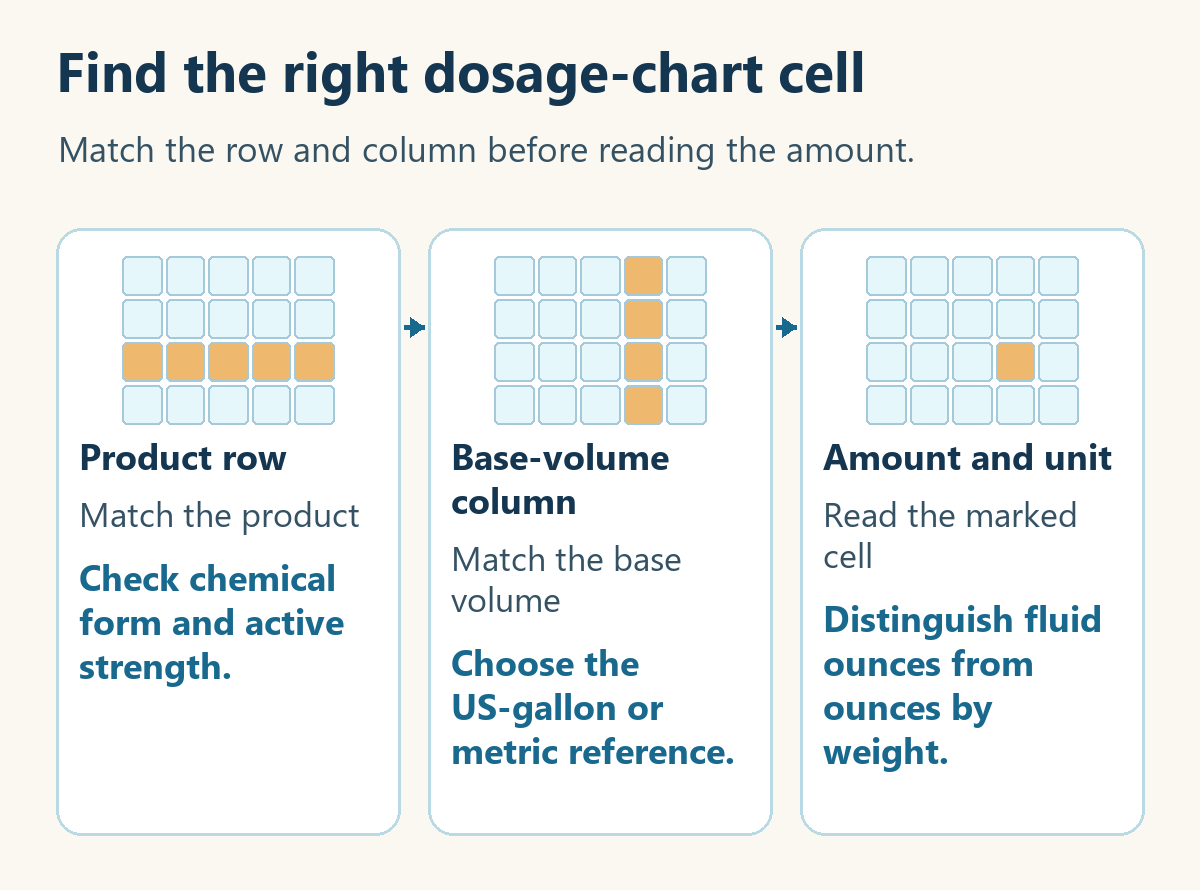
A pool chemical dosage chart gives stoichiometric starting amounts at nominal product strength. Free chlorine (FC) is the active sanitizing chlorine available in water to kill bacteria and algae, measured in ppm or mg/L (1 ppm equals 1 mg/L).
PHTA Appendix B-2 publishes separate rounded columns for 10,000 US gallons (37.85 m³) and 40,000 liters (40 m³).18 Because 40,000 liters is 5.7% larger than 10,000 US gallons, dividing the 40,000 L figures by 4 gives clean per-10 m³ doses, and dividing by 40 gives per-1 m³ doses without introducing gallon-to-metric rounding drift.
Master Dual-Unit Dosage Chart (per 10,000 US Gallons, per 10 m³, and per 1 m³)
The table below covers routine pool chemicals across their standard label strengths. Chart values are rounded guidelines that do not supersede product label instructions.18
| Parameter & Target Change | Chemical & Nominal Strength | per 10,000 US gal (37.85 m³) | per 10 m³ (10,000 L) | per 1 m³ (1,000 L) |
|---|---|---|---|---|
| Increase FC +1 ppm | Liquid chlorine (sodium hypochlorite, 12.5%) | 10.6 fl oz19 | 80 mL | 8.0 mL |
| Increase FC +1 ppm | Liquid chlorine (sodium hypochlorite, 12%) | 10.7 fl oz18 | 82.5 mL18 | 8.3 mL18 |
| Increase FC +1 ppm | Liquid chlorine (bleach, ~10%–10.3%) | 13 fl oz22 | 100 mL | 10 mL |
| Increase FC +1 ppm | Calcium hypochlorite (cal hypo, 67%) | 2 oz18 | 15.8 g18 | 1.6 g18 |
| Increase FC +1 ppm | Dichlor (sodium dichlor, 56%) | 2.4 oz18 | 18 g18 | 1.8 g18 |
| Increase FC +1 ppm | Dichlor (sodium dichlor, 62%) | 2.1 oz18 | 16.3 g18 | 1.6 g18 |
| Increase FC +1 ppm | Trichlor (90%, feeder dosing) | 1.5 oz18 | 11 g18 | 1.1 g18 |
| Increase TA +10 ppm | Sodium bicarbonate (baking soda) | 1.4 lbs18 | 168 g18 | 16.8 g18 |
| Increase TA +10 ppm | Soda ash (sodium carbonate) | 14 oz18 | 100 g18 | 10 g18 |
| Decrease TA −10 ppm | Muriatic acid (31.45% / 31.4%) | 26 fl oz18 | 200 mL18 | 20 mL18 |
| Decrease TA −10 ppm | Sodium bisulfate (dry acid) | 2.1 lbs18 | 258 g18 | 25.8 g18 |
| Raise or lower pH | Soda ash / Muriatic acid / Dry acid | Use acid or base demand test | Use acid or base demand test | Use acid or base demand test |
| Increase CH +10 ppm | Calcium chloride (77% flake) | 1.2 lbs18 | 144 g18 | 14.4 g18 |
| Increase CH +10 ppm | Calcium chloride (100% anhydrous) | 0.9 lbs18 | 101 g18 | 10.1 g18 |
| Increase CYA +10 ppm | Cyanuric acid (stabilizer) | 13 oz18 | 100 g18 | 10 g18 |
| Neutralize FC −1 ppm | Sodium thiosulfate | 2.6 oz18 | 19.8 g18 | 2.0 g18 |
| Increase salt +100 ppm | Pool salt (99% NaCl) | 8.33 lbs | 1.0 kg | 100 g |
Three table details need quick context before you scoop or pour:
- 10% bleach alignment: Salt Lake County Health Department's chart lists 13 fl oz of liquid bleach per 10,000 US gallons for +1 ppm (1/2 gallon for +5 ppm, 1 gallon for +10 ppm) without printing a percentage on that row.22 That 13 fl oz rate aligns with 10%–10.3% liquid bleach under Taylor-based sanitizer charts and Indiana Department of Health's active-chlorine formula.7 For the metric columns, the 12.5% and 10% liquid chlorine entries give direct stoichiometric weight-by-volume equivalents per 10 m³ and per 1 m³, whereas the 12% liquid chlorine row divides the 40,000 L column of PHTA Appendix B-2.
- Pool salt scaling: Pool-salt product data sheets report that one 40 lb bag adds 480 ppm salt to 10,000 US gallons. Dividing 40 lbs by 4.8 gives 8.33 lbs per +100 ppm (or 83.3 lbs per +1,000 ppm) per 10,000 US gallons, which equals 100 g per m³ per +100 ppm.
- Retail counter printing: When printing a wall or counter sheet, keep the pH row visibly blank for fixed numbers so route techs and customers do not pour a single fixed acid volume into low-alkalinity water.
Published Reference Contrast — Acid Required to Lower TA by 10 ppm: PHTA Appendix B-2 (2021) lists 26 fl oz of 31.4% muriatic acid or 2.1 lbs of sodium bisulfate per 10,000 US gallons to reduce total alkalinity by 10 ppm.18 By contrast, CDC 2024 MAHC Annex 5.7.4.4.1 lists 1.3 quarts (41.6 fl oz) of muriatic acid or 1.6 lbs of dry acid for the same 10 ppm drop.11 Because authoritative references differ, follow the container label, add a partial dose first, and re-test after circulation.
Adjusting for Different Active-Ingredient Strengths (47%–78% Cal Hypo, 10% vs. 12.5% Bleach, 77% vs. 94% CaCl₂)
Available chlorine (%) is the weight percentage of active chlorine-releasing compound listed on the sanitizer label, and it controls how much product is needed for each 1 ppm shift. Commercial calcium hypochlorite spans 47% to 78% available chlorine across grades.18
When your bucket strength is not printed on a wall chart, Indiana Department of Health gives a direct per-10,000-gallon formula for +1 ppm: divide 0.083 lbs (for solids) or 1.3 fl oz (for liquids) by the decimal percent of available chlorine.7 For example, 73% cal hypo takes 0.083 ÷ 0.73 = 0.114 lbs (1.82 oz), while 65% cal hypo takes 0.083 ÷ 0.65 = 0.128 lbs (2.05 oz).
PHTA RWQC Table 1 confirms those solid-chlorine yields per 1 lb in 10,000 US gallons: 65% cal hypo adds 7.8 ppm, 70% adds 8.4 ppm, 75% adds 9.0 ppm, and 90% trichlor adds 11.0 ppm, while 1 gallon of 12.5% liquid chlorine adds roughly 12.5 ppm.19 For anhydrous 94% calcium chloride pellets, the +10 ppm dose sits just above 100% anhydrous calcium chloride (0.9 lbs) at roughly 0.96 lbs per 10,000 US gallons, compared with 1.2 lbs for 77% flake.18
Always check the active-ingredient percentage printed on the bucket or carboy before pulling a number off a wall chart. When switching chemical suppliers or seasonal restocks, matching the label strength prevents systematic under-dosing or over-dosing. If you are weighing liquid chlorine against granular shock for your route trucks, compare cost and handling in Pool Shock Liquid vs Powder: Which to Use and When, or explore the full Water Chemistry for Pool Pros hub.
Before multiplying any chart dose by your pool volume, confirm which target range applies to your pool type and local code.
Target Pool Water Chemistry Ranges: PHTA/ANSI, CDC MAHC, and UK HSG282/PWTAG
Before scaling any dose, verify which target water chemistry standard governs your pool. Total alkalinity (TA) measures the water's ability to buffer pH swings, calcium hardness (CH) tracks dissolved calcium that prevents plaster etching or scaling, and cyanuric acid (CYA) is the outdoor stabilizer that shields chlorine from sunlight.
Online cheat sheets often mix residential guidelines with commercial model codes and UK spa-pool rules. The table below puts PHTA Appendix B-1 (2021 recommended ranges, alongside ANSI/PHTA/ICC-11 2026 voluntary consensus water-quality governance), CDC 2024 MAHC (5th Edition), UK PWTAG Code of Practice for normal pools, and UK HSE HSG282 Table 3 for business spa pools side by side.17
Side-by-Side Target Chemistry Table: PHTA/ANSI, CDC 2024 MAHC, and UK PWTAG / HSG282
| Parameter | PHTA Appendix B-1 (Recommended) | CDC 2024 MAHC (Public Model Code) | UK PWTAG (Normal Pools) | UK HSE HSG282 (Business Spas) |
|---|---|---|---|---|
| Free Chlorine (FC) | Pools: 1.0 min / 2.0–4.0 ideal / 5.0 max; Spas: 2.0 / 3.0–5.0 / 10.0 ppm18 | Min 1.0 (no CYA), 2.0 (with CYA), 3.0 (spas); max per product label12 | Hypochlorite <=3 mg/L (stop at 5 mg/L fault); stabilized 2.5–5 mg/L21 | Typical 3–5 mg/L; close if <1 or >10 mg/L6 |
| Combined Chlorine (CC) | Max 0.4 ppm pools / 0.5 ppm spas18 | Action required above 0.4 ppm15 | Less than half FC and <=1 mg/L21 | Review controls above 1 mg/L6 |
| pH | 7.2–7.8 (ideal 7.4–7.6)18 | Annex prefers 7.2–7.615 | Target 7.2–7.4 for chlorine21 | 7.0–7.6 (close spa if outside)6 |
| Total Alkalinity (TA) | 60–180 ppm (ideal 80–100 hypochlorite; 100–120 acidic Cl₂)18 | 60–180 ppm15 | 80–200 mg/L as CaCO₃21 | Managed within pH/balance controls |
| Calcium Hardness (CH) | Pools: 150–1,000 (ideal 200–400); Spas: 100–800 (ideal 150–250) ppm18 | Max 2,500 ppm; Annex prefers 200–400 masonry / 80–200 vinyl15 | Ideal 80–200 mg/L as CaCO₃21 | Managed per water supply balance |
| Cyanuric Acid (CYA) | Ideal 30–50 ppm; max per local code (typically 100 ppm)18 | <=90 ppm (>=300 ppm closure); banned in spas/therapy pools12 | <=150 mg/L (stabilized pools)21 | Not tabulated in Table 3; manage per dilution controls |
| Total Dissolved Solids (TDS) / Temperature | TDS <=1,500 ppm over startup18 | Max temp 104°F (40°C)15 | Managed by routine dilution | TDS <=1,000 mg/L over fill water6 |
Four nuances matter when translating these columns into daily targets:
- Sanitizer choice shifts ideal alkalinity. Under PHTA Appendix B-1, pools running alkaline liquid chlorine or calcium hypochlorite aim for 80–100 ppm TA, whereas pools running acidic trichlor, dichlor, chlorine gas, or BCDMH (bromine tablets) aim for 100–120 ppm TA to prevent rapid pH drops.18
- MAHC spa and therapy CYA rules carry explicit triggers. CDC 2024 MAHC Section 5.7.3.1 prohibits CYA and stabilized chlorine in spas and therapy pools upon new construction, substantial alteration, or disinfection-equipment replacement, and requires existing facilities to stop using them no later than 4 years after code adoption.12
- PWTAG hypochlorite upper limits distinguish drift from faults. Under UK PWTAG Clauses 9.5–9.10, free chlorine above 3 mg/L should not be necessary on unstabilized pools (reduce dosing if exceeded); if a dosing fault drives free chlorine to 5 mg/L, stop chlorination immediately and cease bathing if levels keep rising.21
- HSG282 governs business spa pools, not general swimming pools. On commercial UK spas, HSG282 Table 3 requires closing the spa when pH falls outside 7.0–7.6 or chlorine drops below 1 mg/L or exceeds 10 mg/L, and checking dosing units at 1–2 or 6–10 mg/L.6
Regional Contrast — Cyanuric Acid (CYA) Ceilings: CYA limits vary sharply by jurisdiction. PHTA B-1 lists 30–50 ppm ideal with local codes typically capping at 100 ppm;18 CDC 2024 MAHC caps public venues at 90 ppm (with mandatory closure at 300 ppm or higher and a spa/therapy ban);12 and UK PWTAG allows up to 150 mg/L in stabilized swimming pools.21 Always verify state or local limits before adding stabilizer to a commercial pool.
Recommended Guidelines vs. Model Code vs. Statutory Law (and Saltwater Ranges)
Do not confuse consensus guidelines with enforceable law. PHTA Appendix B-1 and ANSI/PHTA/ICC-11 2026 are voluntary industry consensus standards unless adopted locally.17 Likewise, CDC states explicitly that the MAHC is not federal law: it is a voluntary guidance document for public aquatic venues that becomes legally binding only if adopted (in whole or with modifications) by a state, local, territorial, or tribal authority, and it does not regulate private residential pools.3
For saltwater pools with in-line electrolytic chlorine generators (SWGs), PHTA RWQC notes typical operating salinity of 3,000–5,000 ppm (far below seawater's 31,000–38,000 ppm).20 Because excess salt increases corrosion risk while low salt shortens electrode life, always target the exact salinity window printed in your chlorinator manual.20
Post your local health department code limits next to your ideal target band on commercial pump-room log sheets. Separating statutory closure triggers from daily operating targets prevents accidental violations during routine inspections. For full public-venue compliance clauses, read MAHC Water Chemistry Requirements: Operator Summary; for state-by-state stabilizer rules, check Cyanuric Acid Limits for Commercial Pools by State.
Once you know your target range and current test reading, every parameter except pH scales linearly—so next we explain why pH breaks the fixed-chart rule.
Why pH Adjustment Has No Fixed Single Dose (Acid Demand, Total Alkalinity, and Soda Ash)
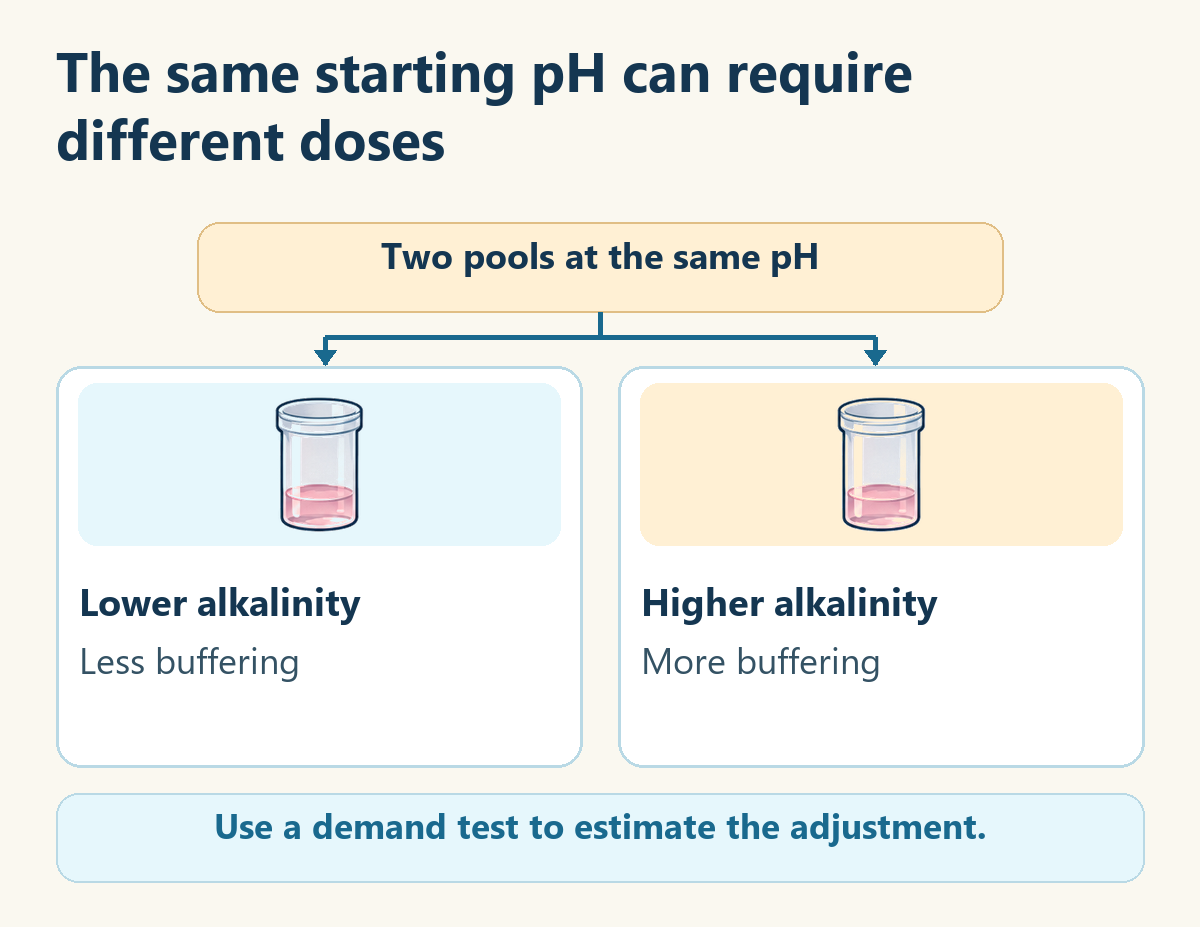
You cannot pull one fixed acid or soda ash volume off a chart to shift pool pH by 0.2. PHTA Appendix B-2 deliberately leaves the Increase/Decrease pH row blank and directs operators to pH Adjustment Testing instead.18
An acid demand test is a drop-by-drop titration of your pool water sample that measures exactly how much acid is needed to reach target pH at your pool's actual alkalinity. Skipping it is the fastest way to overshoot pH downward in low-alkalinity water or waste trips in heavily buffered water.
Why Total Alkalinity Makes Fixed pH Doses Unreliable
Total alkalinity measures the water's capacity to neutralize hydrogen ions, driven mainly by dissolved bicarbonates.11 When total alkalinity is low, a small acid or acidic-chlorine addition causes pH to drop rapidly, risking surface etching and metal corrosion.11
When total alkalinity is high, bicarbonate buffering resists pH movement and demands far more acid to achieve the same 0.2 pH drop. Indiana Department of Health therefore emphasizes running an Acid or Base Demand procedure rather than guessing from a static pH row.7
Taylor Acid Demand and Base Demand Tables (per 10,000 US Gallons) vs. Rough Starting Doses
With a Taylor-style drop test kit (such as R-0005 Acid Demand or R-0006 Base Demand), you count drops added to the pH sample until the color matches your target pH, read the 10,000 US gallon dose below, and scale it by (Actual Pool Volume ÷ 10,000 US gallons). The table below summarizes published Taylor-based drop conversions per 10,000 US gallons:
| Titration Drops (per 10,000 US gal) | 31.45% Muriatic Acid (Standard Taylor Chart) | 93.2% Dry Acid (Standard Taylor Chart) | Soda Ash — Base Demand (Taylor-Based Chart) |
|---|---|---|---|
| 1 drop | 9.16 fl oz | 12.3 oz | 5.00 oz |
| 2 drops | 1.15 pt | 1.54 lbs | 10.00 oz |
| 4 drops | 1.15 qt | 3.08 lbs | 1.25 lbs |
| 10 drops | 2.86 qt | 7.70 lbs | 3.13 lbs |
Chart Contrast — Match Your Own Test Kit Table: Field service manuals reproducing Taylor acid-demand tables list 9.16 fl oz of 31.45% muriatic acid and 12.3 oz of 93.2% dry acid per drop per 10,000 US gallons. Other Taylor-based retail charts list 8.60 fl oz of muriatic acid and 10.00 oz of dry acid per drop alongside 5.00 oz of soda ash per base-demand drop. Always match the exact printed chart and acid strength that belong to your reagent kit.
If you do not have acid or base demand reagents on site, use conservative partial doses and re-test after circulation. Yakima County's reference chart lists illustrative starting doses per 10,000 US gallons for roughly a 0.2 pH change—6 oz soda ash (raising TA by roughly 5 ppm), 12 fl oz of 35% hydrochloric acid (stronger than standard 31.45% muriatic acid, lowering TA by roughly 5 ppm), or 1.0 lb sodium bisulfate (lowering TA by roughly 5 ppm)—while flagging that actual pH shift varies with initial pH.24
On liquid-chlorine pools, PHTA's 2024 CPO Handbook gives an illustrative teaching estimate of 10–16 fl oz (295.7–473.12 mL) of 31% muriatic acid to offset the pH rise from each US gallon (3.785 L) of sodium hypochlorite used. Treat that strictly as a rough budgeting estimate—not a fixed site dose and never a direct mixing ratio between acid and bleach.
Choosing Between Soda Ash, Baking Soda, Acid, and CO₂
Soda ash (sodium carbonate) and baking soda (sodium bicarbonate) are not interchangeable.7 Baking soda raises total alkalinity while nudging pH only slightly, whereas soda ash lifts both pH and total alkalinity strongly.
When only alkalinity is low and pH is already on target, use baking soda instead of soda ash so you avoid overshooting pH and buying acid to pull it back down. When both pH and alkalinity are low, raise pH first with soda ash, then finish total alkalinity with baking soda.7
On commercial pools sanitized with sodium or calcium hypochlorite, Lake County (IL) Health Department notes that carbon dioxide (CO₂) offers an alternative to liquid or dry acid because CO₂ lowers pH without stripping total alkalinity (note that Lake County's handout states CO₂ raises alkalinity, whereas chemically dissolving CO₂ alone leaves total alkalinity essentially unchanged).8 To see how pH, alkalinity, calcium hardness, and temperature interact on plaster and heaters, read Langelier Saturation Index for Pools: Formula and Fixes.
With fixed-ppm doses and titrated pH doses cleanly separated, the next step is turning your pool's exact dimensions into a clean volume multiplier in US gallons or cubic metres.
How to Calculate Pool Volume and Scale Dosages (Worked US Gallon and m³ Examples)
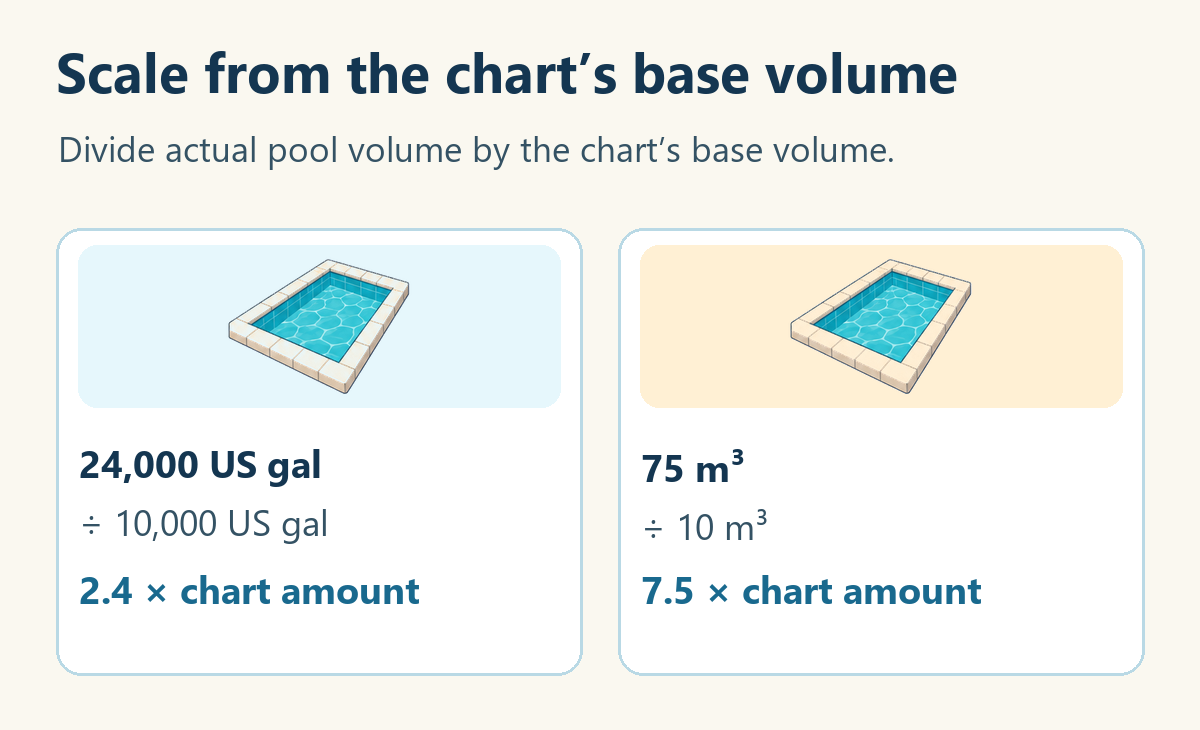
Every fixed-ppm chemical dose scales linearly with pool volume using PHTA Appendix B-3's three-factor formula:18
Total Chemical = Chart Dose × (Actual Pool Volume ÷ Chart Volume) × (Desired ppm Change ÷ Chart ppm Change)
Following Indiana Department of Health's dosage-calculation guide, calculate your Desired Change by subtracting Current from Target when raising a level, or subtracting Target from Current when lowering one.7
Pool Volume Formulas and Dual-Unit Conversion Constants (US gal, Imperial gal, m³, L)
Measure lengths and depths in feet to calculate US gallons using PHTA Appendix B-4's 7.5 gallons-per-cubic-foot factor, where Average Depth equals (Shallow Depth + Deep Depth) ÷ 2.18 Measure in metres and drop the 7.5 multiplier to obtain cubic metres (m³) directly, since 1 m³ holds 1,000 liters.18
| Pool Shape | Volume Formula (US Gallons, dimensions in ft) | Volume Formula (m³, dimensions in m) |
|---|---|---|
| Rectangular | L × W × Avg Depth × 7.518 | L × W × Avg Depth18 |
| Circular | 3.14 × r² × Avg Depth × 7.518 | 3.14 × r² × Avg Depth18 |
| Oval | Short R × Long R × 3.14 × Avg Depth × 7.518 | Short R × Long R × 3.14 × Avg Depth18 |
| Kidney | (Width A + Width B) × L × 0.45 × Avg Depth × 7.518 | (Width A + Width B) × L × 0.45 × Avg Depth18 |
Keep these PHTA Appendix B-4 conversion constants handy whenever crossing between US and metric charts:18
- Volume: 1 US gal = 3.785 L (so 10,000 US gal = 37.85 m³, not 40 m³); 1 m³ = 1,000 L; 1 ppm = 1 mg/L.18
- US vs. Imperial gallons: 1 Imperial gallon = 1.202 US gallons (and 1 US gallon = 0.832 Imperial gallons).18 Mixing up UK/Canadian Imperial gallons with US 10,000-gallon charts creates a major sizing error: an Imperial-gallon pool holds 20.2% more water than the same number of US gallons, so pouring straight from a US chart delivers only 0.832 of the required dose, while applying an Imperial chart to a US pool over-doses by 20.2%.18
- Weight vs. fluid measures: 1 lb = 16 weight oz (0.454 kg); 1 oz = 28.35 g; 1 US gal = 128 fl oz (4 quarts / 8 pints), pairing PHTA Appendix B-4's unit table with Indiana Department of Health's solid-to-pound conversion reminder.187
Worked Examples: Scaling a 24,000 US Gallon Pool and a 75 m³ Metric Pool
Both worked examples below are hypothetical field scenarios calculated directly from PHTA Appendix B-2 base rates:
Example 1 — 24,000 US Gallon Rectangular Pool (Hypothetical Scenario): Suppose a 20 ft × 32 ft pool has a 3 ft shallow end and a 7 ft deep end (Average Depth = 5 ft), giving 20 × 32 × 5 × 7.5 = 24,000 US gallons.18 You want to raise free chlorine from 1.0 ppm to 4.0 ppm (+3.0 ppm) using 67% cal hypo (base rate 2 oz per +1 ppm per 10,000 gal).
- Volume factor: 24,000 ÷ 10,000 = 2.4.
- Change factor: 3.0 ÷ 1.0 = 3.
- Dose: 2 oz × 2.4 × 3 = 14.4 oz by weight (0.90 lbs; per Indiana Department of Health's worked calculation, divide weight ounces by 16 to convert to pounds).7
Example 2 — 75 m³ Commercial Metric Pool (Hypothetical Scenario): Suppose a 12.5 m × 4 m pool averages 1.5 m deep, giving 12.5 × 4 × 1.5 = 75 m³ (75,000 L).18 You want to raise total alkalinity from 70 mg/L to 100 mg/L (+30 mg/L) using sodium bicarbonate (PHTA B-2 metric base: 670 g per 40,000 L per +10 mg/L, or 168 g per 10 m³).
- Volume factor: 75 m³ ÷ 10 m³ = 7.5.
- Change factor: 30 ÷ 10 = 3.
- Dose: 168 g × 7.5 × 3 = 3,780 g, or 3.78 kg of sodium bicarbonate.18
When servicing a new pool with an unknown depth profile, dose a partial share of the calculated amount first and use the actual test response to verify true pool volume. Oregon Health Authority's training manual recommends adding roughly one-third of a calculated dose first (except during breakpoint chlorination), circulating, and re-testing so volume estimation errors do not overshoot stabilizer or hardness.16
Even when your pool volume and 3-factor math are exact, two real-world chemistry effects—chlorine byproducts and liquid chlorine decay—can still make your post-dose test miss the chart.
Chemical Side-Effects and Liquid Chlorine Decay That Throw Off Dosing Math
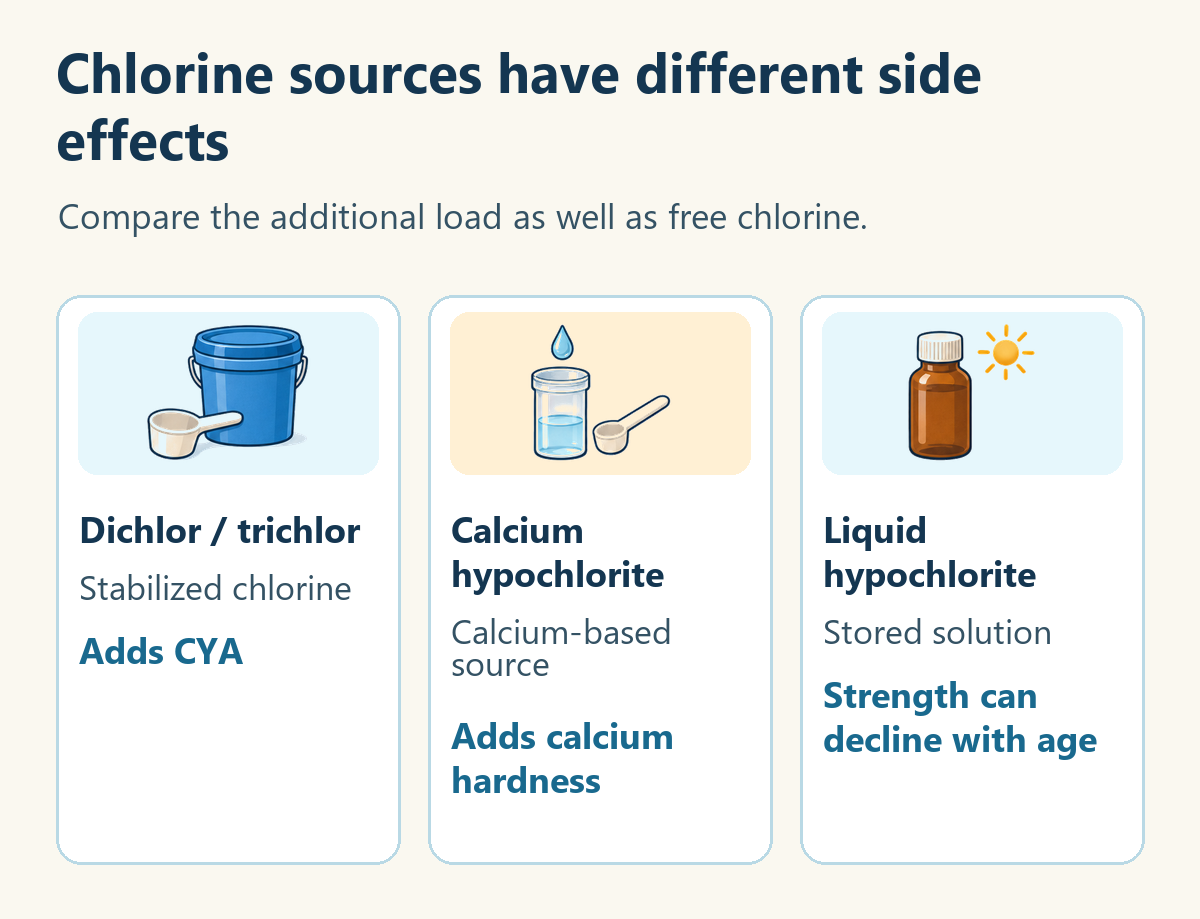
Two real-world chemistry effects make exact chart doses drift over a season: solid chlorines leave permanent stabilizer or calcium behind, and liquid chlorine loses strength rapidly in summer heat.
Chlorine Side-Effects per +10 ppm FC Added (CYA, Calcium Hardness, pH, and CYA-Adjusted Alkalinity)
Every chlorinating compound alters water balance beyond free chlorine. Technical guides from tablet and sanitizer producers plus county public-health tables quantify what rides along with every +10 ppm of free chlorine added:
| Sanitizer | Typical pH Direction in Pool Water | Added per +10 ppm FC | Long-Term Removal Method |
|---|---|---|---|
| Liquid chlorine (NaOCl, 10%–12.5%) | Raises pH (1% solution pH 9–14)9 | 0 ppm CYA, 0 ppm CH | Routine acid pH balancing |
| Calcium hypochlorite (65%–68%) | Raises pH (pH 10–11.8)9 | +7 to 10 ppm CH (0 ppm CYA) | Partial drain and refill only7 |
| Trichlor (90% tablets/granules) | Lowers pH (pH 2.9–3.5)9 | ~+6 ppm CYA | Partial drain and refill only7 |
| Dichlor (56%–62% granules) | Near-neutral initial pH (6.5–6.8); net acidic over time9 | ~+9–9.6 ppm CYA22 | Partial drain and refill only7 |
Salt Lake County Health Department's dosing chart shows how fast dichlor builds stabilizer: 25 oz raises free chlorine by 10 ppm per 10,000 US gallons while 26 oz adds 10 ppm CYA, which is why the chart marks dichlor not recommended for large stabilizer boosts.22 On hard-water pools, tablet-producer data shows 1 lb of 65%–68% cal hypo adds 6–8 ppm calcium per 10,000 US gallons (7–10 ppm CH per +10 ppm FC).
Because Indiana Department of Health confirms that partial draining and refilling is the only practical way to lower elevated CYA or calcium hardness, heavy reliance on stabilized chlorine or cal hypo eventually forces dilution.7 In outdoor stabilized pools, you must also calculate carbonate alkalinity (CYA-adjusted TA)—the portion of alkalinity that actually buffers carbonate water balance. As non-binding guidance, CDC 2024 MAHC Annex 5.7.4.4.1 recommends subtracting one-third of measured CYA from measured total alkalinity (with Annex 5.7.4.6 giving roughly 30% as a practical approximation) before judging true carbonate buffering capacity.11
Liquid Chlorine (Sodium Hypochlorite) Shelf-Life Decay Under Heat, Concentration, and Metals
Liquid chlorine avoids CYA and calcium buildup, but its assay drops steadily in storage. PHTA RWQC's Sodium Hypochlorite Fact Sheet (March 2020) reports that 12.5% liquid chlorine reaches its half-life (falling to 6.25% active chlorine) in approximately 180 days at 77°F (25°C), yet its half-life plunges to just 48 days at 95°F (35°C).19
Higher starting concentrations and trace metals accelerate breakdown even faster. An AWWA Water Quality Technology Conference kinetic modeling paper shows hypochlorite decomposition is second-order in concentration—giving 15.89 wt% bleach at 20°C (pH 13.0) a modeled half-life of only 61.7 days—and reports that raising dissolved copper from 1.03 mg/L to 10.3 mg/L accelerates initial decay 11 times.
For that reason, UK HSE HSG282 Information Box 5 limits 10%–15% sodium hypochlorite storage to cool conditions and a maximum of 3 months,5 and Health Canada directs operators to shield sodium hypochlorite from heat, light, pH drops, and heavy metal cations (while keeping dry cal hypo away from heat, humidity, and organics).4
Buy liquid chlorine in smaller, fast-turning batches during hot months and keep drums out of direct sunlight. Date-labeling every delivery and rotating oldest stock first in a cool, shaded room prevents troubleshooting phantom chlorine demand caused by heat-degraded bleach. If stabilizer buildup is approaching commercial code ceilings, see Cyanuric Acid Limits for Commercial Pools by State; if you are choosing shock formats or clearing milky post-shock water, check Pool Shock Liquid vs Powder: Which to Use and When and Pool Water Milky After Shock: Fix.
Knowing how chemicals interact and age leads straight to the operational rules that prevent equipment damage and dangerous reactions: dosing order, single-addition caps, re-test waits, and when to escalate beyond a chart.
Addition Order, Safety Limits, Re-Test Intervals, and When to Escalate
Safe chemical dosing depends as much on sequence, caps, and circulation time as on correct math. A re-test interval is the mandatory circulation wait between adding a chemical and sampling again so unmixed pockets do not trick you into over-dosing.
Dosing Sequence, Single-Dose Caps, and Re-Test Wait Intervals
Follow this field checklist whenever adjusting multiple out-of-range parameters on the same visit:
- Clear bathers and run circulation. Per Indiana Department of Health and PHTA RWQC safety rules, only adjust pool chemistry with swimmers out of the water and the filtration pump running.719
- Follow a consistent test-and-adjust sequence and keep pH in range. Indiana Department of Health's adjustment checklist checks free available chlorine, total alkalinity, pH, cyanuric acid, and hardness in order, advises confirming pH sits within 7.2–7.8 so sanitizer stays effective, and warns to stagger incompatible additions (such as acid and chlorine) rather than adding them together.7
- Cap single doses and split large corrections. Per Indiana Department of Health guidelines, test for metals in solution when TA is at or below 50 ppm, do not raise total alkalinity by more than 50 ppm at once (re-test after 24 hours for major TA shifts), do not add more than 1 quart of muriatic acid per 10,000 US gallons at once (re-test after 12 hours), and for other large chemical additions, split the dose into thirds over a 2-hour period while still respecting acid caps and re-test intervals.7
- Always add acid to water (AAA) and avoid skimmers. Indiana Department of Health directs operators never to pour water into acid and never to dose chemicals into skimmers, gutters, or vacuum filter tanks.7 San Francisco Department of Public Health recommends pre-diluting measured muriatic acid into a plastic bucket full of water before adding it to the pool (where product labels allow) to prevent wall staining or etching.23
- Respect equipment placement and swimmer re-entry limits. Install automated liquid-chlorine injection points downstream of pumps, filters, and heaters, and per PHTA RWQC (referencing EPA-specified 1.0–4.0 ppm FAC), keep bathers out until tested free chlorine is 4.0 ppm or less—always obeying product labels and local health codes.19
Chemical Incompatibilities That Must Never Mix or Share Feeders
Treat any chemicals the product labels identify as incompatible as separate products. Never mix them or use one product in equipment intended for the other 2.
Check the label and safety data sheet before handling any pool chemical. Follow local pool-operator guidance and keep incompatible products and their equipment separate 172.
Dedicate separate color-coded scoops and clean plastic buckets to each chemical class so dry acid, cal hypo, and trichlor never touch. Labeling each scoop permanently and isolating spills into separate designated containers helps prevent cross-contamination fires in pump rooms and service trucks.
When a Dosage Chart Isn't Enough: Where to Go Next
Routine single-parameter dosage tables assume balanced, clear water. When field readings cross these thresholds, move straight to the specialist guide instead of repeating standard chart doses:
| Field Symptom or Threshold | Why a Dosage Chart Isn't Enough | Dedicated Guide |
|---|---|---|
| Combined chlorine (CC = TC − DPD-FC, using diethyl-p-phenylenediamine reagent) exceeds 0.4 ppm | Breakpoint chlorination requires roughly 10 times the CC concentration in free chlorine13 | Breakpoint Chlorination Calculation: Clearing Chloramines |
| Persistent chloramine odor in an indoor pool | Indoor air handling, bather load, and secondary treatment drive recurring CC | Why Combined Chlorine Keeps Coming Back in Indoor Pools |
| Scaling, plaster etching, or LSI outside −0.3 to +0.3 (or TDS >5,000 ppm) | Water balance depends on pH, temperature, CH, TA, and TDS together10 | Langelier Saturation Index for Pools: Formula and Fixes |
| Commercial pool CYA creeping toward state caps | Statutory CYA ceilings vary by state beyond MAHC's 90 ppm model cap | Cyanuric Acid Limits for Commercial Pools by State |
| Automated ORP (oxidation-reduction potential) controller disagrees with DPD-FC test | NSF/ANSI 50 ORP controllers shift with pH and CYA and need calibration14 | ORP vs ppm Chlorine: What a Controller Actually Measures |
| Preparing a public pool for health-code inspection | Full MAHC design, feeder, and operational rules go beyond dosing math14 | MAHC Water Chemistry Requirements: Operator Summary |
| Choosing between liquid and granular shock for routes | Cost, storage decay, pH shift, and calcium side-effects differ by format | Pool Shock Liquid vs Powder: Which to Use and When |
| Oxidizing organics without raising chlorine or CYA | Potassium monopersulfate (MPS) works differently and interferes with DPD tests | Non-Chlorine Shock (MPS) vs Chlorine |
| Pool turns milky white right after shocking | High pH/TA calcium precipitation, dead algae, or filtration failure requires targeted triage | Pool Water Milky After Shock: Fix |
To browse every chemistry guide in one place, return to the Water Chemistry for Pool Pros hub.
Before closing, the quick FAQ below clears up five everyday chart-reading mistakes techs and counter staff run into most often.
Common Pool Dosage Chart Mistakes (Quick FAQ)
Are dry ounces (oz) and fluid ounces (fl oz) the same on a dosage chart?
No. Per Indiana Department of Health's dosage-calculation guide, dry granular chemicals are weighed in avoirdupois ounces (16 weight oz = 1 lb), whereas liquid chemicals like sodium hypochlorite and muriatic acid are measured by volume in fluid ounces (128 fl oz = 1 US gallon).7 Scooping granular cal hypo or soda ash with a liquid measuring cup throws off actual weight because powder bulk densities vary widely.
Can you use a US 10,000-gallon chart directly for UK or Canadian Imperial gallons?
No—convert pool volume first. One Imperial gallon equals 1.202 US gallons (and 1 US gallon equals 0.832 Imperial gallons), meaning an Imperial-gallon pool holds 20.2% more water than the same number of US gallons.18 Pouring straight from a US gallon chart into an Imperial-gallon pool delivers only 0.832 of the required dose (leaving you well short), whereas applying an Imperial chart to a US pool over-doses by 20.2%.
Why does PHTA's metric column use 40,000 liters instead of 37,850 liters?
PHTA Appendix B-2 publishes a separate 40,000 L (40 m³) metric column with its own separately rounded chemical amounts rather than converting its 10,000 US gallon (37.85 m³ / 37,850 L) column directly.18 Because 40,000 L is 5.7% larger than 10,000 US gallons, scale metric pools from the per-10 m³ or per-1 m³ column rather than treating 10,000 US gallons as equal to 40 m³.
Why does total alkalinity look fine on a test kit when pH still swings wildly?
In stabilized outdoor pools, cyanuric acid contributes to the standard total alkalinity test reading. As non-binding guidance, CDC 2024 MAHC Annex 5.7.4.4.1 recommends subtracting one-third of measured CYA from measured TA (with Annex 5.7.4.6 giving roughly 30% as a practical approximation) to see true carbonate buffering capacity.11
Does doubling a chemical dose clear a pool twice as fast?
No—exceeding single-addition caps risks surface damage, cloudy water, or unsafe residuals rather than faster recovery. Follow Indiana Department of Health caps (at most 50 ppm TA rise with a 24-hour re-test, at most 1 quart muriatic acid per 10,000 US gallons with a 12-hour re-test, and large doses split into thirds over 2 hours) and re-test before adding more.7
Treat the Chart as a Starting Point—Then Titrate pH and Re-Test
A pool chemical dosage chart is your fastest stoichiometric baseline for linear ppm adjustments—chlorine, total alkalinity, calcium hardness, cyanuric acid, and salt—as long as you match the product's exact active-ingredient percentage and keep US gallons, metric litre/cubic-metre columns, and Imperial gallons strictly separate.
For pH, let acid or base demand titration govern the pour rather than trusting a single fixed number. For routine chlorination, budget for cumulative CYA and calcium hardness from solid sanitizers alongside rapid heat-driven strength loss in stored liquid chlorine.
Respect single-addition caps, chemical incompatibility rules, and circulation re-test intervals on every visit. When test results point to high combined chlorine, corrosive or scaling LSI, ORP probe drift, or post-shock cloudiness, move directly to the matching diagnostic guide in the Water Chemistry hub rather than repeating routine chart doses.
References
- NOAA CAMEO Chemicals — Reactivity Profile: Calcium Hypochlorite + Sodium Bisulfate / Soda Ash
- NOAA CAMEO Chemicals / NFPA 49 — Reactivity Profile: Trichloroisocyanuric Acid + Water / Cal Hypo
- CDC — About the Model Aquatic Health Code (Voluntary State/Local Adoption) — 2024-11-06
- Health Canada — Guidelines for Canadian Drinking Water Quality: Chlorine Storage & Decay — 2016-01-12
- UK HSE HSG282 (1st Ed.) — Information Box 5: Sodium Hypochlorite 3-Month Shelf Life & Disinfectants — 2017
- UK HSE HSG282 (1st Ed.) — Table 3 Spa-Pool Chemical Parameter Ranges & Action Limits — 2017
- Indiana Department of Health — Adjusting Chemical Levels in a Swimming Pool
- Lake County (IL) Health Dept (2024) — Raising/Lowering pH and Total Alkalinity Chemicals — 2024-08-26
- Lake County (IL) Health Dept (2024) — Table 3 Disinfectant Available Chlorine & pH Effect — 2024-08-26
- CDC 2024 MAHC Annex (5th Ed.) — Calcium Hardness, TDS & LSI Guidelines (5.7.4.6) — 2024-12-16
- CDC 2024 MAHC Annex (5th Ed.) — Alkalinity Equivalents & CYA Correction (5.7.4.4.1) — 2024-12-16
- CDC 2024 MAHC (5th Ed.) — Free Chlorine Minimums & CYA Limits (5.7.3.1) — 2024-12-16
- CDC 2024 MAHC (5th Ed.) — Glossary: Available Chlorine, DPD-FC & Breakpoint — 2024-12-16
- CDC 2024 MAHC (5th Ed.) — Approved pH Chemicals & Halogen Generator Salt Requirements (4.7.3.2) — 2024-12-16
- CDC 2024 MAHC (5th Ed.) — Total Alkalinity, Combined Chlorine & Calcium Hardness (5.7.4.4) — 2024-12-16
- Oregon Health Authority — Pool Operator Training Manual: Dosage Formula & Split Additions — 2011-03
- PHTA — ANSI/PHTA/ICC-11 2026 Standard & Chemical Operational Parameters Charts — 2026
- Pool & Hot Tub Alliance (PHTA) — Pool & Spa Operator Handbook Appendix B: Water Chemistry Guidelines & Adjustment Guide (2021) — 2021
- Pool & Hot Tub Alliance (PHTA) RWQC — Fact Sheet: Sodium Hypochlorite (Liquid Chlorine) (March 2020) — 2020-03
- PHTA RWQC — In-Line Electrolytic Chlorine Generator Salt Concentration (3,000–5,000 ppm)
- Pool Water Treatment Advisory Group (PWTAG) — Code of Practice (2019/2020, Clauses 9.5–9.10) — 2020
- Salt Lake County Health Department — Dosages Required to Chemically Treat 10,000 Gallons of Water
- San Francisco Department of Public Health (SF.gov) — Water Chemistry: Acid Pre-Dilution & Soda Ash
- Yakima Health District / County — Dosages Required to Chemically Treat 10,000 Gallons of Water
How this guide was prepared
Prepared by Martin. Based on 24 cited sources listed in References. Content date: 2026-11-25.